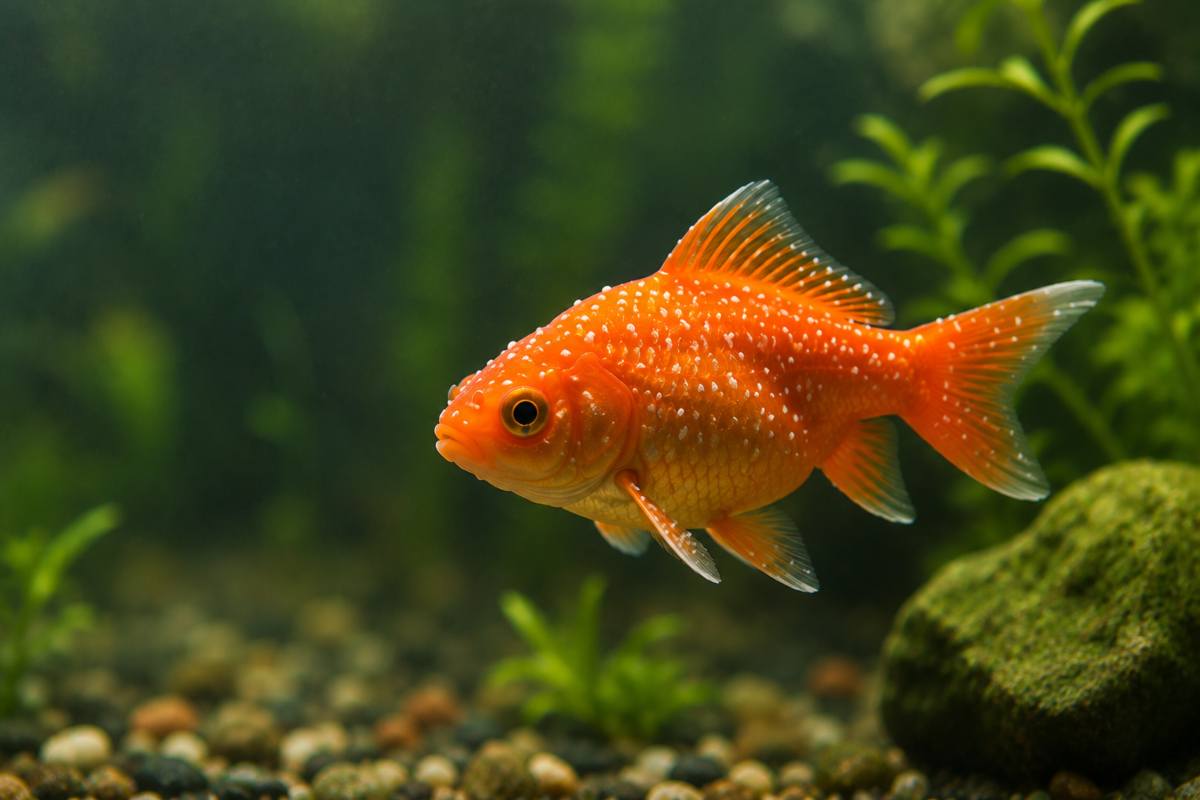
Goldfish deal with Ich differently than most other freshwater fish, mainly because of two things: they’re cold-water fish rather than tropical fish, and a huge number of them live in ponds or oversized bowls rather than standard heated tanks. Both of these change how the disease develops, how it’s spotted, and how it should be treated.
Goldfish share the same underlying parasite and life cycle as other freshwater fish. What’s different is their temperature tolerance, their typical living environment, and how their size and bioload change the risk picture. This article covers those differences in full: why goldfish are prone to Ich, how to identify it correctly, and the treatment approach suited specifically to their biology and housing.
Why Goldfish Are Particularly Prone to Ich
Goldfish face a distinct set of risk factors, several of which are more about how they’re commonly kept than about the fish themselves.
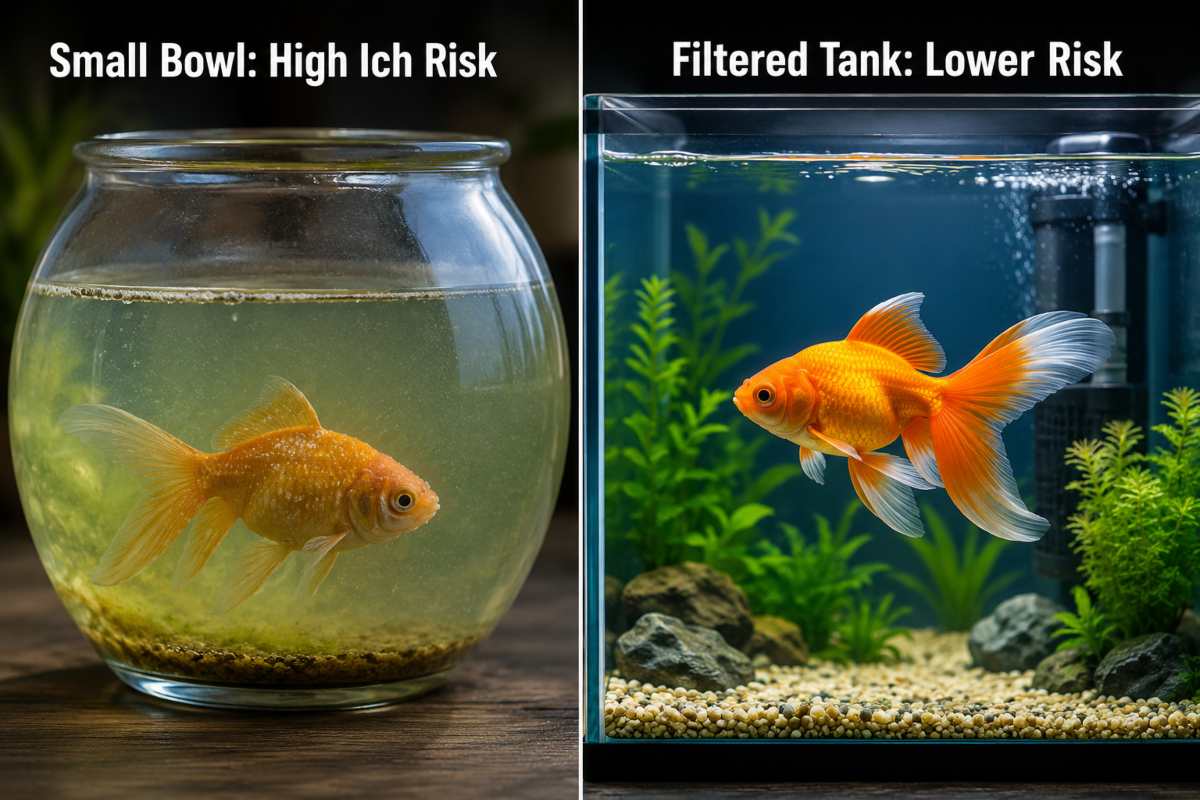
- They’re frequently overstocked or underfiltered. Goldfish produce a large amount of waste relative to their size, and many owners underestimate their bioload, especially with fancy varieties in small tanks. Poor water quality due to overstocking is one of the most common triggers of Ich in this species.
- Many goldfish live in outdoor ponds, where seasonal temperature swings, especially in spring and fall, create exactly the kind of stress and cool, fluctuating water that lets Ich take hold. Pond outbreaks often coincide with these transitional seasons.
- They’re still commonly sold and kept in bowls, despite bowls being unsuitable for goldfish in the long term. Bowls have no filtration and no stable temperature control, both of which substantially increase Ich risk.
- Fancy goldfish varieties (orandas, ranchus, telescopes, and similar round-bodied types) are generally more sensitive to stress and secondary complications than hardier common or comet goldfish, meaning the same Ich exposure can hit them harder.
Recognizing Ich in Goldfish
Because goldfish have a more robust, scaled body and are often larger than many aquarium fish, Ich symptoms tend to be easier to spot on their bodies. However, pond conditions can reduce that visibility.
What to look for specifically on a goldfish:
- White grain-like spots across the body, fins, and gill covers, generally more visible against the goldfish’s solid coloration than on more patterned species
- Flashing against gravel, rocks, or pond liner material
- Clamped or held-back fins, particularly noticeable on fancy varieties with flowing fin types
- Gathering near water inflows, filters, or aerators, where oxygen levels are higher, is a sign of gill irritation
- In ponds specifically, spots may be harder to notice early simply due to murkier water and larger viewing distance, so behavioral changes often get caught first
A Goldfish-Specific Detail: Cold-Water Tolerance and Ich
Goldfish are true cold-water fish and are naturally comfortable in a wider, cooler temperature range than tropical species like bettas. This has two direct effects on Ich in goldfish:
- I can progress more slowly in the cooler water goldfish naturally live in, since the parasite’s life cycle speeds up with warmth. This can create a false sense of security, since slow-moving outbreaks are easy to underestimate until they’re well established.
- Goldfish don’t tolerate the same high treatment temperatures used for tropical fish. Pushing a goldfish tank to 84-86°F, a range appropriate for a betta, is unnecessary and can itself become a stressor for a cold-water species. Their effective treatment range is lower, covered in the treatment section below.
Treating Ich in Goldfish: Step by Step
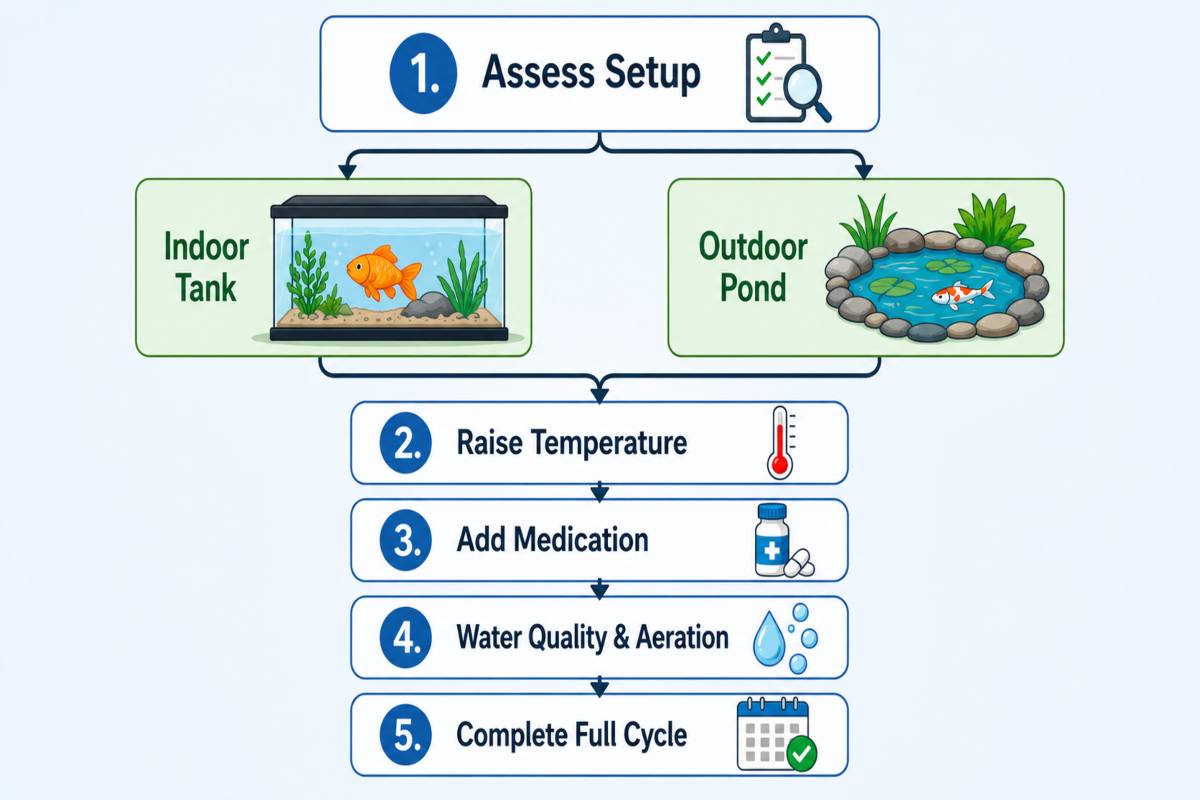
Step 1: Isolate and Assess Your Setup Type
How you isolate your goldfish depends heavily on whether it lives in an indoor tank or an outdoor pond.
- Indoor tank: Move affected fish to a quarantine tank if there are tankmates or live plants present. If the goldfish is already alone in its main tank, you can often treat it in place.
- Pond: Full isolation usually isn’t practical. Most pond keepers treat the entire pond rather than attempting to net and separate individual fish, since chasing a stressed goldfish through a pond causes more harm than the parasite exposure itself.
Step 2: Raise the Temperature, But to a Lower Target Than Tropical Species
- Target range during treatment: 75-80°F (24-27°C), noticeably lower than the range used for tropical fish
- Raise gradually, no more than 2-3°F per day, since goldfish are more sensitive to rapid swings than sudden heat itself
- In outdoor ponds, this step may not be practical at all; treatment timing often has to work around ambient seasonal temperature instead of actively heating the water
Step 3: Choose a Goldfish-Safe Medication
| Treatment | Goldfish Safety Notes |
| Heat increase alone (mild cases) | Helpful but less reliable alone than in tropical species, since the safe temperature ceiling is lower. |
| Aquarium salt | Goldfish tolerate salt notably well compared to many freshwater species and it’s often a first-line treatment; still requires correct dosing relative to tank or pond volume. |
| Malachite green-based medications | Generally effective; avoid use in ponds with live plants or sensitive invertebrates without checking product labeling. |
| Formalin-based medications | Effective but requires good aeration during treatment, since it can lower dissolved oxygen, a bigger concern in crowded ponds. |
| Copper-based medications | Use cautiously around pond plants and any snails or shrimp sharing the pond, since copper is highly toxic to invertebrates. |
A practical note for pond owners: dosing by estimated pond volume is far less precise than dosing a tank, and irregular pond shapes make this worse. Where possible, calculate volume using length x width x average depth as a baseline rather than guessing.
Step 4: Maintain Water Quality and Aeration Throughout Treatment
Goldfish’s higher bioload makes water quality maintenance especially important during treatment. In tanks, partial water changes of 25-30% every 1-2 days help clear free-swimming parasites. In ponds, prioritize maintaining strong aeration throughout treatment, since medication and warmer temperatures both reduce dissolved oxygen, and pond goldfish are often already living close to their oxygen capacity.
Step 5: Continue Treatment for the Full Cycle
Because the parasite’s life cycle runs more slowly in the cooler water typical of goldfish environments, treatment duration is often longer than for tropical fish, generally 10-14 days rather than 7-10 days. Stopping early is especially common in ponds, where visible spots that disappear in murky water can be mistaken for full recovery, even when parasites remain in the substrate.
Goldfish Treatment Checklist
- Determine whether treatment will happen in a tank or an outdoor pond, since this changes almost every following step
- Water volume calculated (measured for tanks, estimated with length x width x depth for ponds)
- Temperature rose gradually to 75-80°F, where practical
- Strong aeration was maintained throughout treatment, especially in ponds
- Medication selected with pond plants and invertebrates factored in, if applicable
- Full 10-14 day treatment cycle completed, not stopped at first visible improvement
- Fancy varieties are monitored closely for secondary stress signs, given their generally lower stress tolerance
Decision Framework: Tank Treatment vs. Pond Treatment
| Situation | Recommended Approach |
| Single goldfish in an indoor tank | Treat in the main tank directly if no sensitive tankmates are present. |
| Multiple goldfish in an indoor tank | Treat the whole tank rather than isolating individuals. |
| Goldfish in an outdoor pond with no other species | Treat the entire pond; full isolation is rarely practical. |
| Pond shared with koi betta or other species | Confirm medication is safe for all species present before treating the whole pond. |
| Pond with live plants or invertebrates | Choose plant- and invertebrate-safe treatments, or temporarily remove sensitive plants if possible. |
Aftercare and Long-Term Prevention for Goldfish
Once Ich treatment is complete, give goldfish time to recover before resuming normal feeding levels, since appetite often takes a few extra days to return fully. For long-term prevention, the two highest-impact changes are usually reducing overstocking relative to filtration capacity and, for pond keepers, closely monitoring water temperature during spring and fall transitions, when outbreaks are most common.
Common Mistakes Goldfish Owners Make When Treating Ich
- Using tropical-fish temperature targets. Pushing water to 84-86°F is unnecessary for goldfish and adds stress rather than helping.
- Underestimating bioload. Continuing to keep goldfish in an undersized, underfiltered setup after treatment sets up the same conditions for reinfection.
- Trying to net and isolate every fish in a pond causes more stress and injury than leaving them in place for a whole-pond treatment.
- Ignoring aeration during medication use is particularly risky in warmer, crowded ponds where oxygen is already limited.
- Confusing anchor worms or fish lice with Ich and applying the wrong treatment type.
Frequently Asked Questions
What temperature should I raise my goldfish tank to for Ich treatment?
Generally 75-80°F (24-27°C), gradually. This is lower than the range used for tropical fish, since goldfish are cold-water fish and don’t need or tolerate the same heat level.
Is aquarium salt safe for goldfish?
Yes, goldfish generally tolerate salt treatment well compared to many freshwater species, making it a common first-line option, provided dosing matches the actual water volume.
Can I treat Ich in an outdoor pond the same way as an indoor tank?
The same core principles apply, but full isolation usually isn’t realistic, aeration becomes more critical, and medication must be checked against any plants, koi, or invertebrates sharing the pond.
Why did Ich show up in my pond during a cool spell?
Sudden temperature drops are a common trigger, particularly during spring and fall transitions, since the temperature swing stresses goldfish’s immune response even though Ich itself favors cooler water for parasite persistence.
How long does goldfish Ich treatment take compared to other fish?
Often longer, typically 10-14 days, since the parasite’s life cycle runs slower in the cooler water goldfish are usually kept in.
Can I harm my pond plants or other pond life?
Ich affects only fish, but some medications used to treat it can harm plants, snails, or shrimp, so the treatment choice needs to account for everything else living in the pond.
Key Takeaways
At The Fish Care, we always emphasize that goldfish need a treatment approach calibrated to their cold-water biology and their environment, not simply a smaller-scale version of tropical fish treatment. The temperature ceiling is lower, the treatment window tends to run longer, and pond-kept goldfish add practical challenges around isolation, aeration, and medication safety for other pond life that tank-only species don’t face. Getting the environment right, both during treatment and afterward, matters as much as the medication choice itself.
Continue reading: Understanding Ich Disease in Fish for the science behind the parasite’s life cycle, or How to Treat Ich in Betta Fish if you’re managing both species.