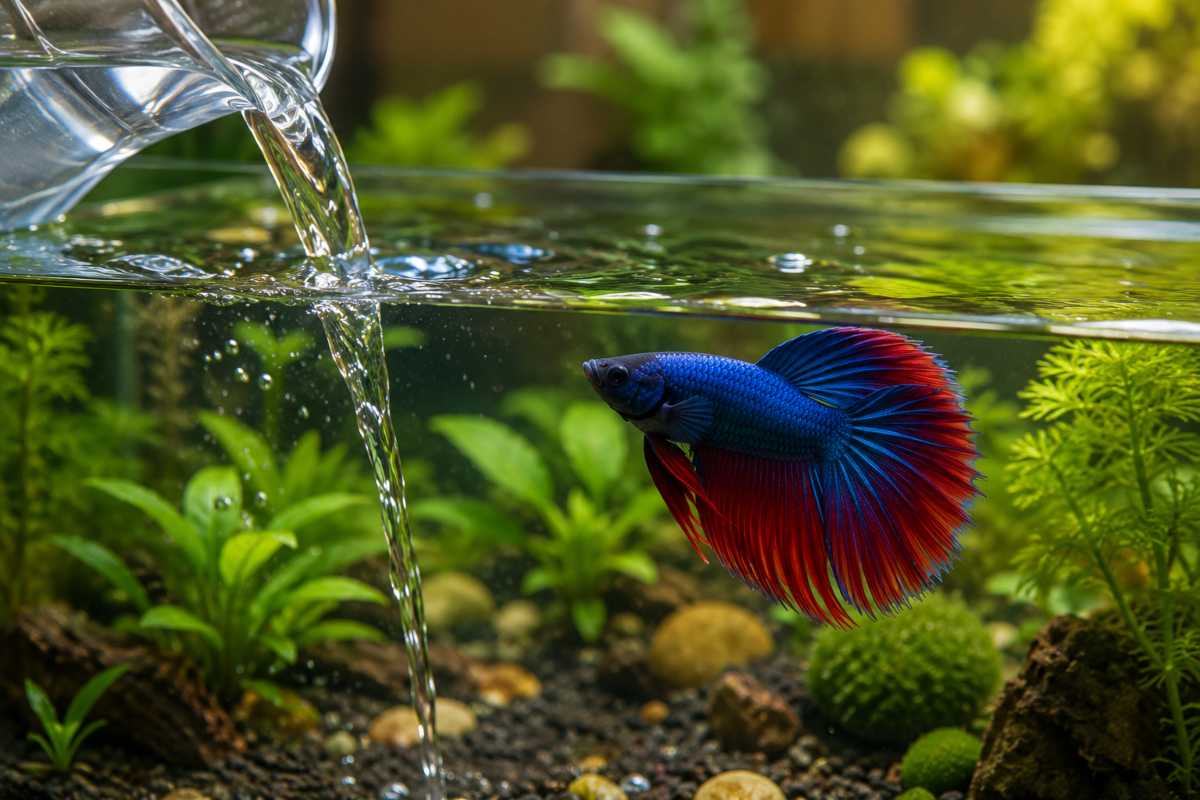
Bettas need dechlorinated, cycled freshwater with a pH between 6.5 and 7.5, and moderate hardness. Straight tap water works fine for almost every household, as long as it’s treated with a water conditioner first. Distilled water, softened water, and untreated well water each come with their own problems, which is where most new owners go wrong.
Here’s what actually matters, and what doesn’t.
The Core Water Requirements
| Parameter | Ideal Range | Why It Matters |
|---|---|---|
| Chlorine / Chloramine | 0 ppm | Both are toxic to fish gills, even at levels safe for humans |
| Ammonia | 0 ppm | Toxic waste byproduct; must be broken down by the nitrogen cycle |
| Nitrite | 0 ppm | Intermediate toxin produced during cycling |
| Nitrate | Under 20–40 ppm | Less toxic, but builds up between water changes |
| pH | 6.5–7.5 | Bettas tolerate a range but do best close to neutral |
| General Hardness (GH) | 5–20 dGH | Mineral content; too soft or too hard causes stress |
| Carbonate Hardness (KH) | Above 4 dKH | Buffers pH so it doesn’t swing suddenly |
According to FishBase, the scientific fish species database used by researchers worldwide, wild Betta splendens populations live in water with a pH between 6.0 and 8.0 and a hardness of roughly 5 to 19 dGH. That’s a wide natural range, which is part of why captive-bred bettas are more adaptable to water chemistry than many other tropical species, as long as chlorine, ammonia, and sudden swings are kept out of the equation entirely.
Why Tap Water Isn’t Automatically Safe
Municipal tap water is treated with chlorine or chloramine to kill bacteria before it reaches your home. Both are effective for that purpose, and both are directly toxic to fish, since fish absorb dissolved compounds through their gills straight into the bloodstream. The EPA confirms that chloramine in particular does not dissipate by letting water sit out, unlike chlorine, which slowly off-gasses over 24 to 48 hours.
This is the single most common mistake new betta owners make: assuming tap water is safe once it “looks clean,” or leaving it to sit out without knowing whether their city uses chlorine or chloramine. A water conditioner removes both instantly and is the only reliable fix regardless of which one your utility uses.
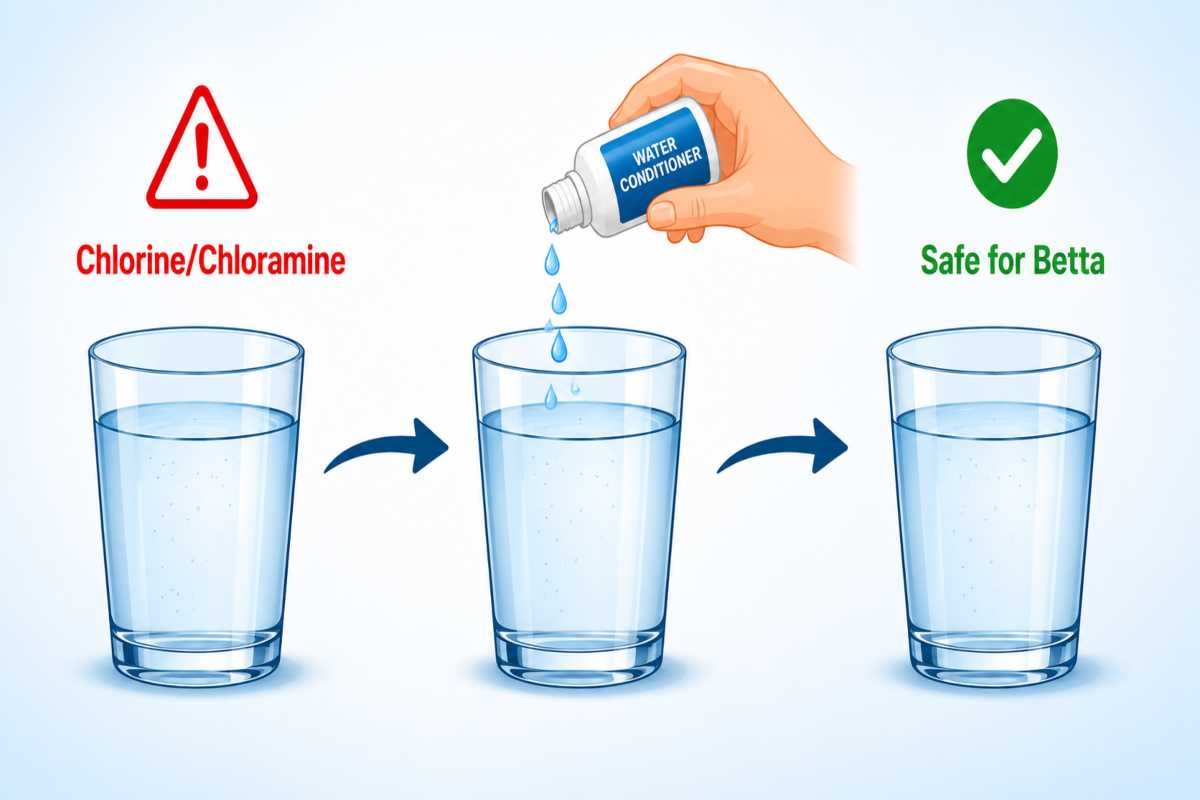 Treating tap water for bettas takes one step: add a water conditioner before use.
Comparing Water Types for a Betta Tank
| Water Type | Safe for Bettas? | Notes |
|---|---|---|
| Tap water + conditioner | Yes, best default | Removes chlorine/chloramine instantly; minerals are already balanced for most areas |
| Bottled spring water | Usually | Check the label for added minerals; still test pH and hardness |
| Reverse osmosis (RO) | Only if remineralized | Strips out minerals along with contaminants, so pH has no buffer and can crash |
| Distilled water | Only if remineralized | Same issue as RO; pure water has no KH to stabilize pH |
| Well water | Case by case | Can carry high mineral content, metals, or bacteria; test before use |
| “Betta water” (bottled) | Yes | Pre-treated and pH-balanced, but more expensive for routine use |
The mistake with RO and distilled water specifically is treating “pure” as automatically better. Without any dissolved minerals, there’s nothing to hold pH steady, and it can shift sharply after a single water change. If you’re using either, they need to be mixed with a remineralising product or blended with treated tap water rather than used straight.
Why the Nitrogen Cycle Matters Just as Much as Water Source
Even perfectly conditioned tap water becomes dangerous once fish waste builds up in it. Ammonia from waste and uneaten food is converted by beneficial bacteria into nitrite, then into less harmful nitrate. This process, known as the nitrogen cycle, typically takes four to six weeks to establish in a new tank before it’s safe to add a betta at full stocking, or can be jump-started with bottled bacteria supplements.
This is a deeper topic on its own, but the short version matters here: the “type” of water a betta needs isn’t just about what comes out of the tap. It’s about what happens to that water after fish are living in it.
Weekly partial water changes of 25 to 30 per cent, paired with regular testing, keep ammonia and nitrite at zero and nitrate within a safe range. If you’re not sure how many gallons that percentage works out to, our aquarium volume calculator makes it easy to figure out exactly how much water to remove and replace.”
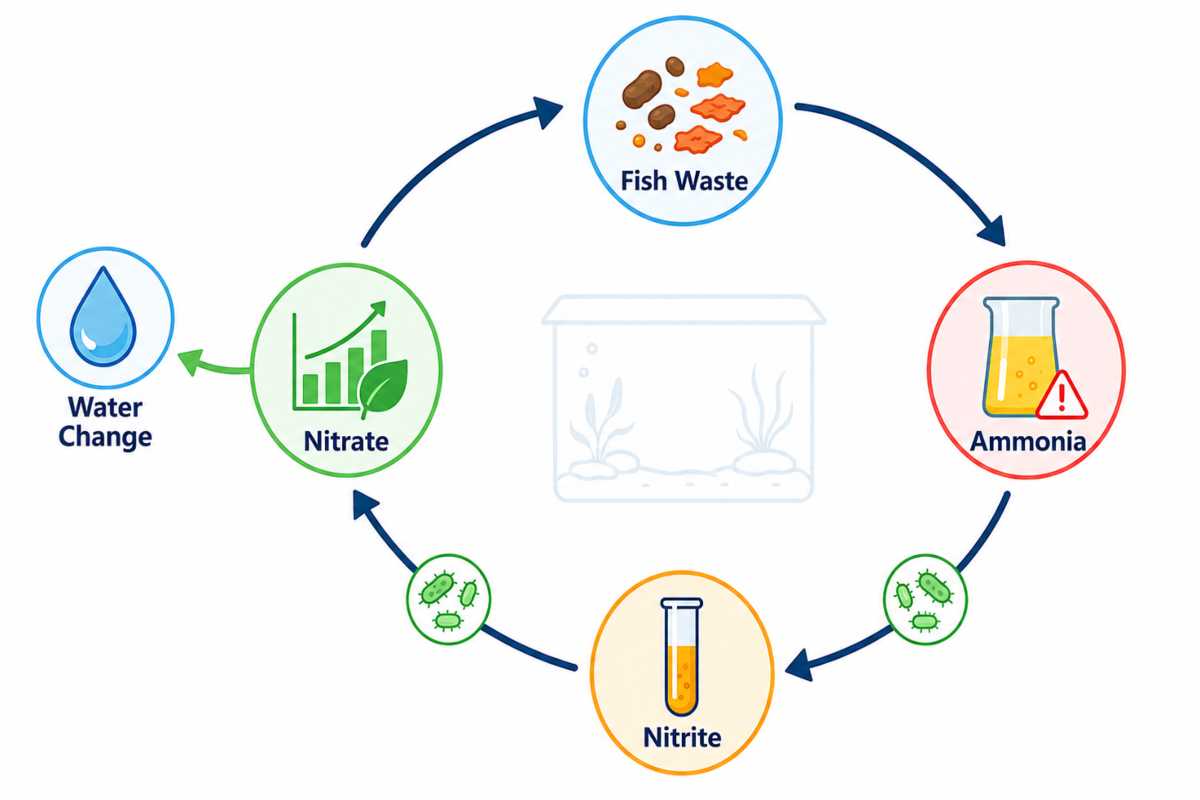 The nitrogen cycle: fish waste breaks down into ammonia, then nitrite, then nitrate.
How to Prepare Water for a Betta Tank
- Fill a clean container with tap water.
- Add a water conditioner rated for both chlorine and chloramine, following the dosage on the label.
- Match the water’s temperature to the tank before adding it, within a degree or two.
- If using RO or distilled water, remineralise it first rather than using it straight.
- Test pH, GH, and KH occasionally, especially after switching water sources or moving to a new area.
Getting a betta’s water right is less about finding one perfect source and more about consistency. At The Fish Care, that’s the standard every care guide is built around: accurate, tested information over guesswork, so your betta’s water stays as stable as its temperature.
Read more to dive deep: How to Set Up a Fish Tank for a Betta
FAQs (Frequently Asked Questions)
Can betta fish live in tap water?
Yes, once it’s treated with a water conditioner that removes chlorine and chloramine. Untreated tap water is not safe.
Is distilled water good for betta fish?
Not on its own. Distilled water has no minerals to buffer pH, so it needs a remineralising product before use.
Do bettas need special “betta water”?
No. Pre-treated bottled betta water is convenient but not required. Conditioned tap water provides the same water chemistry at a fraction of the cost.
How often should betta tank water be changed?
Roughly 25 to 30 per cent weekly for a filtered, cycled tank, adjusted based on tank size and bioload.
Can I use rainwater for a betta tank?
It’s possible but not recommended as a primary source, since rainwater carries very few minerals and no buffering capacity, and can pick up airborne pollutants depending on location.
References
This article is based on water chemistry and toxicity data from the following sources:
- FishBase: The global scientific fish species database used by researchers and fisheries scientists.
- U.S. Environmental Protection Agency (EPA): the federal agency that regulates drinking water disinfectants and their effects on aquatic life.