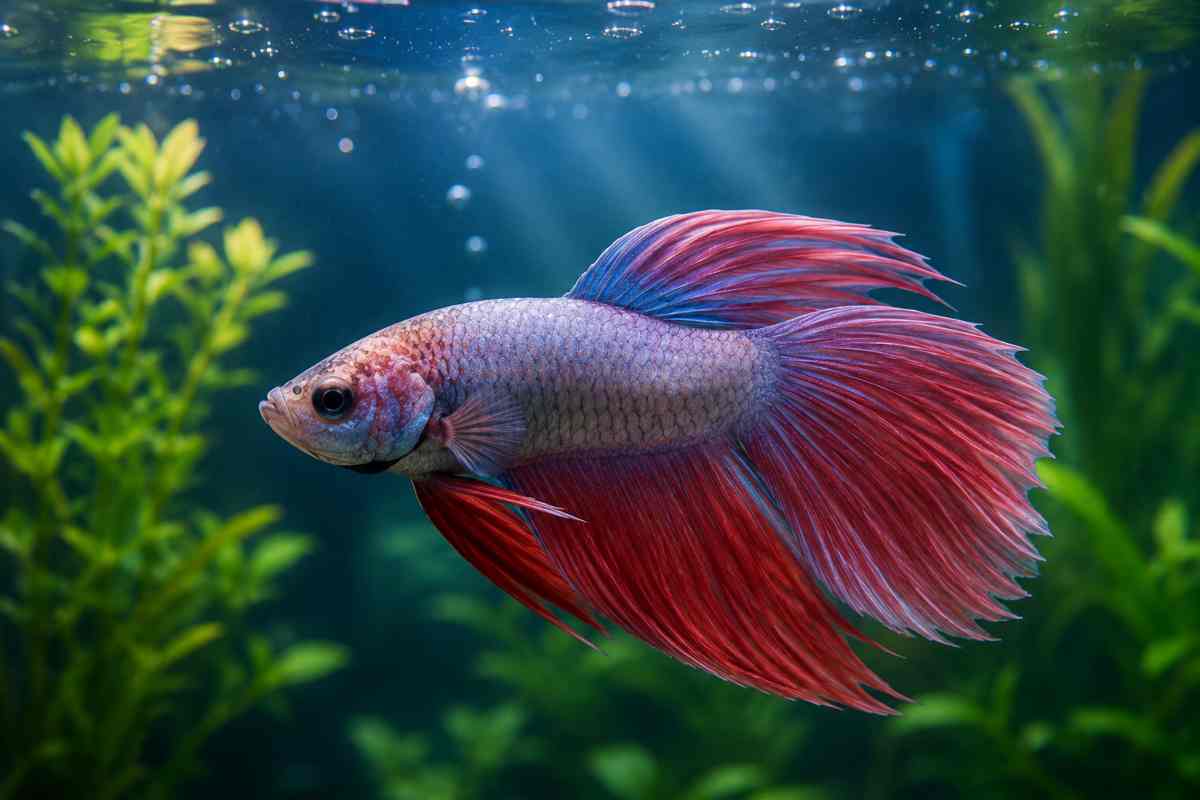
Fish breathe underwater by pulling water in through their mouths, passing it over their gills, extracting dissolved oxygen directly into their bloodstream, and then pushing the oxygen-depleted water back out through their gill covers. This process, called gill respiration, allows fish to survive without ever surfacing for air, unlike whales or dolphins, which are mammals and must breathe atmospheric oxygen.
| Question | Short Answer |
|---|---|
| How do fish get oxygen? | They extract dissolved oxygen from water using their gills. |
| Do fish breathe continuously? | Yes, most fish breathe nonstop, even while resting or sleeping. |
| Can all fish breathe underwater? | Almost all fish use gills, but some species also have organs that let them breathe air. |
| Why can’t fish breathe air like humans? | Their gill filaments collapse and stick together out of water, stopping oxygen absorption. |
| How long can a fish survive out of water? | Most fish survive only a few minutes, though a few species can survive much longer. |
The Basic Process of Fish Respiration
Water contains dissolved oxygen, produced mainly by aquatic plants, algae, and gas exchange with the atmosphere. Fish are built to pull that oxygen out of the water using a highly efficient system built entirely around their gills.
The process happens in four steps.
- The fish opens its mouth and draws in water.
- Water flows across the gills, which sit behind the mouth on both sides of the head.
- Oxygen from the water diffuses into blood vessels inside the gills, while carbon dioxide moves out of the blood and into the water.
- The fish closes its mouth and pushes the used water out through its gill covers, called opercula.
This cycle repeats continuously, often dozens of times per minute depending on the species, water temperature, and oxygen levels.
Gill Anatomy: What Fish Gills Are Made Of
Understanding gill structure makes the whole process much easier to picture.
Each fish has several gill arches on each side of its head. Attached to every arch are rows of thin, feathery structures called gill filaments. Each filament is covered in even smaller folds called lamellae.
The lamellae are where the actual gas exchange happens. They are extremely thin and packed with tiny blood vessels called capillaries. This structure gives the gills an enormous surface area in a very small space, similar to how human lungs pack millions of alveoli into a compact volume.
Related: Betta Fish Anatomy
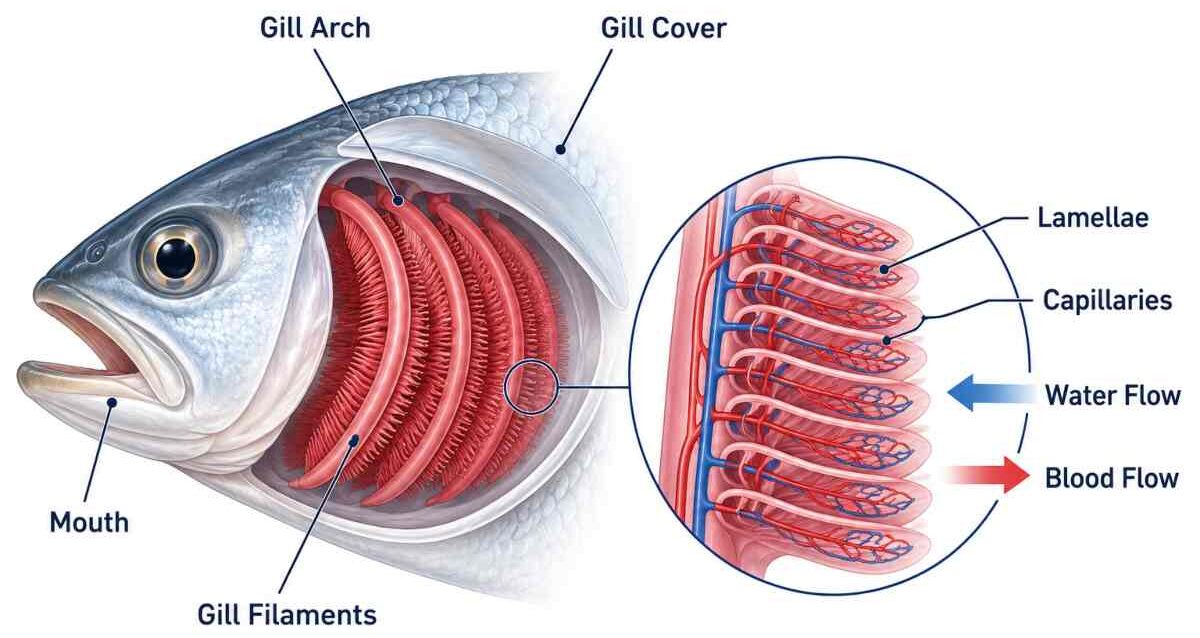 A close-up look at how fish gill filaments and lamellae are structured to absorb oxygen from water.
Why Gills Are So Efficient: Countercurrent Exchange
Fish gills are more efficient than human lungs at extracting oxygen from their environment, partly because of a mechanism called countercurrent exchange.
Blood inside the gill lamellae flows in the opposite direction to the water passing over them. This means blood that has already picked up some oxygen keeps meeting water that still has even more oxygen to give up, all the way along the gill surface. This design allows fish to extract a much higher percentage of the oxygen available in water compared to a system where blood and water flowed in the same direction.
This is one reason gills can extract oxygen from water, even though water holds far less dissolved oxygen than air does.
How Water Moves Through the Gills
Fish use two main methods to keep water flowing across their gills.
Buccal pumping is the most common method, especially in resting fish. The fish opens its mouth to draw water in, closes it, then expands its gill chambers to pull water across the gills before pushing it out through the opercula. This creates a steady in-and-out pumping motion, which is why you can see a resting fish’s mouth and gill covers moving rhythmically.
Fast-swimming species like tuna and some sharks use ram ventilation. Instead of pumping, these fish swim forward with their mouths partly open, forcing a continuous stream of water over their gills. Some of these species must keep swimming constantly, because they rely on forward motion to breathe.
| Method | How It Works | Common In |
|---|---|---|
| Buccal pumping | Mouth and gill covers actively pump water over the gills | Most freshwater aquarium fish, including bettas and goldfish |
| Ram ventilation | Forward swimming forces water over the gills | Tuna, some sharks, and other fast, open water swimmers |
How Oxygen Enters the Bloodstream
Once water reaches the lamellae, oxygen molecules diffuse from an area of higher concentration in the water to an area of lower concentration in the blood. This diffusion happens passively, without the fish using extra energy to force it.
The oxygen binds to hemoglobin in the fish’s red blood cells, the same protein responsible for carrying oxygen in human blood. From there, the bloodstream carries oxygen to the heart, which pumps it throughout the body to fuel muscles, organs, and every other tissue.
At the same time, carbon dioxide, a waste product of the fish’s metabolism, diffuses out of the blood and into the passing water, where it is carried away.
Do Fish Breathe All the Time?
Yes. Respiration in fish is continuous and involuntary, similar to breathing in humans. It does not stop when a fish is resting, sleeping, or staying still. While resting, most fish switch almost entirely to buccal pumping, since they are not swimming forward to force water over their gills.
While sleeping, fish enter a low activity state rather than true unconsciousness, and their gills keep working the entire time. This is one reason bettas and other aquarium fish appear to hover motionless at night while still breathing normally.
While swimming, many species combine ram ventilation with buccal pumping, adjusting the balance depending on speed and oxygen demand. At night, dissolved oxygen levels in a tank or pond can drop slightly because plants stop producing oxygen through photosynthesis and instead consume it, which is one reason well-maintained aeration matters in aquariums with live plants.
Freshwater vs Saltwater Fish Gills
Gills do more than extract oxygen. They also help fish manage salt and water balance, and this process differs between freshwater and saltwater environments.
| Factor | Freshwater Fish | Saltwater Fish |
|---|---|---|
| Water movement | Water constantly enters the body by osmosis | Water constantly leaves the body by osmosis |
| Gill role beyond breathing | Actively absorb salts from the water | Actively excrete excess salts |
| Drinking behavior | Rarely drink water | Drink water regularly to offset water loss |
| Urine output | Produce large amounts of dilute urine | Produce small amounts of concentrated urine |
This is a key reason freshwater fish, the focus at The Fish Care, cannot simply be moved into saltwater or vice versa. Their gills are physiologically adapted to one environment, and sudden changes in salinity can cause serious stress or organ damage.
Which Fish Can Breathe Air?
While the vast majority of fish rely entirely on gills, some species have evolved additional organs that let them gulp air from the surface.
Labyrinth fish, including bettas, gouramis, and paradise fish, have a specialized organ called the labyrinth organ. It sits above the gills and is lined with tissue rich in blood vessels, allowing it to absorb oxygen directly from air. This adaptation lets these species survive in low-oxygen water, such as shallow rice paddies and stagnant ponds in their native habitats.
Other examples include lungfish, which have true lungs, and some catfish species that can absorb oxygen through their gut lining.
Even labyrinth fish still rely on their gills for most of their oxygen needs. The labyrinth organ is a backup system, not a full replacement for gills, which is why bettas still need clean, well-oxygenated water rather than stagnant conditions.
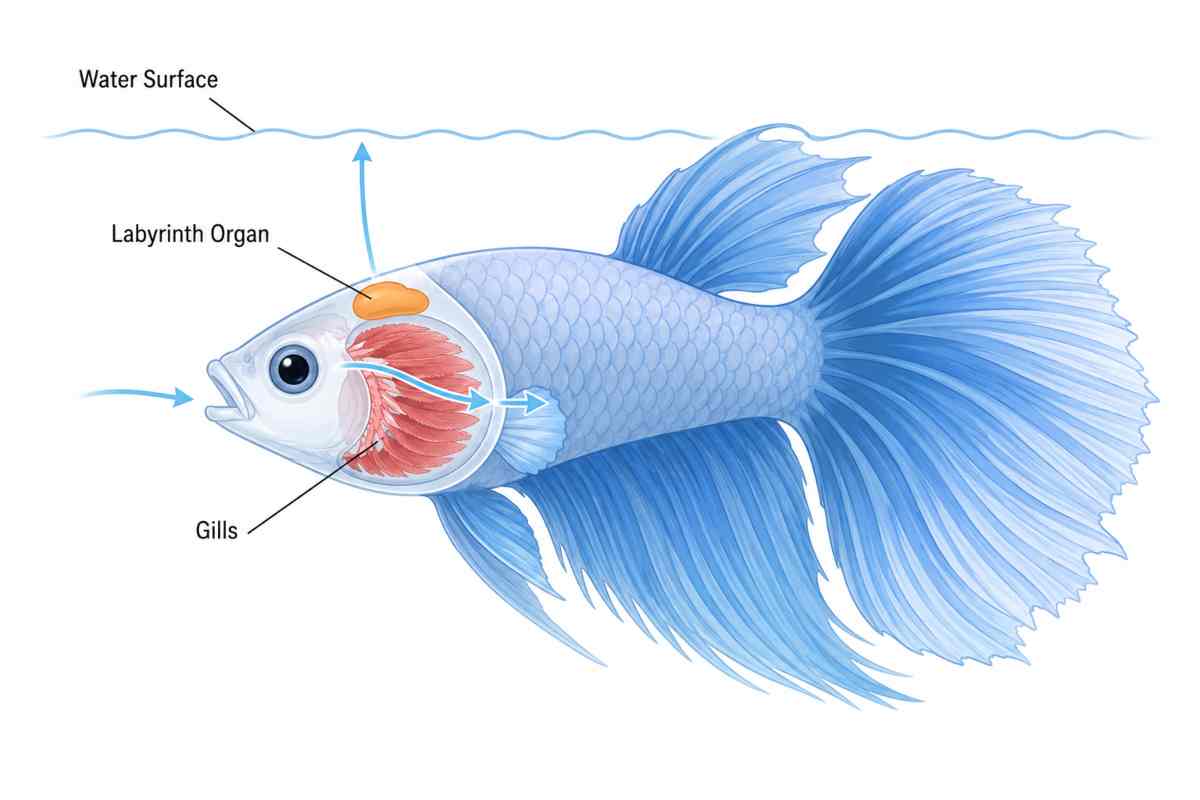 Betta fish breathe using both their gills and a labyrinth organ that lets them gulp air at the surface.
Why Fish Cannot Breathe Air the Same Way Humans Do
Human lungs are internal, rigid structures that stay inflated with the help of surrounding muscle and cartilage, even in dry air. Fish gill filaments are the opposite. They are thin, delicate, and depend on the buoyancy of water to stay separated and functional.
Out of water, gill filaments collapse against each other and stick together, similar to how wet paper towels clump when they dry. This dramatically reduces the surface area available for oxygen exchange, and the surrounding air alone cannot keep the filaments moist enough to function properly.
This is why a fish out of water is not simply holding its breath. Its breathing mechanism is physically failing, even though there is plenty of oxygen in the surrounding air.
Can Fish Survive Outside Water?
Most freshwater aquarium fish can only survive a few minutes out of water before oxygen deprivation causes serious harm. The exact time varies by species, temperature, and humidity.
A few points are worth understanding.
- Keeping a fish’s gills moist slightly extends survival time, which is why Fish are transported in water-filled bags rather than dry containers.
- Cooler temperatures slow metabolism and can modestly extend survival time out of water.
- Air-breathing species like bettas and some catfish can survive somewhat longer than strictly gill-breathing fish, but they still need moisture and should never be kept out of water intentionally.
- No freshwater aquarium fish should ever be left out of water as a matter of routine care. Even brief, repeated exposure causes measurable stress and gill damage.
What Happens When Dissolved Oxygen Gets Too Low
Dissolved oxygen levels in water are not fixed. They change with temperature, plant activity, surface agitation, fish load, and water quality.
When dissolved oxygen drops too low, Fish show clear warning signs.
- Gasping at the surface, trying to access the thin, oxygen-rich layer of water at the top
- Rapid or labored gill movement
- Lethargy and reduced appetite
- Gathering near filter outputs or air stones, where oxygen exchange is highest
- In severe cases, loss of balance or death
Surface gasping is often mistaken for normal behavior. Still, in most aquarium fish it is a sign that oxygen levels need immediate attention, usually through improved surface agitation, added aeration, or a partial water change.
How Temperature Affects Fish Respiration
Warmer water holds less dissolved oxygen than cooler water. At the same time, higher temperatures increase a fish’s metabolic rate, which increases its oxygen demand.
This combination means Fish are most vulnerable to low oxygen stress during warm weather, especially in tanks or ponds without adequate surface movement or aeration. This is one reason summer heat waves are a common trigger for oxygen-related fish deaths, even in tanks that seemed stable the rest of the year.
Also Read: What Temperature Should Betta Fish Water Be
How Water Quality Affects Breathing
Poor water quality does not just stress Fish chemically. It can physically damage the gills themselves.
High ammonia and nitrite levels irritate and burn gill tissue, reducing the surface area available for oxygen exchange. Excess organic waste and algae blooms can also consume dissolved oxygen as they decompose, compounding the problem. Fish in polluted or stagnant water often show the same gasping and labored breathing seen during low oxygen events, because damaged gills cannot extract oxygen efficiently even when some is present.
Maintaining stable water parameters is therefore not just about comfort. It directly protects the organ system fish depend on to survive every second of their lives.
Conclusion
Fish breathing is a highly refined system built around gills, countercurrent blood flow, and a constant, involuntary pumping motion that never stops, even while a fish rests or sleeps. Understanding how this system works makes it much easier to recognize warning signs like surface gasping, appreciate why water quality and temperature matter so much, and understand why species like bettas still need oxygenated, well-filtered water despite their labyrinth organ. At The Fish Care, this kind of foundational biology knowledge is what makes every other part of fishkeeping, from tank setup to disease prevention, make more sense.
Frequently Asked Questions
How do Fish breathe if they don’t have lungs?
They use gills, thin filament structures filled with blood vessels that absorb dissolved oxygen directly from water as it passes over them.
Do Fish drink water while they breathe?
Freshwater fish absorb water through their skin and gills by osmosis and rarely need to drink, while their gills continuously handle both oxygen exchange and salt balance.
Can Fish drown?
Yes. If a fish’s gills cannot extract enough oxygen, whether from being out of water, extremely low dissolved oxygen, or gill damage, it can suffocate, which is functionally similar to drowning.
Why do Fish need an air pump or bubbler?
Air pumps increase surface agitation, which improves oxygen exchange between air and water, raising dissolved oxygen levels available to the Fish.
Do all Fish breathe the same way?
No. Most rely entirely on gills, but some species, including bettas and other labyrinth fish, lungfish, and a few catfish, have evolved extra organs that let them supplement their oxygen intake with air.
How can I tell if my Fish is struggling to breathe?
Watch for rapid gill movement, gasping at the surface, lethargy, or clamped fins, and test your water parameters and oxygen levels right away if you notice these signs.
References
- NOAA Fisheries, National Oceanic and Atmospheric Administration, https://www.fisheries.noaa.gov/
- Merck Veterinary Manual, Respiratory System of Fish, https://www.merckvetmanual.com/