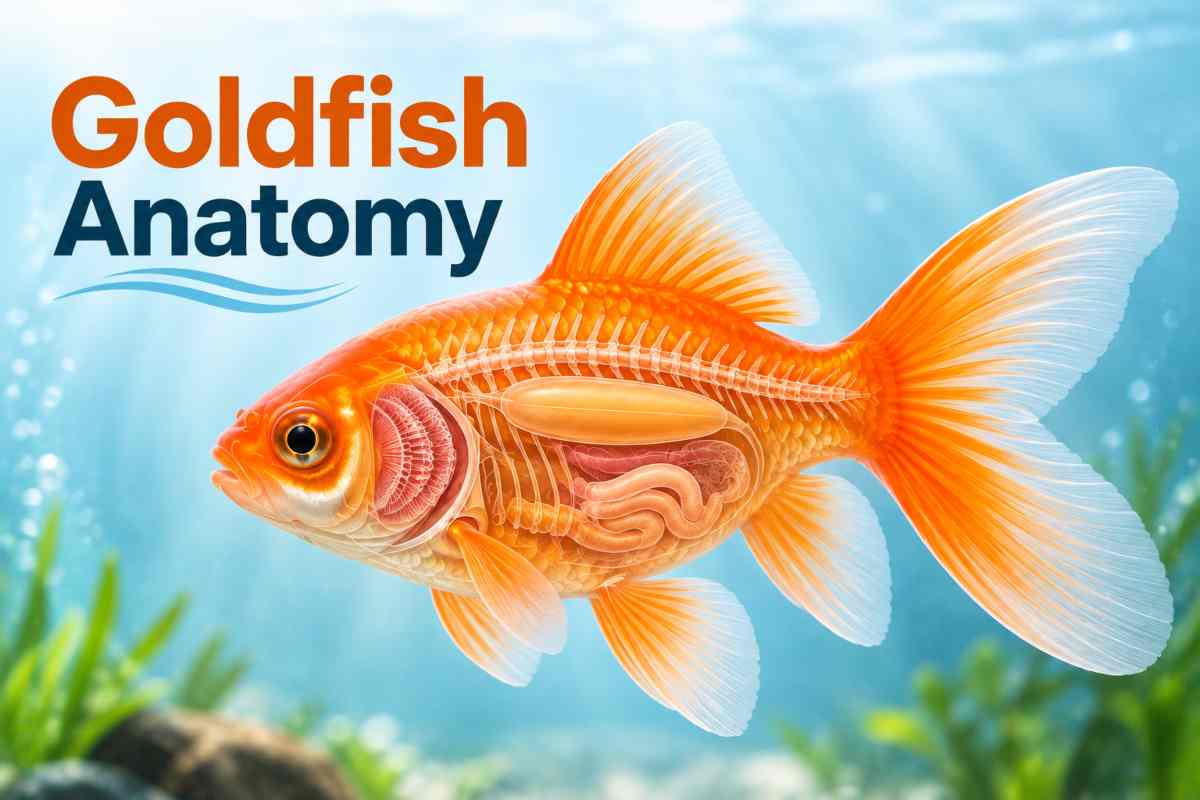
A goldfish’s body is built around a handful of features that set it apart from most other pets: it has no eyelids, no true stomach, a swim bladder that controls buoyancy, gills that pull oxygen from water instead of air, and a skeleton designed purely for swimming. These structures explain nearly everything about how goldfish eat, move, breathe, and get sick, and understanding them makes it much easier to keep a goldfish healthy for the long term.
Key Takeaways
- Goldfish have no stomach, so small, frequent meals digest more comfortably than one large feeding.
- No eyelids means goldfish can never close their eyes, making stable lighting and clean water essential for eye health.
- The swim bladder controls buoyancy, and most floating or sinking problems trace back to diet, temperature, or infection rather than a mystery illness.
- Fancy goldfish have rounder bodies that compress internal organs, making them more prone to swim bladder and digestive issues than slim-bodied common or comet goldfish.
- Goldfish have sharp hearing, a wide field of vision, and a lateral line that senses movement, giving them a far richer sensory world than most owners assume.
What Are the External Parts of a Goldfish?
A goldfish’s body is divided into three main regions: the head, the trunk, and the tail. The head runs from the mouth to the edge of the gill cover, the trunk holds most of the internal organs, and the tail contains the muscles that power swimming.
The skin is covered in overlapping scales arranged in diagonal rows, and each scale is coated in a layer of mucus, often called the slime coat. This mucus layer protects the fish from bacteria, parasites, and minor scrapes, which is why handling a goldfish with dry hands or a net can remove enough of it to leave the fish vulnerable to infection.
Unlike catfish or loaches, goldfish have no barbels around the mouth. Their mouth is small, toothless, and positioned to feed from the surface, midwater, and substrate alike, since goldfish are natural omnivores that graze throughout the water column.
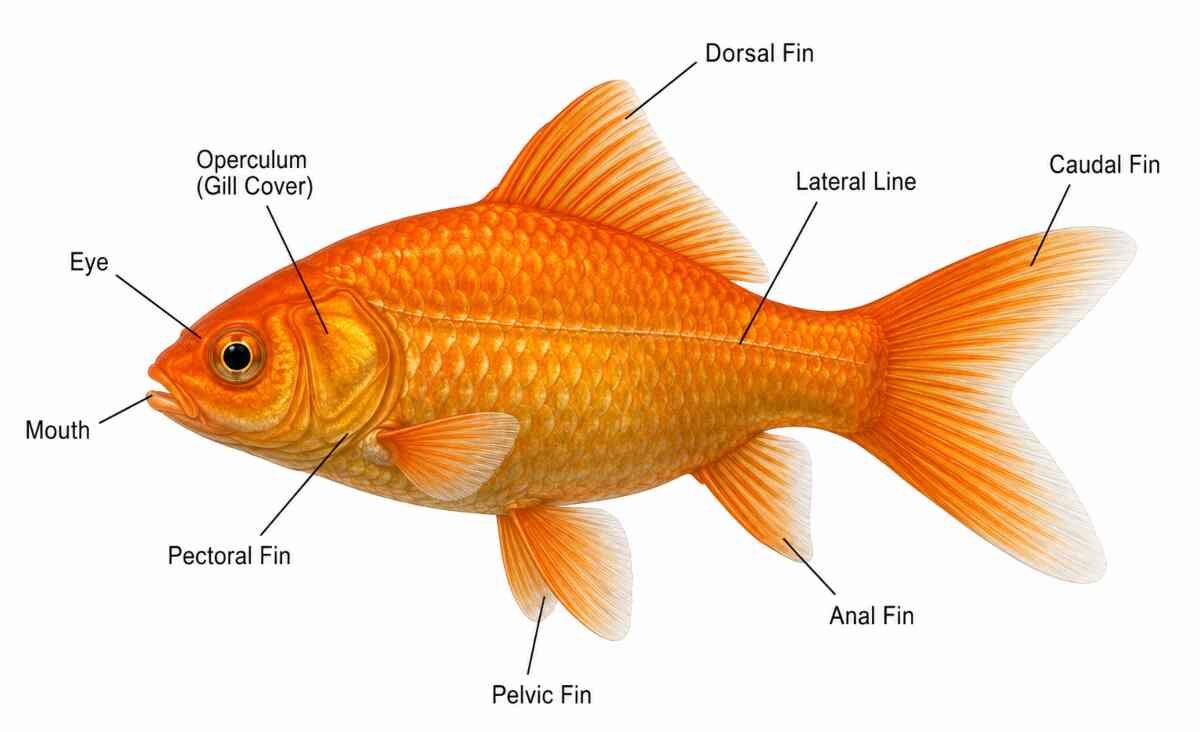 The external anatomy of a goldfish, with each fin and key body part labeled.
How Many Fins Does a Goldfish Have and What Do They Do?
A standard, single-tailed goldfish has seven fins in total, though fancy varieties often have doubled fins that change this count. Each fin serves a distinct mechanical purpose rather than being purely decorative.
| Fin | Location | Main Function |
|---|---|---|
| Dorsal fin | Top of the back | Stability and prevents rolling while swimming |
| Caudal fin (tail) | Rear of the body | Main propulsion and steering |
| Anal fin | Underside, near the tail | Stabilizes the body during forward motion |
| Pectoral fins (pair) | Behind the gills | Fine steering, braking, and slow maneuvering |
| Pelvic fins (pair) | Underside, mid-body | Balance and hovering in place |
Fancy goldfish varieties, such as those with twin tails, effectively duplicate the caudal and anal fins into two lobes each. This looks striking, but it also reduces swimming efficiency, which is one reason fancy goldfish tend to be slower and less agile than single-tailed common or comet goldfish.
What Organs Does a Goldfish Have Inside Its Body?
Beneath the scales, a goldfish carries a compact set of internal organs adapted for an aquatic, cold-blooded lifestyle:
- Gills: extract dissolved oxygen from the water
- Heart: a two-chambered pump that circulates blood at a pace tied to water temperature
- Hepatopancreas: combined liver and pancreas-like tissue that processes nutrients and toxins
- Kidneys: filter waste and regulate the fish’s internal salt and water balance
- Swim bladder: a gas-filled organ that controls buoyancy
- Digestive tract: runs from the mouth to the vent, with no stomach chamber along the way
Because goldfish are ectothermic, their metabolism, digestion speed, and oxygen needs all rise and fall with water temperature. A goldfish in 65°F water digests food far more slowly than the same fish in 75°F water, which is part of why overfeeding in cold water is such a common cause of digestive blockages.
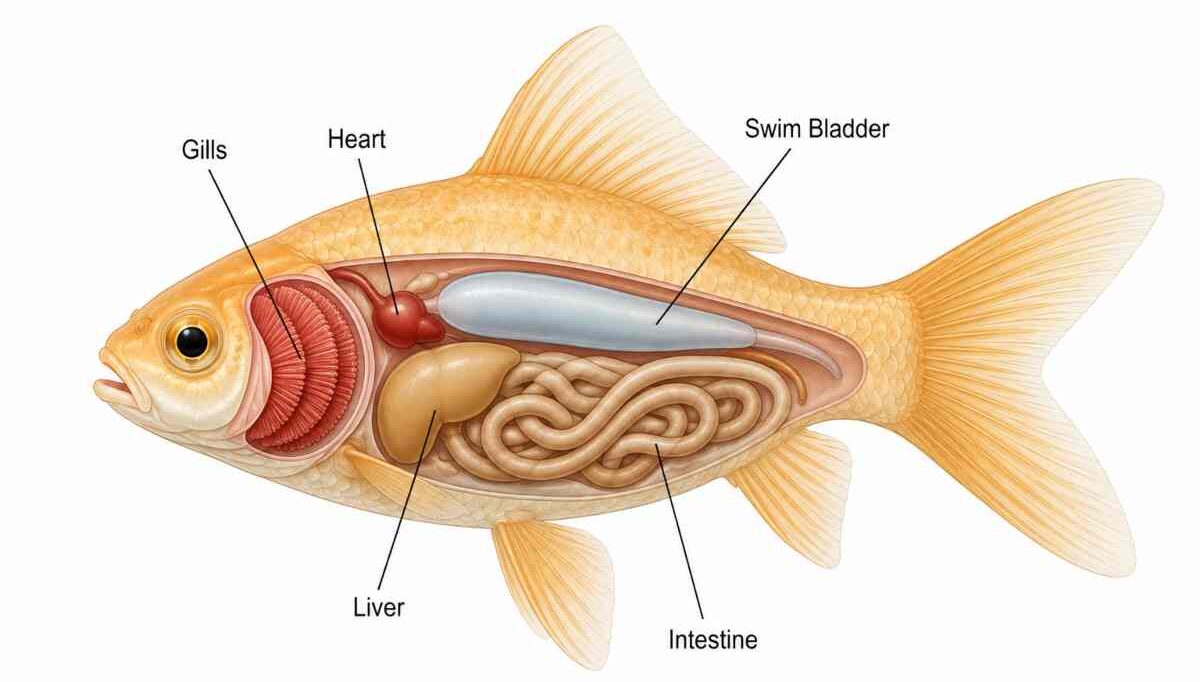 A cutaway view of a goldfish’s internal organs, showing where each one sits inside the body.
How Do Goldfish Breathe Underwater?
Goldfish extract dissolved oxygen from water using their gills, which sit behind the operculum, the hard flap on each side of the head. Water enters through the mouth, passes over thin, blood-rich gill filaments, and exits under the operculum. As water flows across the filaments, oxygen diffuses into the bloodstream and carbon dioxide diffuses out, a process that works far less efficiently than air breathing, which is why stable, well-oxygenated water matters so much for goldfish health.
Goldfish are unusually tolerant of low-oxygen conditions compared to most aquarium fish. Research on their physiology, including work summarized by the University of Florida’s aquatic sciences program, shows that goldfish and their relative the crucian carp can survive brief periods of very low oxygen by shifting to anaerobic metabolism, something few other freshwater fish can do. This tolerance does not mean goldfish thrive in poor conditions; it simply explains why they can survive situations that would kill less hardy species.
Does a Goldfish Have a Stomach?
No. Goldfish are one of several fish species that lack a true, distensible stomach. Instead, food passes from the esophagus directly into a long, folded intestine that handles both digestion and nutrient absorption along its entire length.
This has a practical consequence: a goldfish cannot store a large meal the way a stomached animal can, so it needs to eat small amounts frequently rather than one large meal per day. It also means high-fiber, low-fat foods move through the gut more comfortably, while dense, fatty, or poorly soaked foods are more likely to cause the intestinal blockages that lead to buoyancy problems.
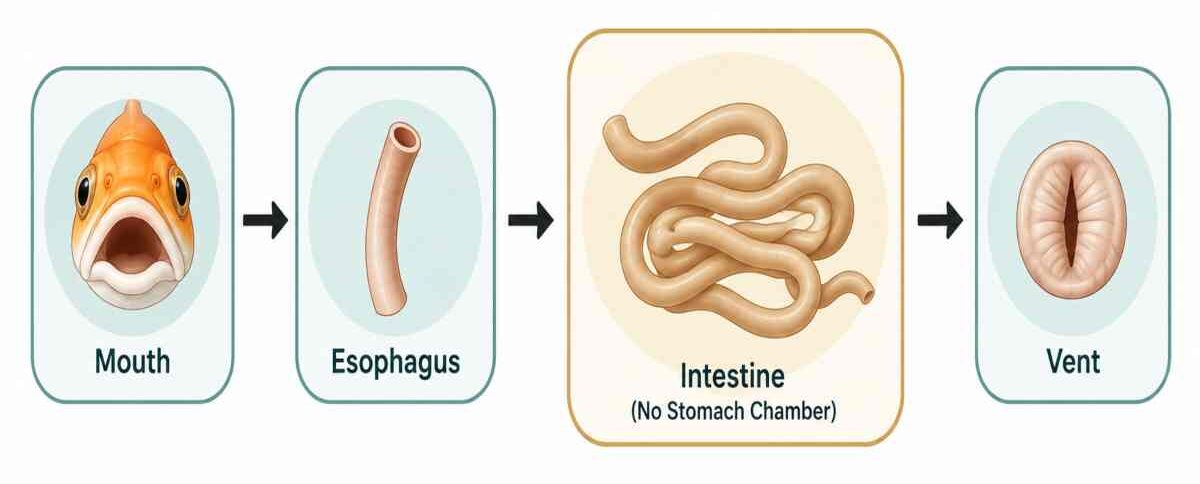 Food moves from a goldfish’s mouth straight to the intestine, since goldfish have no stomach.
How Does a Goldfish’s Swim Bladder Work?
The swim bladder is a gas-filled internal organ that lets a goldfish hover at a chosen depth without constantly swimming to stay afloat. By adjusting the volume of gas inside the bladder, the fish fine-tunes its overall density to match the surrounding water.
This system is delicate. Swallowed air from gulping at the surface, constipation from a blocked intestine pressing against the bladder, cold water slowing gut motility, and certain bacterial infections can all disrupt the bladder’s function. When that happens, a goldfish may float nose-down, sink to the bottom, or swim sideways, a set of symptoms commonly grouped as swim bladder disorder rather than a single disease.
Can Goldfish See, Hear, and Smell?
Goldfish rely on a combination of senses that work quite differently from a human’s, and each one shapes how they respond to their tank environment.
Sight
Goldfish have a wide field of view and some ability to see in the ultraviolet range, but they have no eyelids. They cannot close their eyes, so they rely entirely on water quality and periods of dim light to protect and rest their eyes rather than blinking.
Hearing
Hearing works through a set of small bones called Weberian ossicles, which connect the swim bladder to the inner ear and amplify vibrations traveling through the water. This gives goldfish notably sharp hearing for a fish, and it is one reason sudden tank taps or loud vibrations near the aquarium can genuinely stress them.
Lateral Line, Smell, and Taste
Running along each side of the body is the lateral line, a row of fluid-filled canals that detect pressure changes and water movement. This sense lets a goldfish detect nearby objects, other fish, or an approaching hand even in murky or dark water, functioning almost like a distributed sense of touch at a distance. Smell and taste are also well developed, concentrated in nostril-like nares and in taste buds spread across the mouth and even parts of the skin, which helps explain why goldfish can locate food by scent before they see it.
In short, a goldfish experiences its tank through sight, sharp hearing, water-borne vibration, and a strong sense of smell and taste working together, not through any single dominant sense.
How Does Fancy Goldfish Anatomy Differ From Common Goldfish?
Selective breeding over centuries has produced two broad anatomical categories among goldfish, and the differences go well beyond color.
| Feature | Common/Comet Goldfish | Fancy Goldfish (Oranda, Ranchu, etc.) |
|---|---|---|
| Body shape | Slim, torpedo-shaped | Rounded, egg-shaped |
| Tail | Single caudal fin | Often doubled, shorter, more delicate |
| Swim bladder | Aligned normally with body shape | Often compressed by rounder body, more prone to disorders |
| Swimming speed | Fast, agile | Slower, less maneuverable |
| Special features | None | May include a wen (raised head growth) or telescope eyes |
The rounder body cavity of wide fancy varieties compresses the internal organs, including the swim bladder and intestine, into a tighter space. This anatomical trade-off is the main reason fancy goldfish are statistically more prone to swim bladder disorder and digestive blockages than their slimmer, single-tailed relatives.
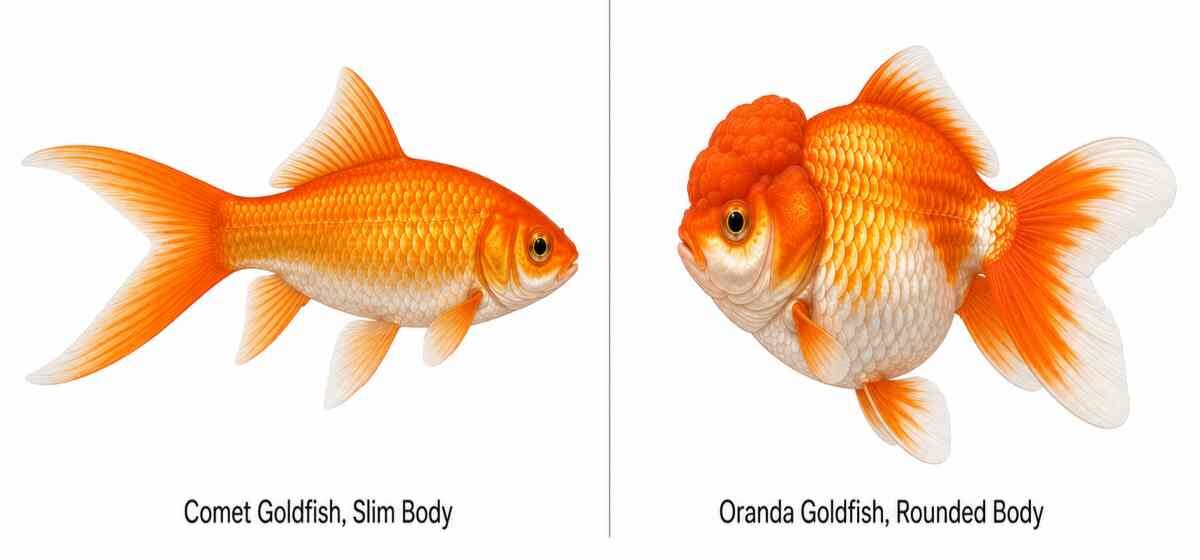 Comet goldfish have slim, fast-swimming bodies, while oranda goldfish have rounder, compressed bodies.
What Do People Get Wrong About Goldfish Anatomy?
A few misconceptions come up often enough to address directly.
The Three-Second Memory Myth
The claim that goldfish have a three-second memory is false. Studies of their brain structure and behavior show that goldfish can learn and retain associations, such as recognizing feeding times or navigating a maze, for weeks or longer.
Does Tank Size Limit a Goldfish’s Growth?
Tank size does not physically cap a goldfish’s growth through any anatomical mechanism. It mainly limits growth by restricting water quality and space, which is why goldfish kept in bowls often become stunted and unhealthy rather than staying naturally small.
How Long Does It Take a Goldfish to Reach Full Size?
Depending on the variety and living conditions, a goldfish’s skeleton and organs can continue developing for two to three years, and some common goldfish in spacious ponds grow well beyond a foot in length over a lifetime that can exceed a decade.
Bringing It All Together
Every quirk in goldfish care traces back to their anatomy. The missing stomach explains why small, frequent meals work better than a single large meal. The swim bladder explains why floating or sinking fish are usually dealing with a digestive or bacterial issue rather than something mysterious. The gills and unusually strong low-oxygen tolerance explain why goldfish can survive in conditions that would harm other fish, without that tolerance ever being an excuse for poor water quality. At The Fish Care, this kind of anatomical grounding is what turns generic care advice into decisions that actually match how a goldfish’s body works.
Related Article: Betta Fish Anatomy
Frequently Asked Questions (FAQs)
Do goldfish have teeth?
Not in the mouth. Goldfish have pharyngeal teeth located in the throat, which they use to grind food against a hard pad before swallowing.
Why do goldfish not have a stomach?
It is a trait shared with several other cyprinid fish species; their digestive system evolved to process food continuously along the intestine rather than storing it in a stomach chamber.
Can goldfish feel pain?
Current scientific understanding, supported by research into fish nociceptors and behavior, indicates that goldfish have the neural structures to detect and respond to painful stimuli, which is a key reason careful handling and prompt treatment of injuries matter.
Why do goldfish sometimes float upside down?
This is almost always related to swim bladder disorder, often triggered by constipation, overfeeding, swallowed air, or cold water slowing digestion.
Do goldfish have a brain?
Yes, goldfish have a relatively well-developed brain for a fish, supporting memory, learning, and coordinated sensory processing from their eyes, lateral line, and inner ear.