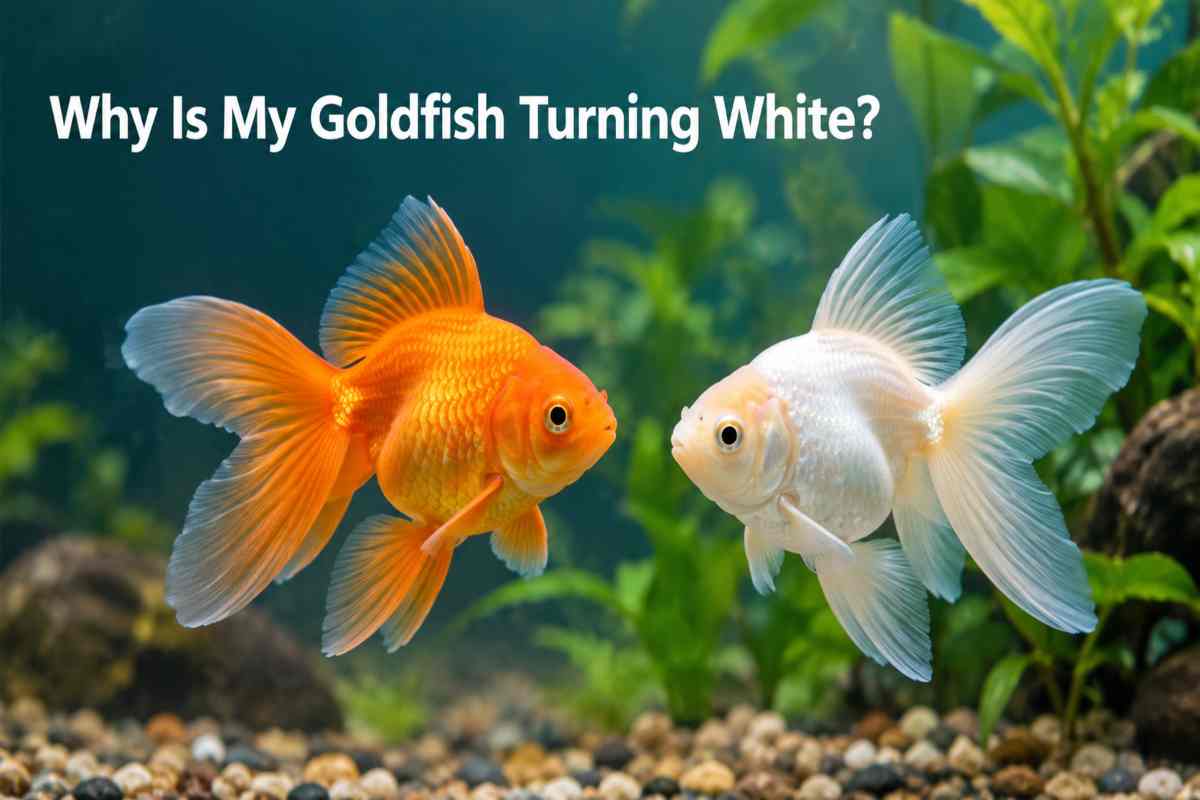
Most goldfish turn white for one of four reasons: natural aging or genetics, a lack of pigment-building food or light, stress from poor water quality, or an infection. The fastest way to tell which one you are dealing with is to look at the type of white. An even, flat paleness in an active fish that eats well is usually harmless fading or mild stress. Raised dots, fuzzy tufts, or a milky film point to a problem that needs attention within days.
Key Takeaways
- Flat, gradual fading in a goldfish that swims and eats normally is usually linked to age, genetics, diet, or lighting; raised dots, cotton-like tufts, or a cloudy film can indicate irritation or disease.
- Test ammonia, nitrite, nitrate, and pH before taking action. Poor water quality is one of the most common fixable causes of goldfish color changes and can cause serious harm quickly.
- Small white dots on a male goldfish’s gill covers and pectoral fins are usually breeding tubercles, not ich.
- Goldfish cannot produce carotenoids themselves, so their orange coloration depends partly on their diet. Color may return over weeks to months when diet, lighting, or stress caused the change, but age-related or genetic changes may be permanent.
- Never medicate without identifying the likely cause first. Match treatment to what you are actually seeing rather than treating every white mark as a disease.
Which Type of White Are You Seeing?
“White” can mean several very different things. Match what you see to the table below before deciding what to do.
| What you see | Most likely cause | Typical behavior | Urgency |
|---|---|---|---|
| Even, gradual paleness over weeks or months | Age, genetics, diet, light | Active, eating normally | Low |
| Sudden dullness or washed-out color | Stress, ammonia or nitrite, chlorine, temperature shock | Hiding, clamped fins, fast gills | High: test water today |
| Milky or gray film, cloudy patches | Excess slime coat from irritants or slime-coat parasites | Flashing, scratching, fast gills | High |
| Tiny, raised, salt-like dots across body and fins | Ich | Flashing, lethargy | High |
| A few dots only on gill covers and front edge of pectoral fins | Breeding tubercles in a mature male | Chasing other fish, otherwise normal | None |
| Fluffy, cotton-like tufts | Fungus, usually after an injury | Varies | Moderate to high |
| Flat white or gray patches, frayed edges, especially mouth or back | Columnaris (bacterial) | Lethargic, gasping | Emergency |
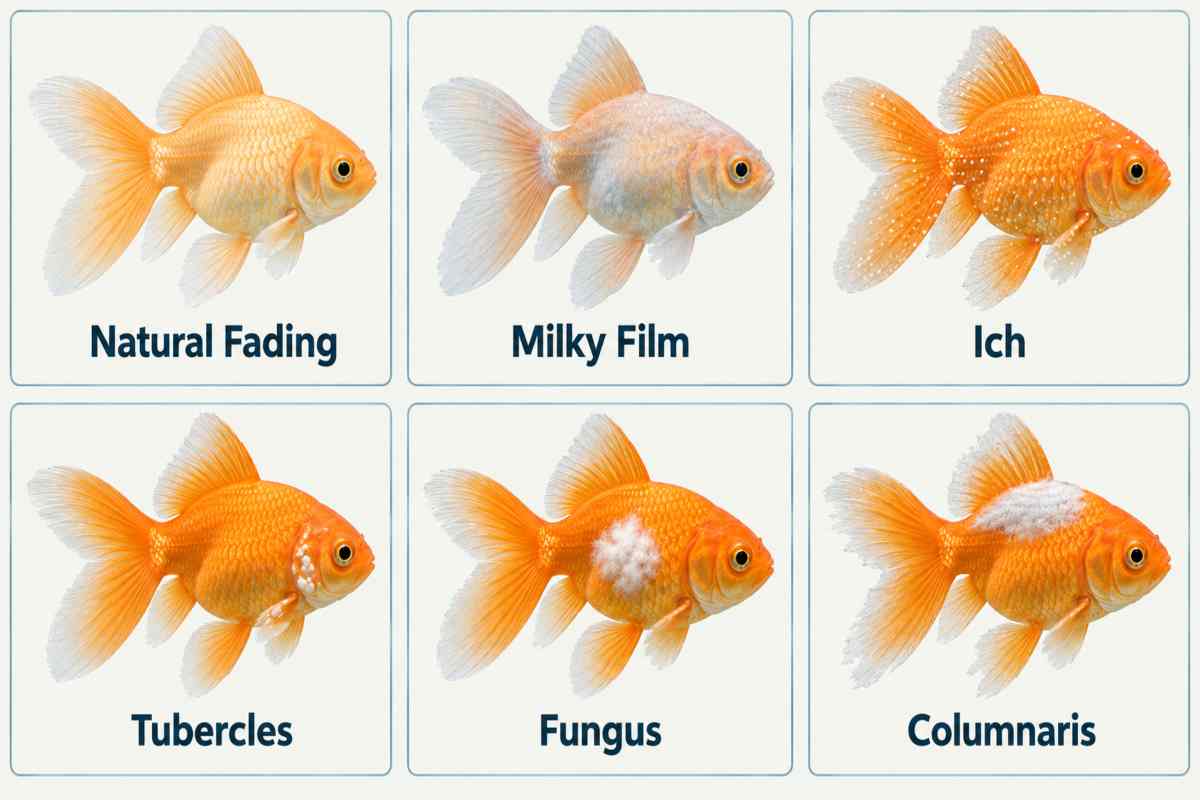 How to tell harmless fading from disease by sight
Is It Normal for a Goldfish to Fade to White as It Ages?
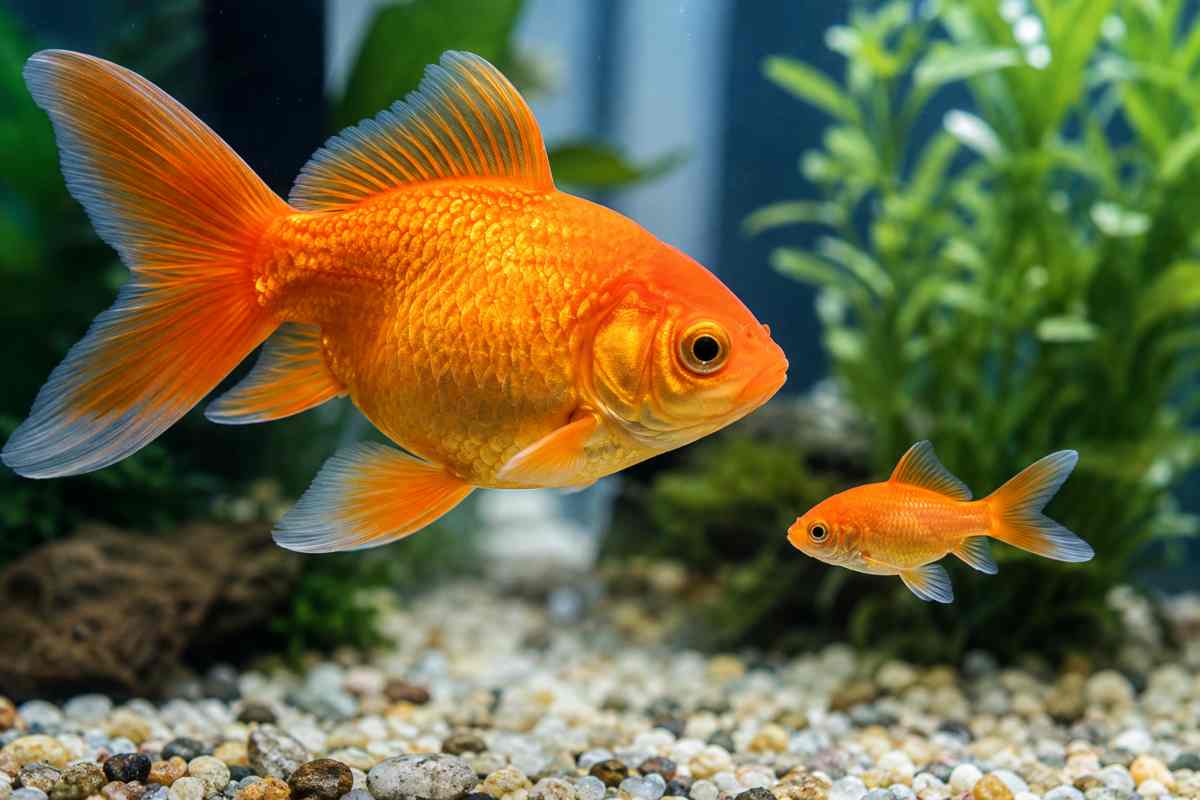
Yes, and it is the most overlooked answer. Goldfish are not born orange. Fry start dull brown or olive-bronze, and the orange develops over the first months to years, at a pace that varies widely between fish and varieties.
The reverse can happen later. Many adult goldfish gradually lighten, shifting from deep orange to pale orange, yellow, cream, or white. This is often symmetrical and slow, and the fish behaves normally.
Selective breeding plays a big role in this. Goldfish varieties carry unstable pigment combinations, so a fish’s final color can differ from what it looked like at the pet store. Regrown scales after an injury can also come in paler at first.
Black moors deserve a special mention. They frequently lose black pigment with age, sometimes turning bronze, orange, or mottled, and some develop pale patches. Without other symptoms, this is a color change, not an illness.
Signs the fading is harmless: it is gradual, even on both sides, the fins are clear and open, breathing is calm, appetite is normal, and water tests are clean.
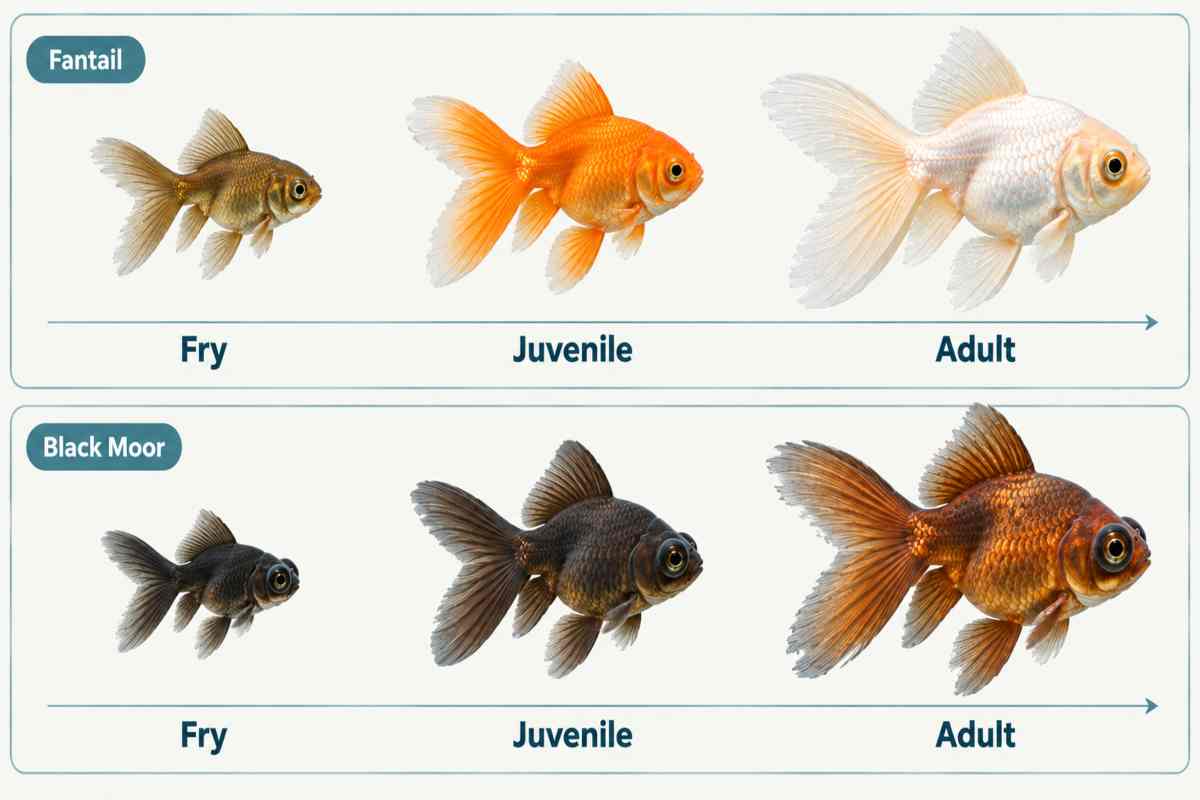 Goldfish color naturally shifts over a lifetime
Can Diet and Lighting Make a Goldfish Turn White?
They can. Goldfish cannot produce carotenoids, the pigments behind orange and red, from scratch. They must get them from food. A long-term diet of cheap flakes with little natural pigment content can lead to slow color loss.
A varied diet of quality goldfish pellets or gel food, with occasional foods rich in natural carotenoids such as astaxanthin or spirulina, supports color. Color-enhancing foods can deepen a fish’s shade, but they will not reverse fading caused by age or genetics.
Light plays a supporting role. Pigment cells respond to light and background, and goldfish kept in dim tanks often look paler than fish in bright ponds, though the effect varies by variety. A regular 8- to 10-hour light cycle from a full-spectrum aquarium light is plenty. Avoid direct sun on the tank, which drives algae growth and temperature swings.
Can Poor Water Quality or Stress Turn a Goldfish White?
Yes, and this is the cause that most often needs fast action. Goldfish produce a lot of waste, so ammonia and nitrite can build up quickly in small, overstocked, or uncycled tanks. Both irritate gills and skin and strip the protective slime coat. The fish may respond by going pale or by producing extra mucus that looks like a gray-white film.
Stress alone can also wash out color. Sudden temperature changes, aggressive tank mates, and overcrowding are common triggers. University extension programs such as UF/IFAS consistently identify poor water quality and stress as leading contributors to fish disease.
A useful contrast: ammonia damage often shows as red streaking first, and dark or black patches may appear during healing. If you see black rather than white, think ammonia burn.
Why does a goldfish turn white after a water change?
Three suspects come up again and again:
- Untreated or under-dosed tap water. Chlorine and chloramine damage gills and skin. Dose your conditioner for the full tank volume.
- Temperature or pH shock. Large swaps with water that differs sharply from the tank stress the fish.
- A crashed filter. Rinsing filter media under the tap can kill beneficial bacteria and trigger an ammonia spike a day or two later.
What to do right now
- Test ammonia, nitrite, nitrate, and pH with a liquid test kit. Strips are less reliable.
- Aim for 0 ammonia, 0 nitrite, and nitrate as low as practical, ideally under 40 ppm.
- If ammonia or nitrite is above zero, change 30 to 50 percent of the water with conditioned, temperature-matched water. Repeat daily until both read zero, and add extra aeration.
- Feed lightly for a day or two and leave the filter media alone (rinse it only in old tank water).
- Watch for 24 to 48 hours and compare the fish against the table above.
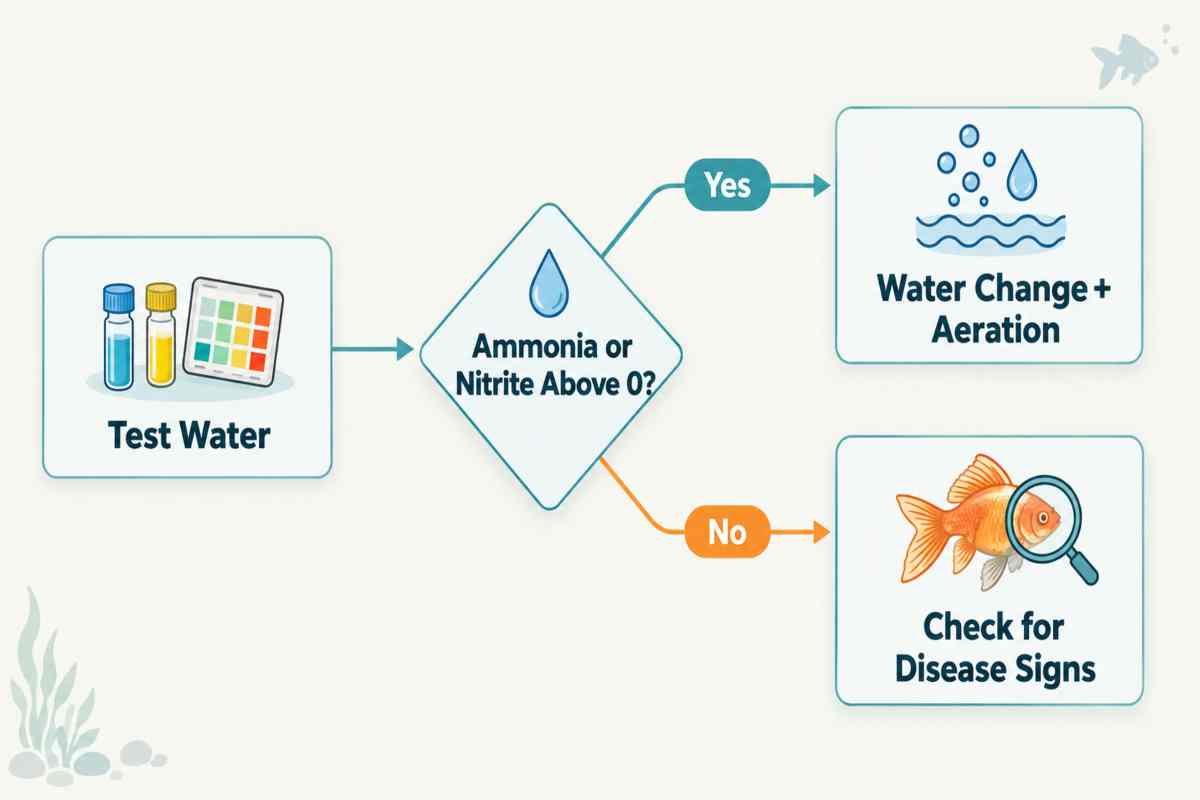 What to do when your goldfish turns white
When Is White a Sign of Disease in Goldfish?
If the water is clean and the white looks raised, fuzzy, or patchy, infection or parasites become more likely. Veterinary references such as the Merck Veterinary Manual describe most of these in detail.
Ich (white spot disease). Caused by the parasite Ichthyophthirius multifiliis, it shows as tiny, salt-like raised dots on the body, fins, and gills, often flashing against objects. The parasite’s life cycle speeds up in warmer water, and the whole tank needs treatment, not just the fish.
Breeding tubercles, not ich. Mature male goldfish often develop small white bumps on the gill covers and the front edge of the pectoral fins, especially in spring. They stay in those spots, do not spread over the body, and the fish acts completely normal.
Fungus. Cotton-like tufts usually grow on tissue that was already injured or stressed. Treat the underlying cause, such as poor water or a wound, along with the fungus.
Columnaris. Despite its cottony look, this is a bacterial infection caused by Flavobacterium columnare. It shows as flat white or gray patches, often around the mouth or as a “saddle” on the back, with frayed fins. It can progress fast, so treat it as an emergency and consider an aquatic veterinarian.
Slime-coat parasites and fin rot. A dull, dusty, or milky film with clamped fins suggests parasites or heavy irritation. White, frayed fin edges suggest bacterial fin rot, usually driven by water quality.
Anchor worms and fish lice. These are visible, thin, thread-like or disc-shaped parasites on the skin, usually with red, inflamed tissue around them.
When Is a White Goldfish an Emergency?
Color alone rarely tells the whole story. Behavior does. Act quickly if you see any of these:
- Gasping at the surface or fast gill movement
- Clamped fins, or lying on the bottom or tilted
- White or gray patches spreading within 24 to 48 hours
- Ulcers, red streaks, or raised, pinecone-like scales
- Refusing food along with color change
Test the water first, fix any ammonia or nitrite, and then identify the disease. Wrong medications and incorrect salt doses can harm a goldfish more than the original problem. If the fish keeps declining, an aquatic or exotics veterinarian can run a skin or gill scrape to confirm the diagnosis.
Can a White Goldfish Turn Orange Again?
Sometimes. It depends entirely on why the color faded.
| Cause of fading | Can color return? |
|---|---|
| Diet or lighting | Often yes, gradually over weeks to months |
| Stress or water quality | Often yes once the cause is fixed, if no permanent damage occurred |
| Disease damage | Partly. Scarring or regrown scales may stay paler |
| Age or genetics | Usually not, and the fish is often perfectly healthy |
Be patient. Pigment recovery is slow, and a fish that is active, eating, and breathing normally is healthy no matter its shade.
How Can You Prevent Goldfish From Fading?
Prevention is mostly good husbandry. Give the fish a large, fully cycled tank (goldfish grow bigger than most people expect), strong filtration, and regular partial water changes based on stocking level. Feed a quality, varied diet in small portions, keep a consistent light cycle, and quarantine new fish for at least four weeks before adding them to your main tank.
Final Thoughts
A goldfish turning white is not always a crisis, but it is always a signal worth reading. Look at the texture of the white, test your water, and watch behavior for a day or two. That combination answers the question in most cases. At The Fish Care, we recommend acting on evidence rather than guesswork, and consulting an aquatic veterinarian when a fish is declining. This article is educational and not a substitute for professional veterinary diagnosis.
Frequently Asked Questions (FAQs)
Why is my black moor turning white or orange?
Black moors commonly lose black pigment with age, light exposure, or diet, shifting to bronze, orange, or mottled patterns. If the fish is healthy, it is a color change, not a disease.
Why are my goldfish’s scales turning white and peeling?
This usually points to injury, ammonia or chemical burns, or bacterial or parasitic damage. Test the water immediately and keep it pristine. Deep ulcers, redness, or lifted scales need veterinary input. Lost scales typically regrow, often paler at first.
Why is my goldfish turning white on its head?
In males, small white bumps on the gill covers are usually breeding tubercles. Elsewhere on the head, look for ich dots or cotton-like fungus on an injury. On fancy varieties with head growth (wen), the tissue can look pale or whitish, and scraped wen tissue is prone to fungal infection.
References
- Merck Veterinary Manual: https://www.merckvetmanual.com/
- University of Florida IFAS Extension (EDIS): https://edis.ifas.ufl.edu/