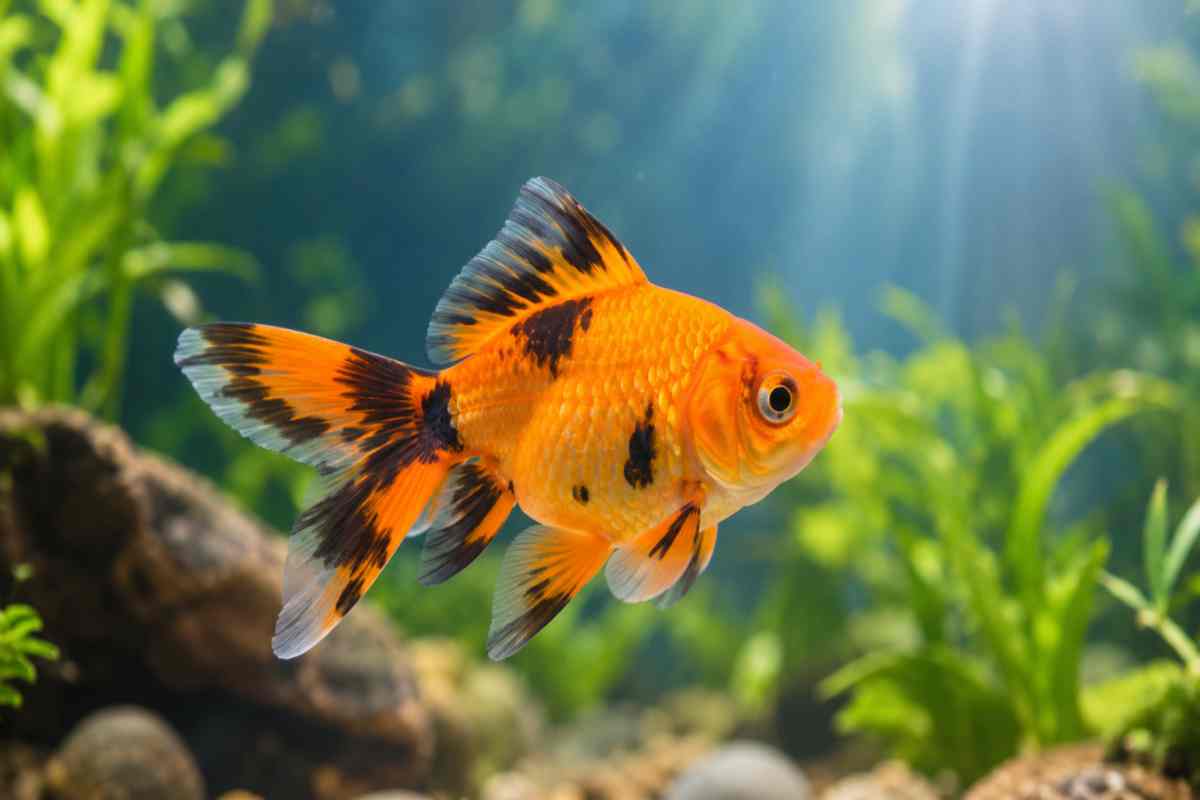
Your goldfish is most likely turning black because of one of five things: an ammonia or nitrite burn from poor water quality, physiological stress after a water change or new tank cycle, a healing scar over an old wound, a parasitic infection called black spot disease, or a completely normal genetic color change tied to age or breed. The right response depends entirely on which one it is, and the fish’s behavior is usually the fastest way to tell them apart. A goldfish that is eating, swimming, and behaving normally is rarely in danger. A goldfish that is also clamping its fins, gasping at the surface, or hiding is telling you something urgent.
Key Takeaways
- Sudden black patches with clamped fins, gasping, or lethargy can indicate ammonia or nitrite poisoning and require immediate water testing.
- Small, distinct black dots that resemble ground pepper are typically black spot disease, a parasitic infection, especially when the goldfish is otherwise acting normally.
- A black patch over a previous wound, red area, or ulcer is often caused by melanin production during healing and may fade over several weeks.
- Gradual, even darkening without other symptoms is often a natural pigment change related to genetics, age, or breed.
- Testing ammonia, nitrite, nitrate, and pH is the most useful first step when a goldfish changes color unexpectedly.
Is Black Coloring Normal for Goldfish? Understanding Pigment Cells
Goldfish get their color from pigment cells called chromatophores, which sit in and just under the skin. The black and dark brown ones are called melanocytes (or melanophores), and they work using the same pigment, melanin, that colors human skin and hair. Orange and red tones come from a different group called xanthophores and erythrophores, while iridescent shine comes from iridophores.
Because goldfish carry several of these pigment types at once, color is not fixed the way it is in many other pets. A goldfish’s melanocytes can become more or less active in response to genetics, age, injury, hormones, and environmental stress, which is exactly why a single fish can shift between black, orange, white, and calico patterns over its lifetime. This is one of the most distinctive traits of the species, and it’s the reason goldfish owners see far more dramatic color changes than owners of almost any other freshwater fish.
-
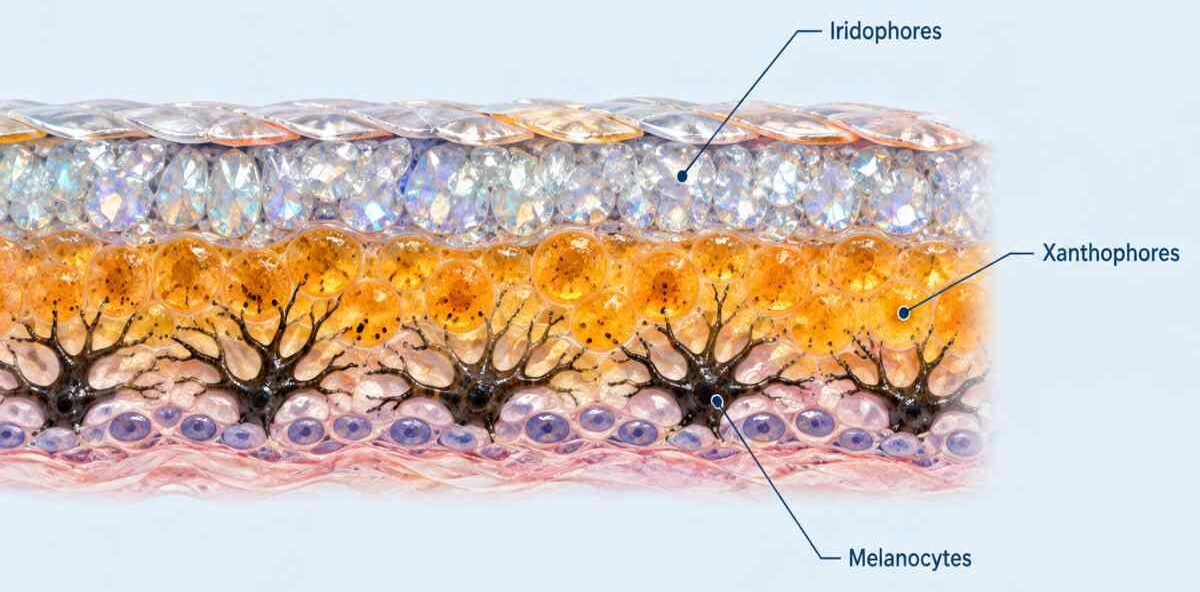
How melanocytes, xanthophores, and iridophores give goldfish their color.
Could Ammonia Poisoning Be Turning My Goldfish Black?
Yes, and it is the first cause to rule out. Ammonia burns are one of the most common reasons a goldfish develops sudden black or dark brown patches, especially on the fins, gills, and body edges. This happens because ammonia is directly toxic to fish tissue, and melanin production increases around damaged or irritated skin as part of the body’s repair response, similar to bruising.
Ammonia poisoning is especially common in what’s known as new tank syndrome, when a tank hasn’t yet built up the beneficial bacteria colony needed to process fish waste. Goldfish produce a lot of waste relative to their size, so an uncycled tank, an undersized filter, or simple overcrowding can push ammonia and nitrite into dangerous territory within days.
What Water Parameters Should I Check?
| Parameter | Safe Range | Danger Zone | Effect When Elevated |
|---|---|---|---|
| Ammonia (NH3/NH4+) | 0 ppm | Above 0.25 ppm | Chemical burns, blackened patches on skin, gills, and fins |
| Nitrite (NO2-) | 0 ppm | Above 0.25 ppm | Similar tissue damage plus impaired oxygen transport in the blood |
| Nitrate (NO3-) | Under 20 to 40 ppm | Sustained levels above 40 ppm | Chronic stress and a weakened slime coat over time |
| pH | Stable, matched to your source water | Swings of 0.3 or more within a day | Stress blackening, a response sometimes called pH shock |
| Temperature | Stable within the species’ comfort range | Swings of several degrees in a short period | General stress and a suppressed immune response |
A reliable liquid water testing kit is the only accurate way to check these numbers. Test strips can help with a quick check but are less precise for ammonia and nitrite, the two values that matter most here. According to the University of Florida’s aquaculture extension research on water quality, ammonia toxicity is one of the most preventable yet common causes of stress and tissue damage in home aquariums, which lines up closely with what shows up in goldfish tanks that skip proper cycling.
If your test results show any detectable ammonia or nitrite, the standard first response is a partial water change of 25 to 50 percent, repeated daily until the numbers return to zero, along with confirming that your filter is appropriately sized and fully cycled.
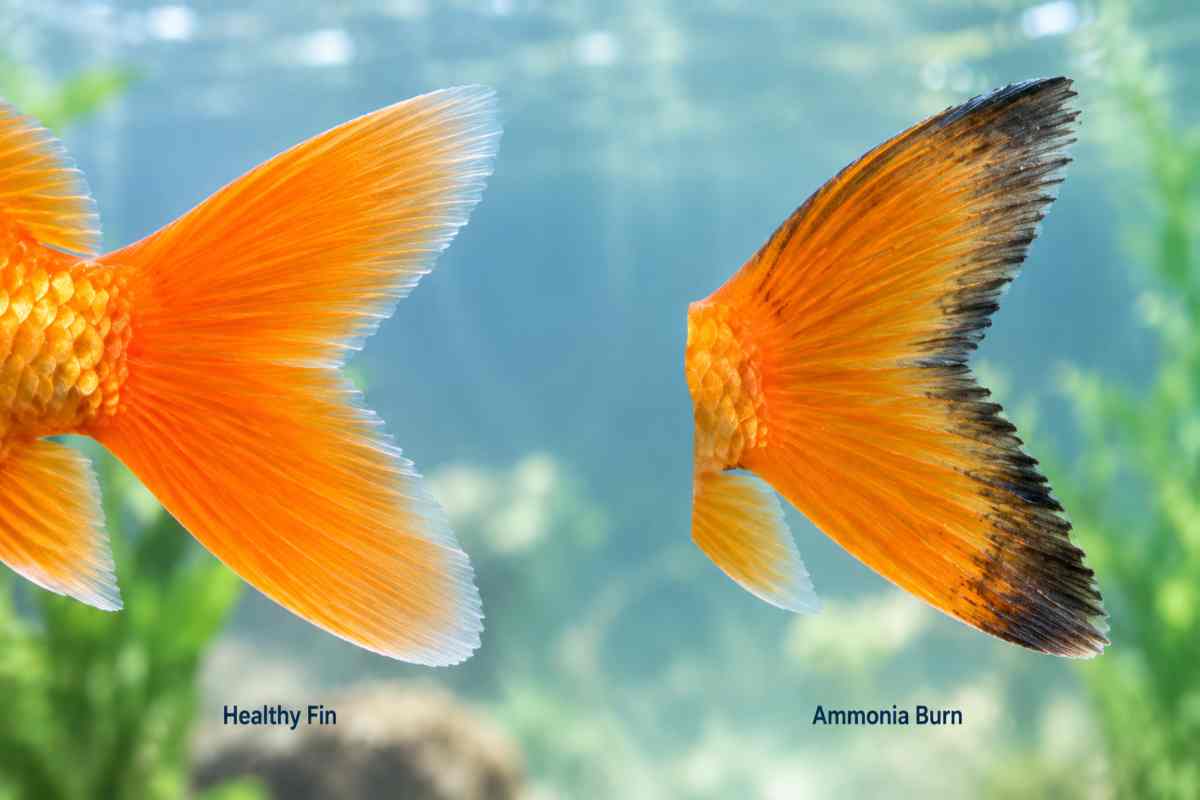 Healthy fin versus early ammonia burn, dark edging on the fin tips.
Why Did My Goldfish Turn Black After a Water Change?
A sudden dark patch appearing within a day or two of a water change is usually a stress response rather than direct chemical damage, assuming the new water itself was properly treated. Rapid shifts in pH, hardness, or temperature between the old tank water and the new water can trigger what’s often called pH shock. Melanocytes can darken temporarily as part of this general physiological stress response, even without actual injury.
This is more likely if the replacement water wasn’t closely matched to the tank’s existing temperature, or if you changed a large percentage of the water at once in a tank that wasn’t already struggling with poor parameters. Leftover chlorine or chloramine from unconditioned tap water can also irritate the skin like an ammonia burn.
The fix here is prevention on the next water change: match the temperature within a degree or two, use a dechlorinator every time, and avoid changing more than 25 to 50 percent of the water at once in a stable, established tank. If the darkening was purely stress-related and the water quality checks out afterward, most goldfish return to their normal color within one to three weeks.
Are Black Spots on My Goldfish Something to Worry About If It’s Acting Normal?
This is one of the most reassuring signs in fishkeeping: behavior almost always matters more than appearance. If your goldfish is eating with its usual enthusiasm, swimming normally, holding its fins upright, and interacting with tankmates as usual, black spots are much more likely to be cosmetic than dangerous.
Several breeds and color varieties are genetically prone to developing black markings unrelated to illness. Calico goldfish, in particular, are known for shifting patterns throughout their lives, and telescope-eye and black moor varieties can show uneven fading and darkening as they mature. Even standard orange comets and fancy goldfish can develop black smudges on individual scales as a normal part of aging, without this signaling any underlying problem.
The clearest way to separate normal genetic changes from a medical issue is to track the pattern over two or three weeks. Genetic and age-related color shifts tend to spread slowly and evenly, while medical causes usually come with a second symptom, whether that’s clamped fins, appetite loss, or visible sores.
Why Is My Orange Goldfish Getting Black Edges on Its Fins?
Black edging specifically on fin tips is one of the more commonly Googled symptoms, and it has three realistic explanations that look similar at first glance but need very different responses.
Comparing the Most Likely Causes
| Cause | What It Looks Like | Other Signs to Check | Action Needed |
|---|---|---|---|
| Ammonia or nitrite burn | Black or brown edging, often starting at fin tips and gills | Clamped fins, gasping at the surface, redness or fraying | Test water immediately and perform a partial water change |
| Black spot disease (parasite) | Small, distinct, raised black dots scattered rather than edged | Fish otherwise eats, swims, and behaves normally | Not usually urgent, but treatment is recommended |
| Healing or melanin scar | A solid black patch exactly where a previous injury, ulcer, or fin tear was | Patch is localized, not spreading, and slowly shrinks over weeks | No action needed; monitor for shrinkage |
| Genetic pigment shift | Smooth, even, and typically symmetrical color change | Completely normal behavior and appetite | No action needed |
Fin edging that appears within a day or two, along with any behavioral changes, strongly points to water quality. Edging that has been present and unchanging for weeks on an otherwise healthy fish is far more likely to be pigment-related.
What Is Black Spot Disease in Goldfish and How Do I Treat It?
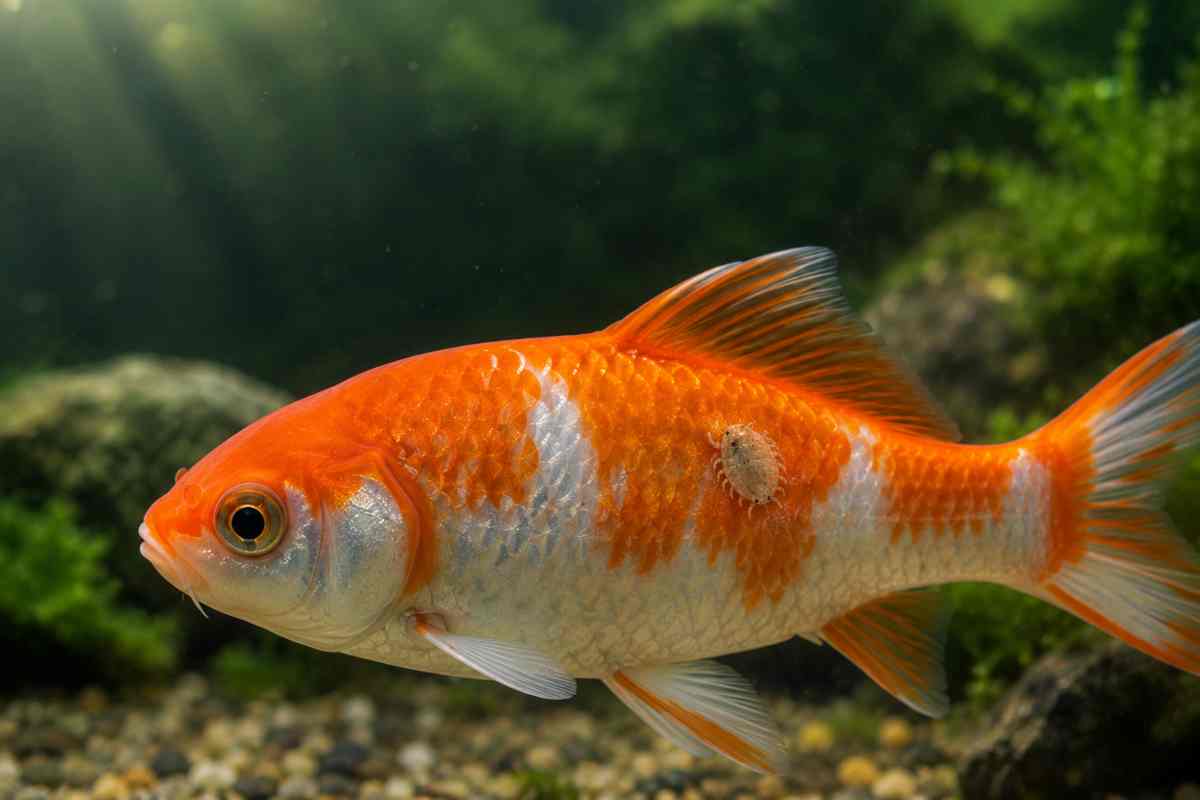
Black spot disease is caused by a parasitic flatworm, most commonly a trematode in the Neascus group, and it has a distinctive life cycle involving snails and fish-eating birds. Free-swimming larvae released from infected snails burrow into a fish’s skin, and the fish’s own melanocytes surround the parasite with black pigment, essentially walling it off. This is why the spots look like small, raised, pepper-like dots rather than a smooth discoloration.
Because the parasite needs a bird host to complete its life cycle, black spot disease genuinely cannot spread from fish to fish inside a closed aquarium the way ich or fungal infections can. It’s most commonly introduced through new plants, fish, or water sourced from an outdoor pond where snails and wild birds have access.
Treating Black Spot Disease Step by Step
- Confirm the pattern matches raised, discrete black dots rather than a spreading patch or edging.
- Remove any snails from the tank, since they’re required for the parasite’s life cycle to continue.
- Improve overall water quality with a full round of testing and any needed water changes, since a weakened immune system makes symptoms more visible and recovery slower.
- Consider a short course of aquarium salt treatment at a fish-safe concentration, which can help with the fish’s slime coat and secondary stress. However, it will not eliminate an already-encysted parasite.
- Monitor over several weeks. Existing spots typically fade on their own as the fish’s immune system reabsorbs the encysted larvae, usually within a few months.
- Quarantine and treat any new plants or fish before introducing them to prevent reinfection.
Most fish with black spot disease make a full cosmetic recovery without any specialized medication, since the real long-term fix is breaking the parasite’s access to a snail and bird host rather than treating the fish itself directly.
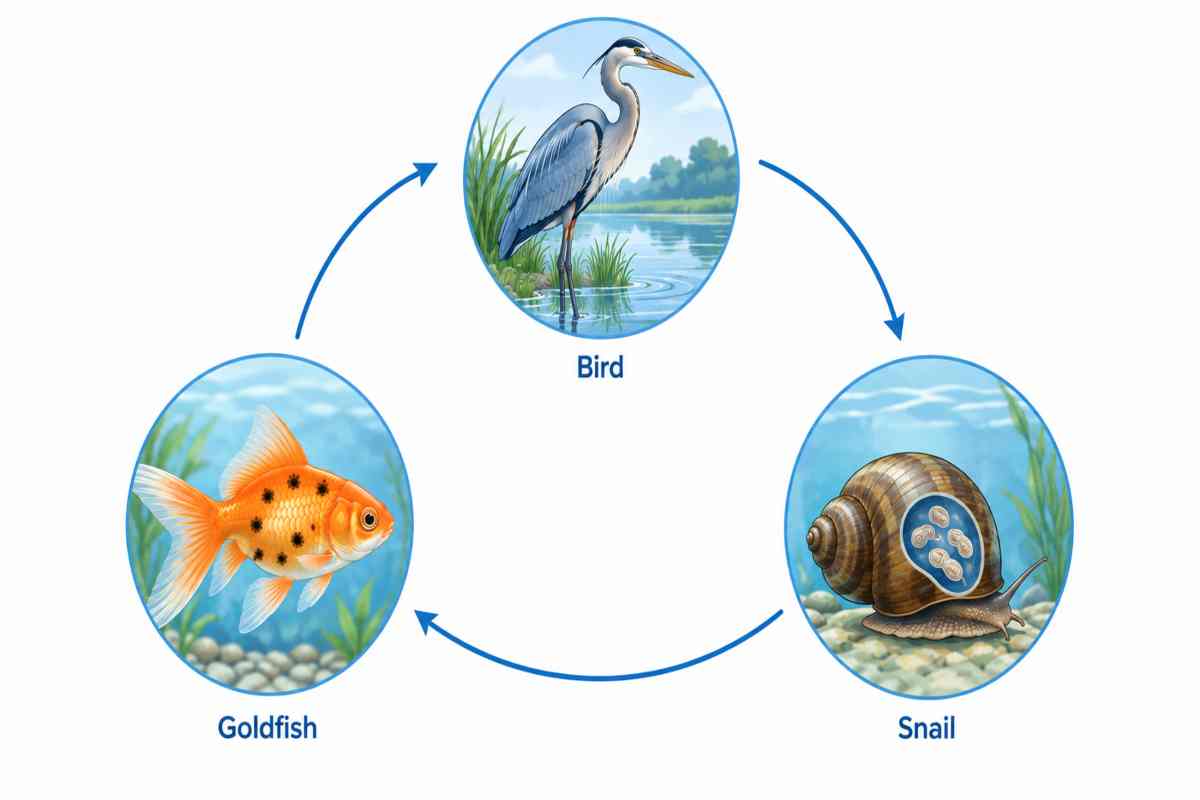 The black spot disease life cycle, from bird to snail to goldfish and back.
Does Melanin Appear When Goldfish Heal From Injuries?
Yes, and this is one of the more underexplained causes of black patches. When a goldfish sustains an injury, such as a torn fin, a scrape from decor, or a healed ulcer from an earlier bacterial infection, melanocytes frequently become active at the repair site as part of normal tissue healing. This produces a solid black patch that sits directly over the old wound rather than scattered spots or edging.
This kind of scar tissue pigmentation is a genuinely good sign. It typically means the injury is closed and healing rather than open and at risk of infection. Over the following weeks to a few months, as the tissue underneath fully regenerates, the black coloring usually fades and, in many cases, the original orange or white pigment eventually returns.
Why Does My Goldfish Turn Black Then Orange Again?
This question points to one of the most well-documented quirks of the species. Common and comet goldfish are often born a dull olive-black or bronze as juveniles, then gradually transition to their familiar orange as they mature, usually between three months and a year old, depending on genetics and growth rate. This is a completely separate process from adult color changes and is simply part of normal development.
Adult goldfish can also cycle through color changes for other reasons: a stress-related darkening that clears once water quality improves, a healing scar that fades back to orange, or, in calico and telescope varieties, an ongoing, lifelong shifting of pigment patterns with no fixed endpoint. Very old goldfish, sometimes 10 years or more, can also gradually lose pigment altogether and fade toward white or pale gold, which is a natural part of aging rather than a health concern.
-
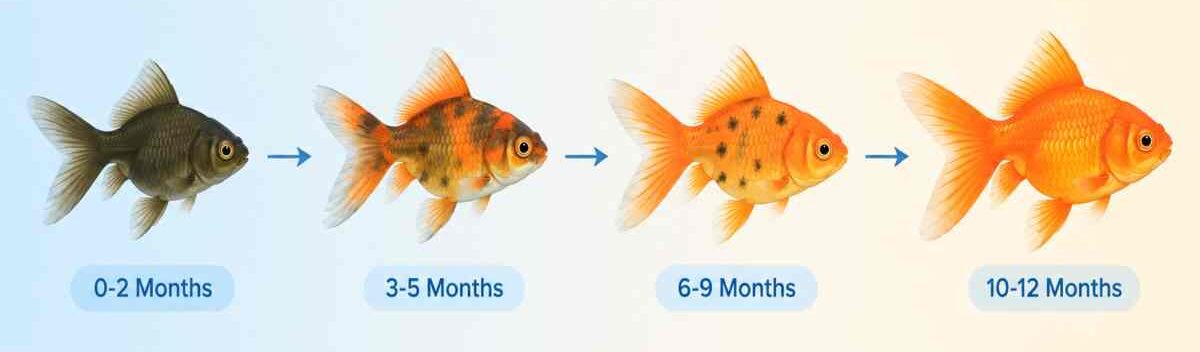
How a goldfish’s color shifts from dark juvenile to orange adult over its first year.
How Do I Test and Fix My Water Quality to Stop the Blackening?
Since water quality accounts for most medically significant cases of black discoloration, a consistent testing and maintenance routine is the most effective long-term prevention.
- Test ammonia, nitrite, nitrate, and pH weekly in an established tank, and daily during the first month of a new setup.
- Change 20 to 30 percent of the water weekly as a baseline, increasing frequency if you detect any ammonia or nitrite.
- Match the filter’s rated capacity to your actual bioload, keeping in mind that a single fancy goldfish can produce as much waste as several smaller community fish.
- Avoid overcrowding, since bioload capacity, not just tank volume, is what determines how much waste your filtration can realistically process.
- Vacuum substrate during water changes to remove waste before it breaks down into ammonia.
- Introduce new fish gradually and avoid overfeeding, since uneaten food is one of the fastest ways to spike ammonia in a goldfish tank.
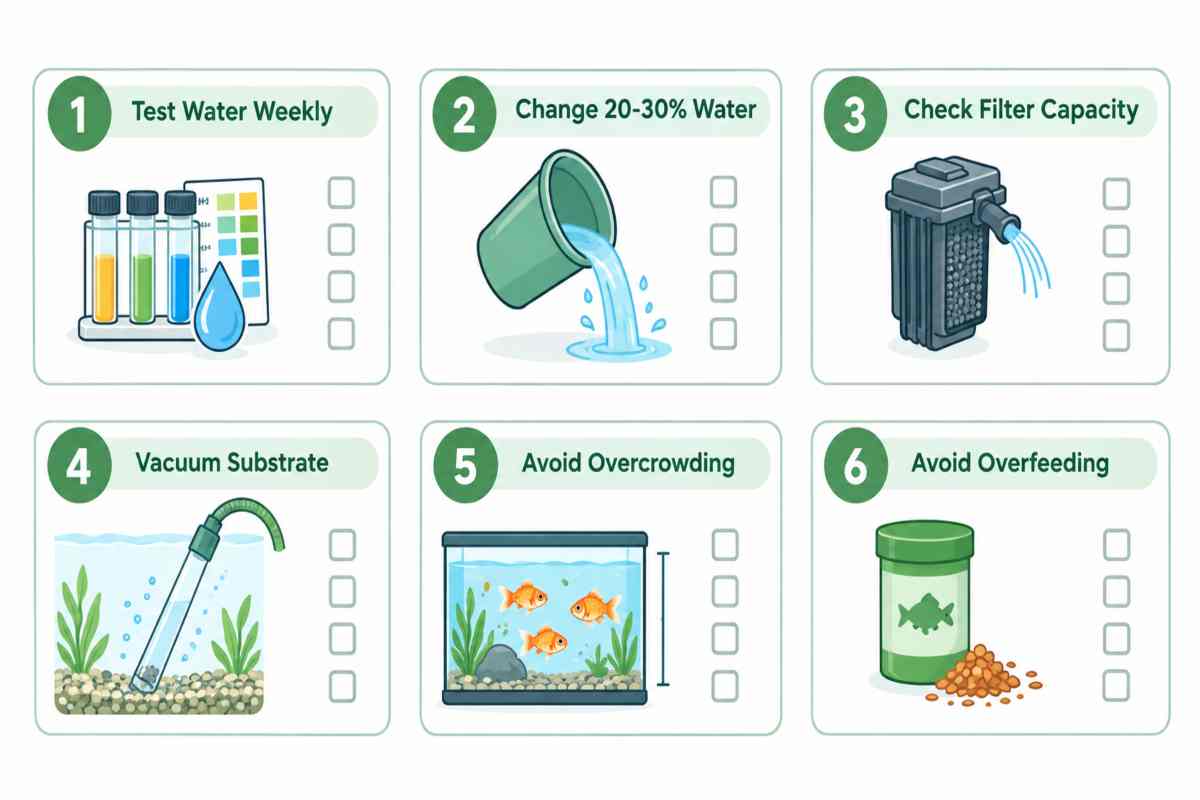 Six weekly steps to keep goldfish tank water quality stable.
When Should I See a Vet or Be Concerned?
Most black discoloration resolves on its own once you correct water quality or the underlying pigment process runs its course. A smaller number of cases need closer attention or a veterinary consult, particularly one from an aquatic veterinarian, since general veterinary practices don’t always have fish-specific experience.
Seek help promptly if black or dark patches appear alongside any of the following: rapid breathing or gasping at the surface, clamped or frayed fins that don’t recover within a few days, visible ulcers, open sores, or cottony growth, loss of appetite lasting more than two to three days, or noticeable lethargy and hiding. These combinations suggest an active infection or ongoing water quality emergency rather than a benign pigment change, and delaying treatment in these cases tends to make recovery harder.
At The Fish Care, we treat sudden color changes like this as a signal worth investigating rather than ignoring, since goldfish often show water quality problems on their skin well before they show them in their behavior.
Frequently Asked Questions (FAQs)
Will my goldfish’s black spots go away on their own?
Often, yes. Genetic pigment shifts, healing scars, and mild black spot disease typically fade or resolve within several weeks to a few months without intervention, as long as water quality stays stable.
Can stress alone turn a goldfish black?
Yes. Physiological stress, whether from a water change, transport, aggressive tankmates, or sudden environmental shifts, can trigger temporary melanocyte activity even without a physical injury.
Is black spot disease contagious to other fish in my tank?
Not directly. The parasite behind black spot disease requires a snail and a bird host to complete its life cycle, so it cannot spread from fish to fish inside a closed aquarium.
Should I remove a goldfish with black spots from my main tank?
Isolation usually isn’t necessary for black spot disease or pigment-related darkening. It matters more if the fish is also showing signs of a bacterial or fungal infection that could spread.
Can I use aquarium salt to treat black discoloration?
Aquarium salt can support slime coat recovery and reduce general stress during treatment for black spot disease or minor burns. Still, it won’t reverse pigment changes caused by genetics or aging, and it isn’t a substitute for correcting water quality.
Do all goldfish turn black as they age?
No, though many common and comet goldfish darken as juveniles before turning orange, and some individuals develop black markings or fade in color later in life. This varies considerably by breed and genetics rather than being universal.