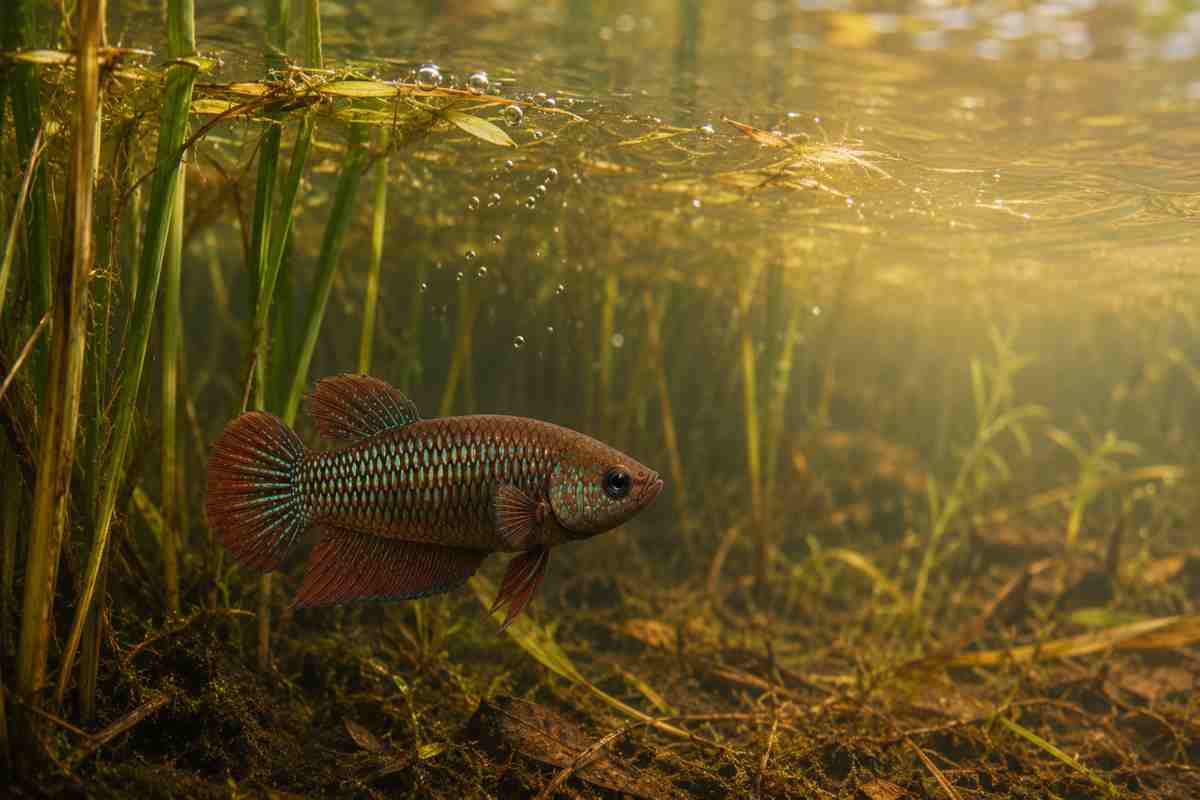
Betta fish (Betta splendens) are native to central Thailand, primarily the Chao Phraya and Mae Klong river basins, and are also found in parts of Cambodia. They inhabit shallow, slow-moving or standing freshwater such as rice paddies, flooded fields, roadside ditches, ponds, marshes, and canals, usually in warm, soft, slightly acidic water surrounded by dense floating vegetation.
That single fact explains almost everything about how bettas behave, breathe, and grow in captivity. The sections below break down exactly what that habitat looks like and why it matters for anyone keeping bettas at home.
Native Range: Which Countries Have Wild Bettas?
Betta splendens, the species most commonly sold as a pet, originated in the lowlands of central Thailand. Its native range centers on the Chao Phraya and Mae Klong river drainages, which cover a large agricultural region including areas around Bangkok, Ayutthaya, and the surrounding provinces.
| Region | Status |
|---|---|
| Central Thailand (Chao Phraya, Mae Klong basins) | Native range |
| Cambodia | Native range, overlapping populations |
| Vietnam, Malaysia, Indonesia | Introduced or naturalized populations, not original native range |
| Global aquarium trade | Farmed and bred, not wild populations |
It’s worth separating “where Betta splendens naturally evolved” from “where betta-type fish exist today.” The genus Betta as a whole is far more widespread, with different species spread across Thailand, Cambodia, Vietnam, Myanmar, Malaysia, Singapore, and the islands of Borneo and Sumatra in Indonesia. The species sold in pet stores worldwide, however, traces back specifically to Thailand’s central lowlands.
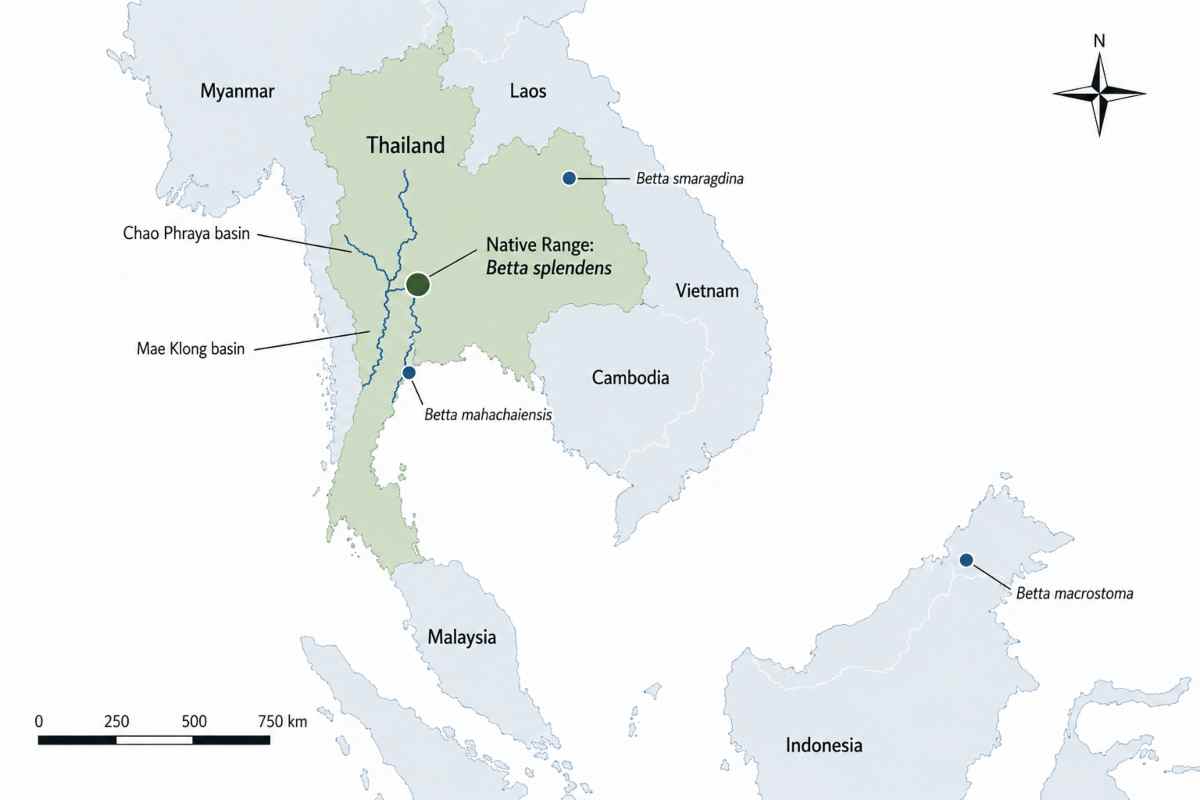 The native range of Betta splendens centers on Thailand’s Chao Phraya and Mae Klong river basins, with related wild species found across the region.
What Their Natural Habitat Actually Looks Like
Wild bettas don’t live in open rivers or lakes. They occupy shallow, quiet freshwater habitats that are easy to overlook because they’re often artificial or seasonal:
- Rice paddies — flooded agricultural fields are one of the most common habitats, especially during the growing season.
- Roadside ditches and irrigation canals — slow-moving channels that connect paddies and drain water across the landscape.
- Marshes and swamps — permanent or semi-permanent wetlands with thick vegetation.
- Ponds and flooded pools — small standing bodies of water, often shaded.
- Slow-moving streams — quiet backwaters rather than fast river channels.
What unites all of these is stillness. Bettas are poor swimmers in fast current because their fins are built for short bursts and hovering, not sustained swimming against flow. This is a key reason still or barely-moving water defines their habitat.
Water Conditions in the Wild
The water bettas evolved in is warm, shallow, soft, and often low in oxygen. This combination shaped much of their physiology, including the labyrinth organ that lets them breathe air directly from the surface.
| Parameter | Typical Wild Range |
|---|---|
| Temperature | 24 to 30°C (75 to 86°F) |
| pH | 6.0 to 7.5, generally soft and slightly acidic |
| Water depth | Often under 30 cm (12 inches), sometimes just a few centimeters |
| Flow | Minimal to none, standing or barely moving water |
| Oxygen level | Frequently low, especially in dense vegetation or during dry periods |
| Vegetation cover | Dense, with floating and emergent plants |
This is why recommended betta care mirrors these numbers closely, favoring warm, stable, softer water over cold or fast-moving conditions, a principle The Fish Care emphasizes throughout its betta care guides.
Related: What Type of Water Do Betta Fish Need
Vegetation and Hiding Places
Dense plant cover is not optional in betta habitat; it’s central to survival. Floating plants like water hyacinth and duckweed shade the water, reduce stress from predators and sunlight, and provide anchor points for bubble nests. Submerged and emergent vegetation, including rice stems themselves, offers cover from birds, larger fish, and other predators.
This vegetation also breaks the water’s surface tension in a way that helps trap the air bubbles bettas use to build their nests, an important detail for understanding wild breeding behavior.
What Wild Bettas Eat
Wild bettas are carnivorous opportunists. Their natural diet consists mostly of:
- Mosquito larvae and other insect larvae
- Small insects that fall onto the water’s surface
- Zooplankton
- Tiny crustaceans
This is very different from the flake or pellet-based feeding most captive bettas receive. Still, it explains why bettas are natural surface feeders with a strong preference for meaty, protein-rich foods over plant matter.
Behavior in Their Natural Environment
Male bettas in the wild are territorial, but not to the same exaggerated degree often assumed from their reputation as “fighting fish.” In open habitats with room to retreat, confrontations are usually brief displays rather than prolonged fights, since the wild environment gives losing fish somewhere to escape to.
Males build bubble nests among floating vegetation, where fertilized eggs are protected until hatching. Females and non-breeding males tend to stay more hidden, using plant cover to avoid both predators and territorial males.
This contrasts with the exaggerated aggression seen in domestic show bettas, which have been selectively bred for fin size and fighting displays under controlled, confined conditions.
Surviving Seasonal Change
Thailand’s wet and dry seasons dramatically reshape betta habitat throughout the year. During the monsoon season, rice paddies and ditches flood, expanding available habitat and connecting previously separate pools. During the dry season, many of these same water bodies shrink or disappear entirely.
Bettas cope with this in two important ways:
- Air breathing. The labyrinth organ allows them to gulp oxygen directly from the air, letting them survive in shallow, oxygen-poor puddles that would suffocate most other fish.
- Tolerating temporary, low-quality water. Wild bettas can survive brief periods in shallow, warm, and even muddy conditions that would stress many aquarium fish, though this is a survival mechanism, not an ideal condition.
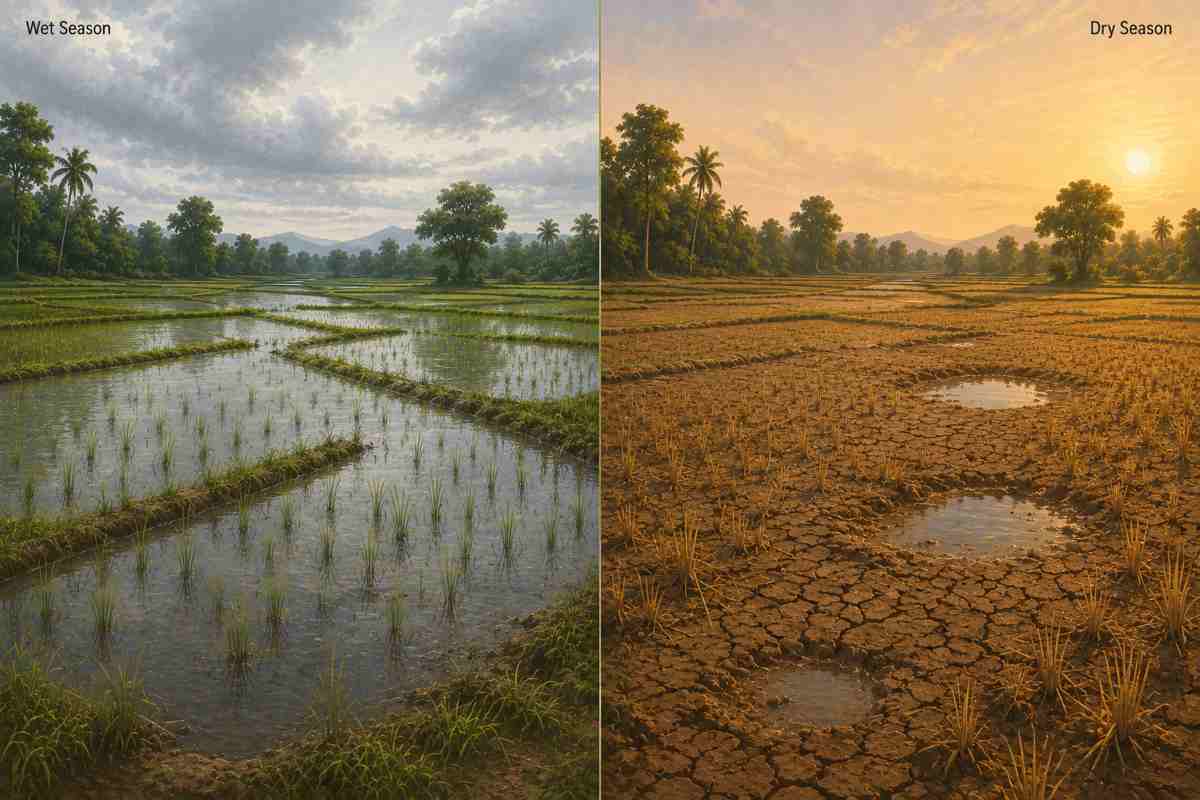 Wild betta habitat shifts dramatically between the connected waterways of wet season and the shrinking pools of dry season.
Wild Bettas vs. Domestic Bettas
The betta sold in pet stores today looks and behaves quite differently from its wild ancestor, mostly due to over a century of selective breeding for color and fin length.
| Trait | Wild Betta | Domestic Betta |
|---|---|---|
| Fin size | Short, functional for swimming and evasion | Long, elaborate, often impairs swimming |
| Coloration | Muted green, brown, or dull red for camouflage | Vivid, saturated colors bred for display |
| Swimming ability | Strong, agile in vegetation and current | Often weaker, especially long-finned varieties |
| Aggression | Territorial but situational, retreat is common | Can be more consistently aggressive, especially in confined spaces |
| Genetic diversity | High, wild populations | Reduced, concentrated in ornamental bloodlines |
| Hardiness | Adapted to fluctuating natural conditions | More sensitive to poor water quality despite hardy reputation |
Readers interested in how these ornamental differences developed can find a full breakdown covering major color and fin varieties elsewhere on the site.
Can Domestic Bettas Survive in the Wild?
Generally, no. Releasing a domestic betta into a natural water source is not a safe or responsible option for several reasons:
- Their oversized fins make sustained swimming and predator evasion difficult.
- They lack the camouflage coloration that protects wild bettas from predators.
- They have been bred for aquarium conditions, not natural fluctuations in temperature, food availability, or water quality.
- In regions outside their native range, released bettas can become an invasive species, competing with or disrupting local ecosystems.
If a betta can no longer be kept, rehoming to another aquarist, a local fish store, or an aquarium club is a far better option than release into any natural body of water.
Other Wild Betta Species and Where They Live
Betta splendens is only one of more than 70 recognized species in the genus Betta, and many others occupy very different habitats across Southeast Asia.
| Species | Native Region | Habitat Type |
|---|---|---|
| Betta splendens | Central Thailand, Cambodia | Rice paddies, ditches, ponds |
| Betta imbellis | Thailand, Malaysia | Shallow ponds and slow streams |
| Betta smaragdina | Northeastern Thailand | Rice paddies and ditches |
| Betta mahachaiensis | Samut Sakhon, Thailand | Brackish-influenced coastal wetlands |
| Betta macrostoma | Brunei, Borneo | Forest streams |
| Betta unimaculata | Borneo | Fast-flowing forest streams, an exception to the typical still-water pattern |
Several Bornean and Sumatran species live in blackwater peat swamp forests, where tannins from decaying leaves stain the water dark and lower the pH to as acidic as 4 to 6, conditions very different from the paddies where Betta splendens is found. This diversity is a large part of why wild betta conservation is such a broad topic on its own.
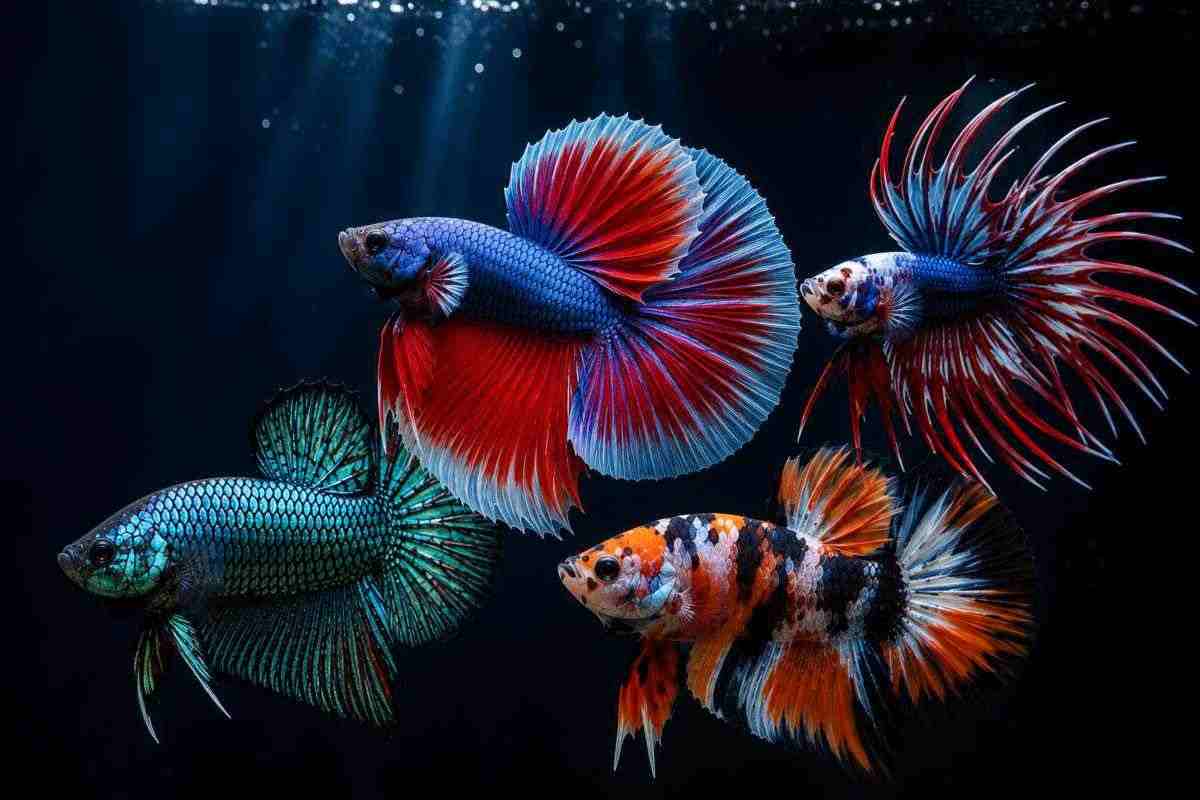
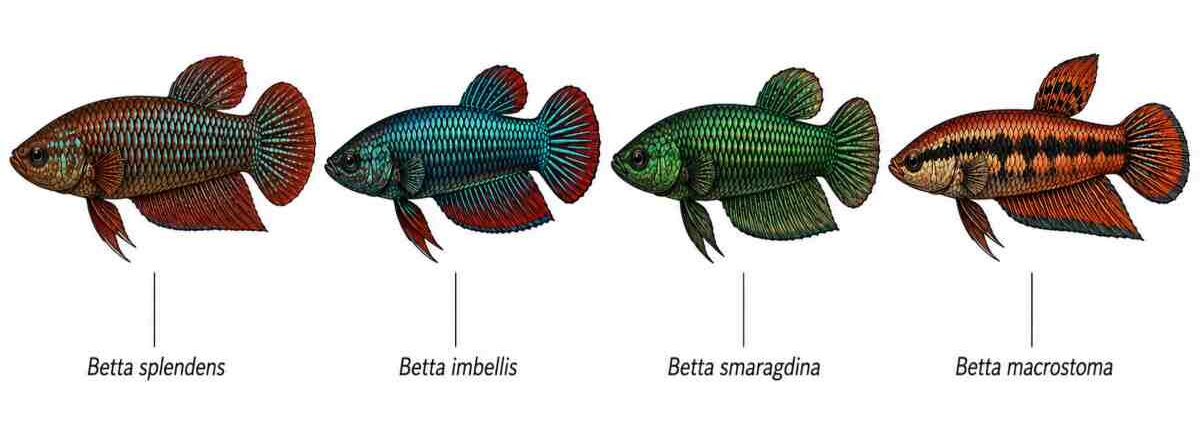 Wild Betta species vary widely in color and pattern, from iridescent blue-green to banded orange, unlike the exaggerated coloring of domestic show bettas.
Applying Wild Habitat Knowledge to Your Aquarium
Understanding natural habitat isn’t just trivia; it directly informs better care. A few practical takeaways:
- Keep water warm and stable, ideally between 24 and 27°C (75 to 80°F).
- Favor soft, slightly acidic to neutral water rather than hard, alkaline water.
- Provide floating plants or gentle surface cover to reduce stress and encourage natural behavior.
- Keep water flow low to moderate, since bettas are not adapted to strong current.
- Avoid assuming labyrinth breathing means bettas don’t need clean, filtered water. It’s a survival adaptation for emergencies, not an ideal living condition.
Readers setting up a new tank with these principles in mind can find a complete walkthrough in a dedicated tank setup guide.
Frequently Asked Questions
Do betta fish live in rivers?
Rarely. Wild bettas favor still or barely-moving water like paddies, ditches, and ponds rather than flowing river channels, since their fins aren’t built for sustained swimming against current.
What is the natural water temperature for betta fish?
Wild betta habitats typically stay between 24 and 30°C (75 to 86°F), reflecting Thailand’s tropical climate.
Related: What Temperature Should Betta Fish Water Be
Are wild bettas the same species sold in pet stores?
Most pet store bettas are Betta splendens, the same species found in the wild, but generations of selective breeding for color and fin length have made them look and behave quite differently from their wild ancestors.
Can you find wild bettas outside Thailand and Cambodia?
Betta splendens is native mainly to central Thailand and Cambodia, though other Betta species occur naturally across Malaysia, Indonesia, Vietnam, and Myanmar.
Why do wild bettas need to breathe air?
Their natural habitats often have low oxygen levels, especially in shallow, vegetation-choked, or seasonal water. The labyrinth organ lets them supplement gill breathing with atmospheric air, an adaptation for survival rather than a sign they don’t need oxygenated water.
References
- IUCN Red List of Threatened Species, Betta splendens assessment: https://www.iucnredlist.org/
- FishBase, species profile for Betta splendens: https://www.fishbase.se/