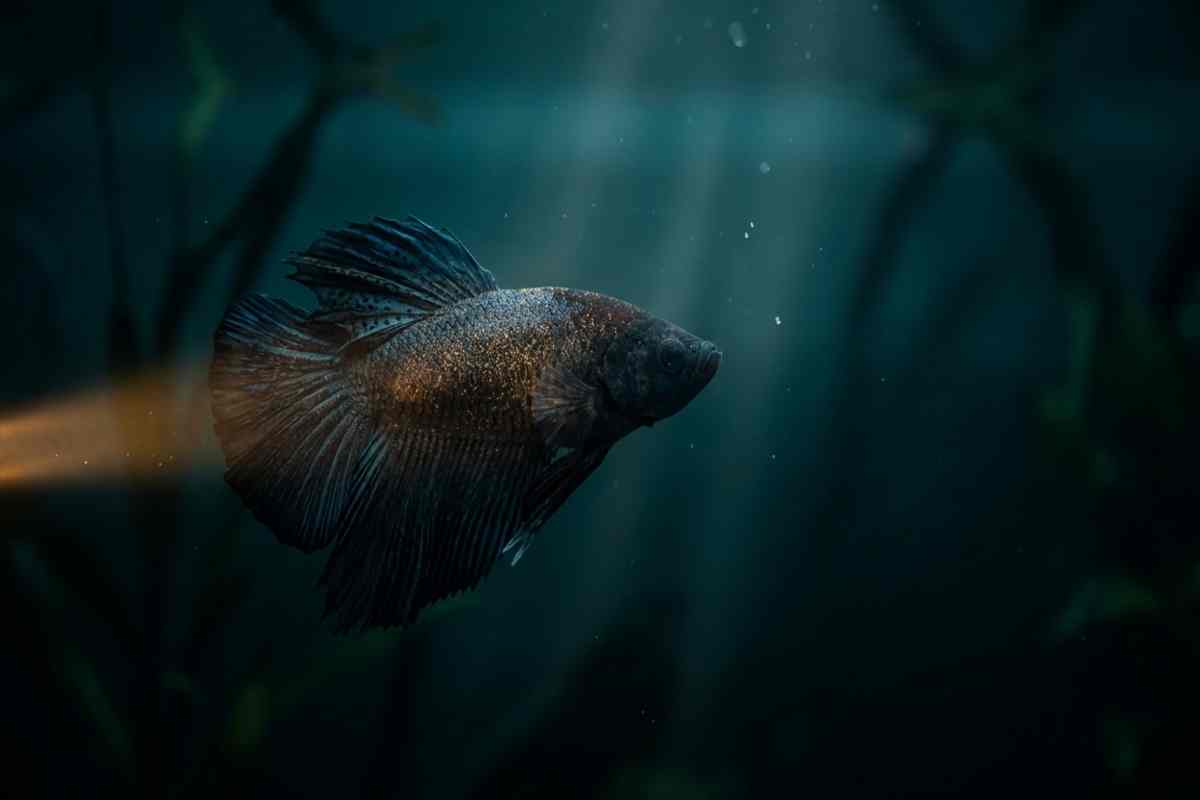
Velvet disease (also called gold dust or rust disease) is a parasitic infection caused by tiny dinoflagellates, Piscinoodinium in freshwater and Amyloodinium in saltwater. It looks like a fine golden or rusty dust on the skin, but early warning signs often include flashing, clamped fins, and fast gill movement.
Key Takeaways
- Know the cause: Parasitic dinoflagellates cause velvet, and the responsible species differs between freshwater and saltwater systems.
- Look beyond the dust: Flashing, clamped fins, and rapid gill movement may appear before the characteristic dusty appearance.
- Act the same day: Velvet can progress quickly, so prompt treatment is important when the disease is suspected.
- Use copper carefully: Copper-based medication is commonly used for velvet, but the concentration should be monitored with an appropriate copper test kit throughout treatment.
- Don’t just move the fish: The parasite can remain in the aquarium environment, so address the display tank or maintain an appropriate fishless period to help prevent reinfection.
Velvet is one of the most dangerous parasitic diseases in home aquariums. It moves faster than ich, hides in the gills, and is easy to misdiagnose. The good news: if you catch it early and follow the full treatment course, many fish recover.
This guide covers how to recognize it, how the parasite actually lives, what to do in the first 24 hours, how to treat it safely, and which fish and tank inhabitants are at risk from the medication.
What Is Velvet Disease?
Velvet disease is an infection of the skin, fins, and gills by parasitic dinoflagellates. These are single-celled organisms related to the algae that live inside corals. The disease takes its name from the velvety, dust-like sheen the parasites create on the fish’s body.
You will see it called by several names, and they all point to the same problem:
- Gold dust disease and rust disease, the common hobbyist names for the golden-yellow or rusty coating
- Oodiniosis, the veterinary term, from the old genus name Oodinium
- Freshwater velvet, caused by Piscinoodinium species (mainly P. pillulare)
- Marine velvet, caused by Amyloodinium ocellatum in saltwater and brackish systems
The older name Oodinium is still widely used online, but current science separates the freshwater and marine parasites. A molecular study in the Journal of Parasitology found that the two groups are only distantly related and evolved fish parasitism independently. They look and behave alike, but they are not the same organism.
-
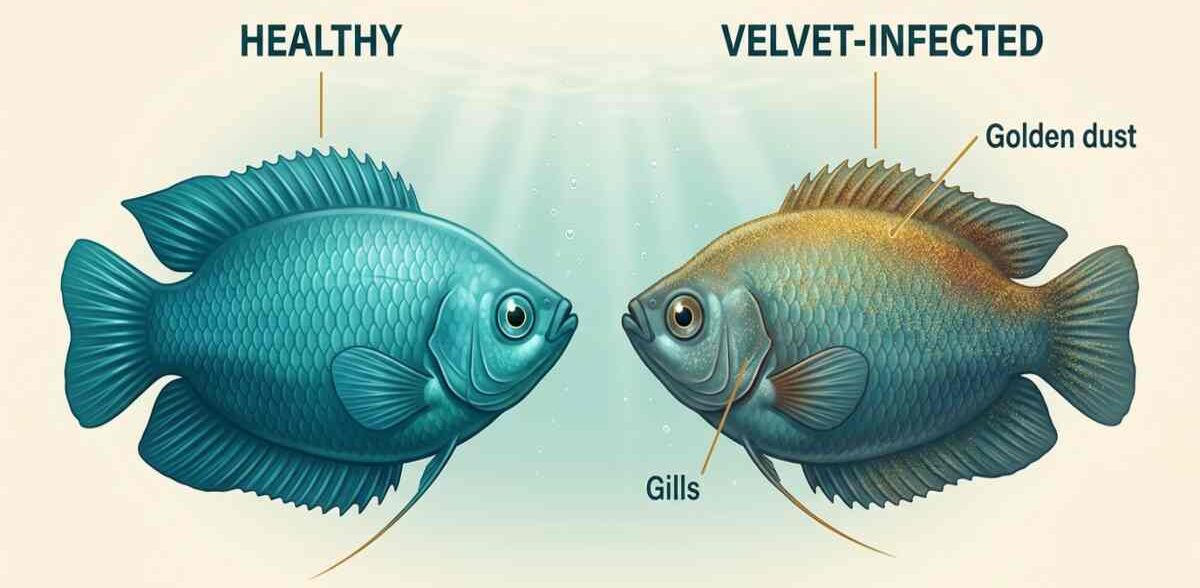
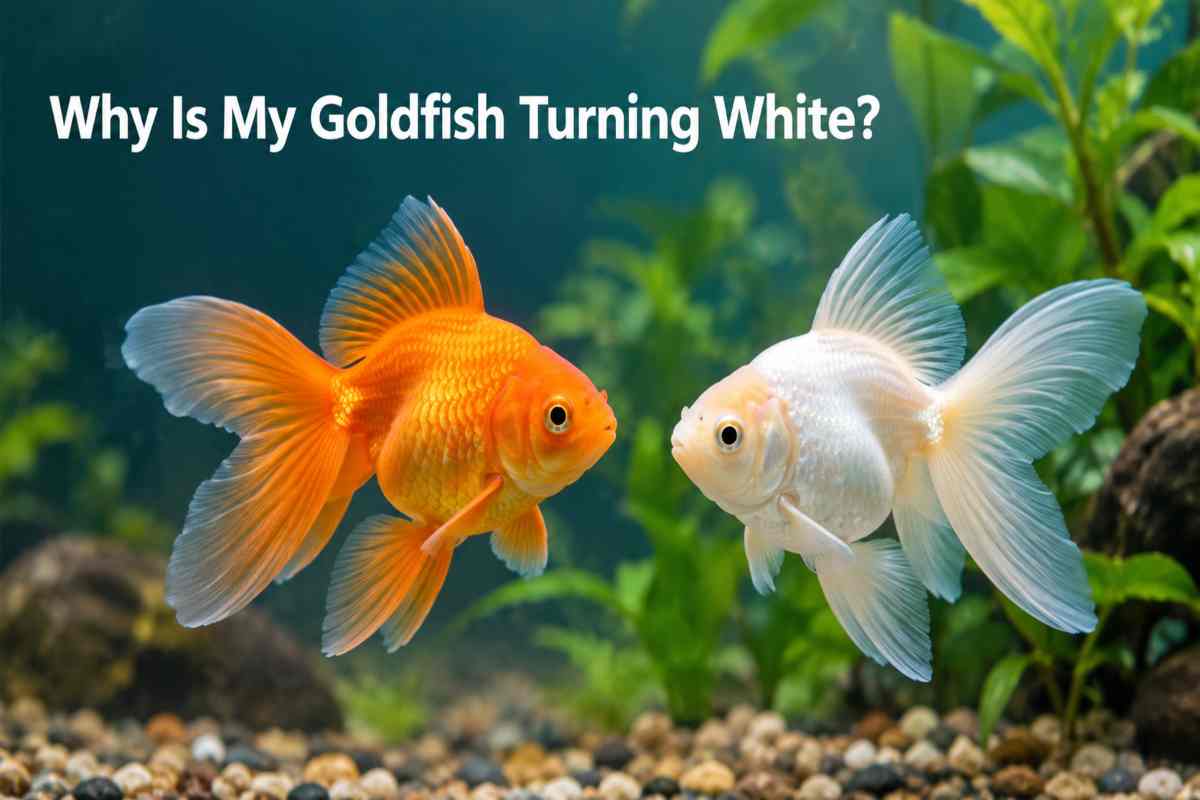
Healthy fish (left) vs. velvet disease (right): look for fine golden dust. Healthy fish (left) vs. velvet disease (right): look for fine golden dust.
Velvet Disease Symptoms: What to Look For
Many guides tell you to look for gold dust and stop there. That is a mistake, because the gills are often hit early, and by the time dust is visible, the infection may already be heavy.
Early signs (before you see any dust)
- Flashing: the fish scratches its sides against decorations, gravel, or the substrate. This is the classic first sign of skin irritation.
- Clamped fins: fins held tight against the body.
- Rapid gilling: gill covers moving faster than normal.
- Lethargy and reduced appetite: the fish hangs near the surface or hides.
Visible signs
- A fine, dusty coating that looks gold, yellow, or rust-colored, usually starting on the back, dorsal fin, and tail
- Dull color and a cloudy or “peeling” look to the skin as the infection spreads
- Gasping at the surface, a sign of advanced gill damage and oxygen shortage
How to spot velvet in a dark-colored fish
Dark fish hide the dust well. Turn off the room lights, then shine a flashlight across the fish’s body from the side at a low angle. Velvet shows up as a faint, uniform shimmer, as if the fish has been lightly sprinkled with powder. Check from several angles, because the coating can look like nothing at all in direct light.
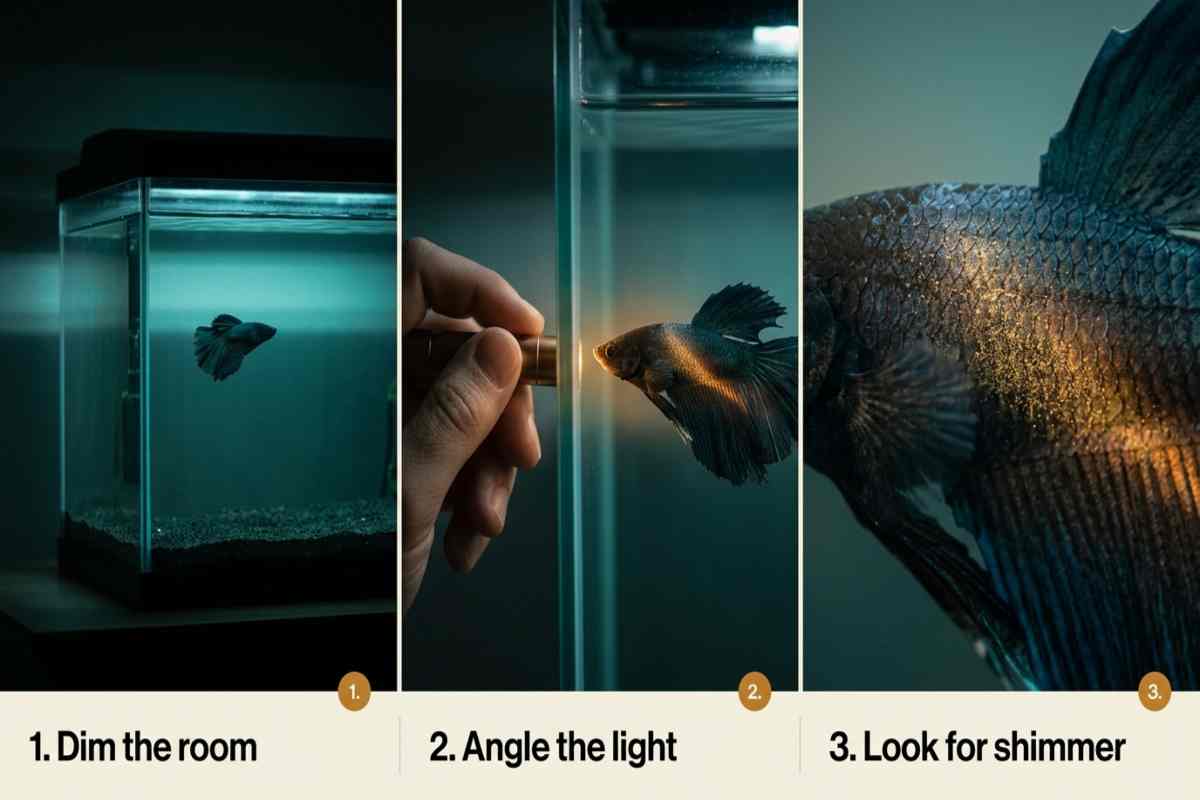 Shine a flashlight at a low angle in a dark room to reveal velvet’s faint golden shimmer.
Velvet vs. Ich: How to Tell the Difference
This is the most common diagnostic mistake, and it matters because the two diseases respond to different strategies. A ciliate, Ichthyophthirius multifiliis, causes ich (white spot disease). A dinoflagellate causes velvet.
| Feature | Velvet | Ich (White Spot) |
|---|---|---|
| Appearance | Fine dust or blanket, gold, yellow, or rust | Distinct, raised white spots like grains of salt |
| Spot Size | Tiny, well under 1 mm, often hard to see individually | Larger, around 0.5–1 mm, easy to count |
| Where It Starts | Often the gills, then back, dorsal fin, and tail | Body and fins, with the gills affected in later stages |
| Best Way to See It | Flashlight at a low angle in a dark room | Usually visible in normal light |
| Speed | Fast; small fish and fry can die within days | Dangerous, but usually slower |
| Typical Response | Copper-based medication is a standard treatment approach | May respond to heat, salt, and standard ich medications |
| Cause | Dinoflagellate (Piscinoodinium) | Ciliate (Ichthyophthirius multifiliis) |
A fish can carry both at once, which is another reason to treat promptly rather than guess. A skin scrape or gill clip examined under a microscope by an aquatic vet is the only way to confirm for certain.
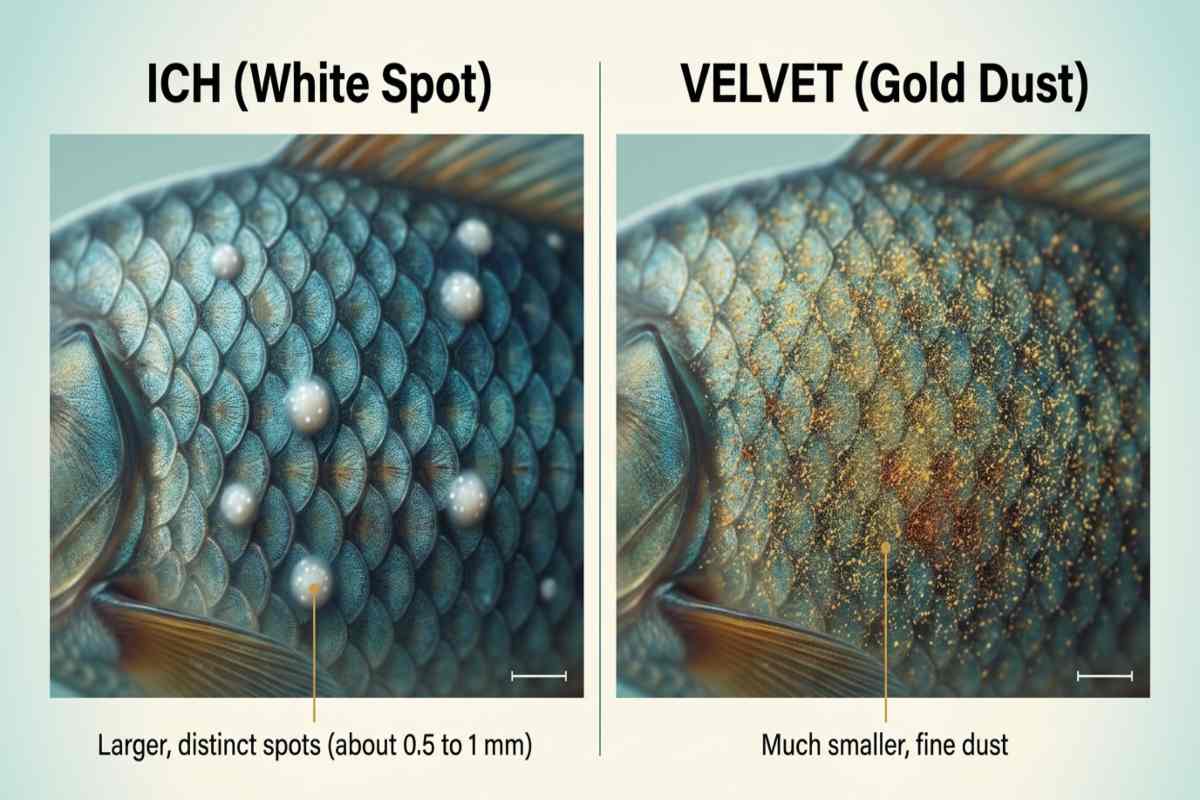 Ich shows as distinct white spots, while velvet looks like fine golden dust.
The Velvet Life Cycle (Why Treatment Takes So Long)
Understanding the life cycle explains the most important rule of velvet treatment: medication works only on part of the cycle, so you must treat long enough to catch every generation.
| Stage | What Happens | Can Medication Reach It? |
|---|---|---|
| Trophont | The feeding stage. It attaches to the skin or gills with root-like anchors and feeds on host cells. | Poorly. It is embedded in tissue. |
| Tomont | The mature parasite drops off the fish, forms a protective cyst, and divides repeatedly. | No. It is encysted, usually on the substrate or decor. |
| Dinospore | The free-swimming stage released from the cyst. It must find a fish to continue its life cycle. | Yes. This is the stage medication is aimed at. |
| Back to Trophont | A dinospore that finds a host attaches to it and starts feeding. | Only while it is still a free swimmer. |
Dinospores are short-lived. In warm water, they generally need to find a host within about one to two days. Because cysts hatch over several days rather than all at once, a short course of medication leaves survivors behind. That is why treatment runs for weeks, not days.
Two other facts shape your strategy:
- Temperature speeds the cycle. Warmer water means faster development, so parasites emerge and meet the medication sooner. Cooler water slows everything down and stretches the problem out.
- Freshwater velvet is partly photosynthetic. The parasite contains chloroplasts, which is why many aquarists dim or turn off the lights during treatment. Once a heavy infection is established, the parasite feeds mainly on the fish, so darkness supports recovery but isn’t a cure on its own.
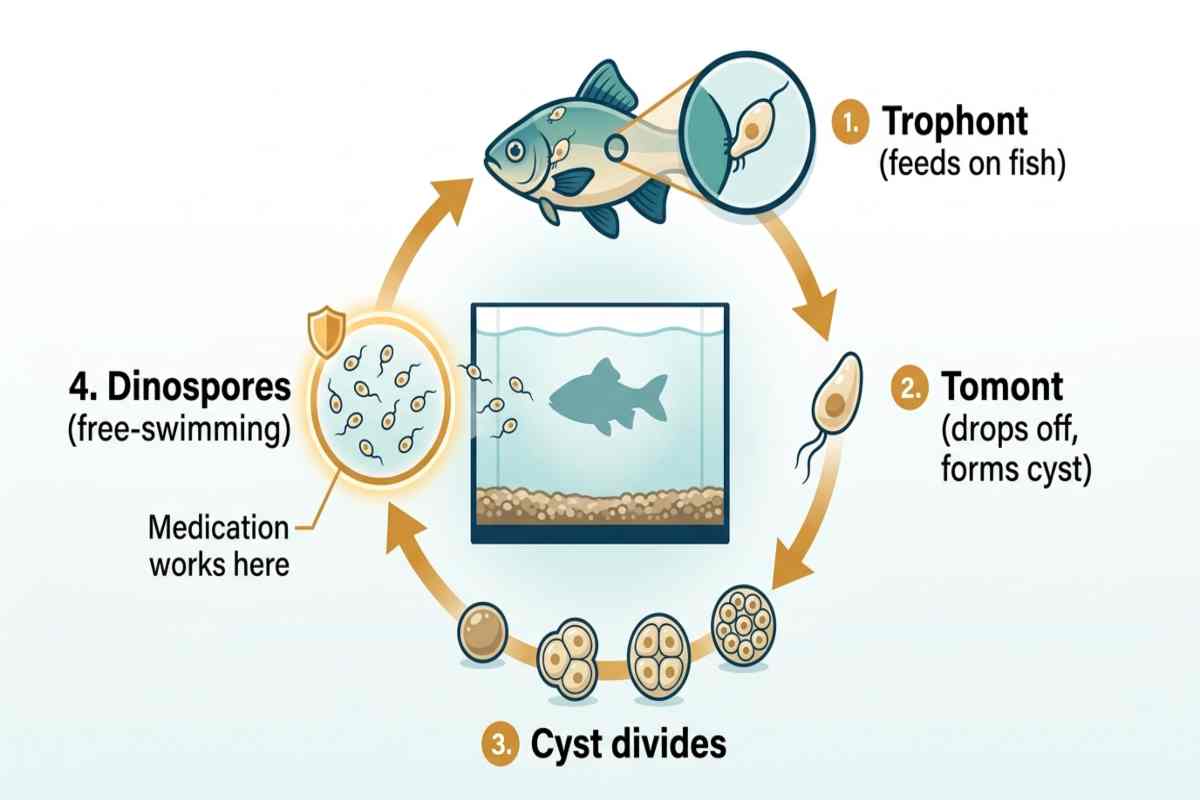 Medication only reaches velvet’s free-swimming dinospore stage, which is why treatment lasts weeks.
What Causes Velvet Disease?
The parasite has to be introduced. Stress and poor water quality do not create velvet out of nothing, but they make the infection much harder for your fish to fight off.
Common ways it enters a tank:
- New fish added without quarantine (the most common route)
- Water, nets, or equipment moved from an infected tank
- Plants or decorations from an infected system, since cysts can sit on surfaces
- Heavily traded or stressed stock that has been through rough transport
What makes outbreaks worse:
- Sudden temperature drops. A published outbreak report in an endangered barb species notes that a sudden fall in water temperature has been linked to outbreaks.
- Overcrowding and weak filtration
- Poor water quality, including ammonia, nitrite, and heavy waste build-up
- Weakened immunity from transport, bullying, or poor diet
Most freshwater fish can be affected, but small, active, warm-water species are hit hardest. Bettas, gouramis, killifish, small tetras, barbs, danios, and cichlids are commonly reported. Fish that recover from an outbreak can gain some resistance, as described in FAO fish parasite research, but don’t count on it to protect them from a new introduction.
Is Velvet Contagious? Can It Spread to Humans?
Yes, it spreads easily between fish. The free-swimming dinospores move through the water and attach to any susceptible tank mate. Cysts on gravel, plants, and decor keep reseeding the tank. By the time one fish looks sick, every fish in the tank has usually been exposed.
No, it does not infect people. Velvet is a fish parasite. Wash your hands and disinfect equipment between tanks to stop it spreading to other aquariums, not to protect yourself.
How long can velvet survive without a fish? Dinospores usually last only a day or two without a host. Encysted tomonts take longer to work through their cycle. That is why a fishless fallow period (see below) works.
How to Treat Velvet Disease in Freshwater Fish
Treat the same day you suspect it. Waiting for “more proof” costs fish.
Step 1: Move fish to a hospital tank (and understand its limits)
A bare hospital tank with a heater, an air stone, a cycled filter or frequent water changes, and a few hiding places makes treatment easier and protects sensitive tank mates. If you are setting up a quarantine tank for the first time, keep it simple and bare so you can see the fish and clean it easily.
But moving fish does not clear the display tank. Cysts and free-swimming dinospores stay behind, so either:
- Treat the whole display tank (only if everything in it tolerates the medication), or
- Leave the display fishless (fallow) for at least four weeks while you treat the fish elsewhere. Many keepers use six weeks to be safe, because the extra time costs nothing.
Step 2: Remove activated carbon
Activated carbon pulls medication out of the water. Take it out of every filter before you start. You can restore it after the full course.
Step 3: Dose with copper
Copper-based medication is the standard treatment for freshwater velvet, and the Merck Veterinary Manual’s table of protistan fish parasites lists copper sulfate for Piscinoodinium. Copper is toxic, so precision matters:
- Follow the product label exactly, and use a copper test kit made for that product type (chelated and ionic copper are measured differently).
- Know your water. Copper is more toxic in soft, low-alkalinity water, so measure alkalinity and hardness first. Never guess a dose.
- Maintain the level. Water changes remove copper, so retest and re-dose to keep it in the therapeutic range for the full course.
- Do not mix copper with other medications unless the label says it is safe.
Step 4: Add supportive measures
- Raise the temperature gradually to the upper end of what your species tolerates (for many tropical fish, about 28 °C / 82 °F). This speeds the life cycle so more parasites meet the medication. Add strong aeration, because warm water holds less oxygen. Do not push coolwater fish such as goldfish beyond their comfort range.
- Dim or turn off the lights if you have no live plants. Fish eat fine in low light.
- Add aquarium salt for tolerant species, commonly 1 to 3 g per liter. Salt alone rarely cures velvet, but it can reduce osmotic stress and help the fish cope. Skip or reduce it for scaleless fish and salt-sensitive species.
- Keep water pristine. Change water on schedule (re-dosing copper afterward), vacuum the substrate to remove cysts, and keep ammonia and nitrite at zero.
Step 5: Keep treating long enough
Run the full course, usually 10 to 14 days at minimum, and continue for several days after the last visible sign disappears. Stopping when the dust fades is the classic cause of relapse, because cysts are still hatching.
Realistic treatment timeline
| Time | What to Expect |
|---|---|
| Day 0 | Hospital tank ready, carbon removed, medication started, and lights dimmed. |
| Days 1 to 3 | Fish may remain lethargic. Watch breathing closely. |
| Days 4 to 7 | Flashing and gilling should begin to ease. Appetite returns in many fish. |
| Days 8 to 14 | Visible dust is gone. Keep dosing and testing copper. |
| After Treatment | Run fresh carbon, perform water changes, and observe for relapse for at least a week or two. |
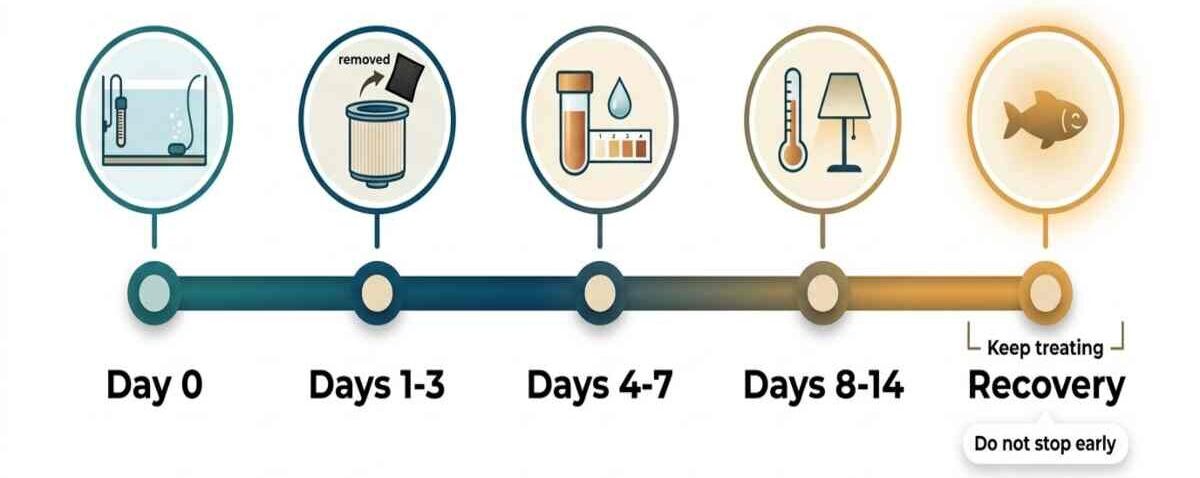 Treat for at least 10 to 14 days and keep going after the dust disappears.
Which Fish and Tank Inhabitants Can’t Handle Copper?
Copper is the usual treatment, but it can kill the wrong animals. Check this before you dose.
| At Risk | Why | What to Do |
|---|---|---|
| Snails, shrimp, crabs, and other invertebrates | Copper is highly toxic to them. | Treat fish in a separate tank. Do not dose a tank holding invertebrates. |
| Live Plants | Some plants can be damaged or stressed by copper. | Remove plants or treat the fish in a bare tank. |
| Scaleless Fish (many catfish, loaches, some eels) | They may be more sensitive to copper, salt, and some medications. | Dose conservatively, watch closely, and consult an aquatic veterinarian if unsure. |
| Fry and Juveniles | Smaller bodies may have less tolerance for medications. | Use extra caution and test medication levels frequently. |
| Corals and Reef Invertebrates | They are extremely sensitive to copper. | Never dose a reef display. Use a separate hospital tank. |
For sensitive species, an aquatic veterinarian can suggest alternatives. Other medications exist, but they carry their own risks, so do not substitute without advice.
-
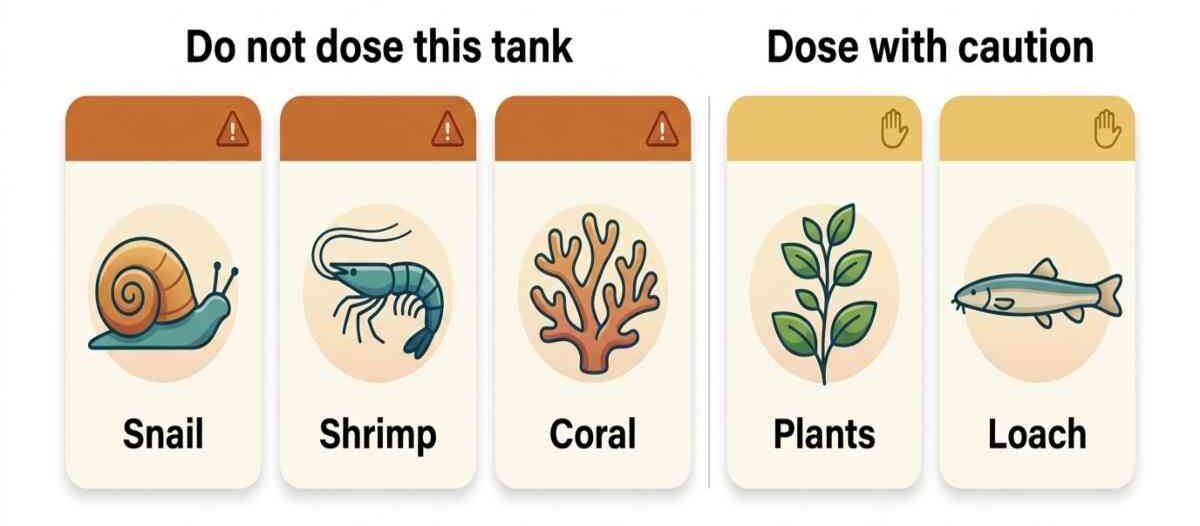
Copper can harm snails, shrimp, and corals, and some plants and scaleless fish need caution. Copper can harm snails, shrimp, and corals, and some plants and scaleless fish need caution.
Freshwater Dips and Salt Baths: Do They Work?
You will see “freshwater dip” recommended for velvet. That advice comes from marine fish, where a short bath in fresh water causes osmotic shock to the parasites on a saltwater fish (the Merck table above lists freshwater dips for marine food fish). It does not translate to freshwater fish, which already live in fresh water.
The reverse, a brief salt bath, is a technique used in fish farming, but it is stressful and risky for sick, weak, or scaleless fish. For most home aquarists, a hospital tank, copper, and warm, aerated water are safer.
Marine Velvet vs. Freshwater Velvet
| Feature | Freshwater Velvet | Marine Velvet |
|---|---|---|
| Parasite | Piscinoodinium (mainly P. pillulare) | Amyloodinium ocellatum |
| Where | Freshwater aquariums | Saltwater and brackish systems |
| Severity | Serious, especially for small fish and fry | Generally described as more aggressive by the Southern Regional Aquaculture Center |
| Early Signs | Flashing, clamped fins, and rapid gilling | Rapid breathing, flashing, faded color, and fine dusting |
| Treatment Approach | Copper, heat, and a hospital tank | Copper or other marine-specific treatments, plus a hospital tank |
| Special Concern | Plants, snails, and shrimp | Corals and all reef invertebrates |
If you keep a reef tank, the key rule is the same: treat fish in a separate hospital tank and never put copper in the display.
When Treatment Fails, or the Fish Is Not Recovering
If a fish keeps gasping at the surface, refuses food for many days, and does not improve after several days of correct treatment, severe gill damage is the likely cause. Gills that have lost too much tissue cannot supply enough oxygen, and no medication reverses that.
First check the basics: copper level, oxygen, temperature, water quality, and whether the diagnosis was right. If a fish is clearly suffering and has no realistic chance of recovery, humane euthanasia is the kind option. An aquatic veterinarian can perform it, and some hobbyists use a carefully prepared clove oil overdose. Remove dying fish promptly, as dead fish can release more parasites.
How to Prevent Velvet Disease
- Quarantine every new fish for four weeks. Use a separate tank and watch for flashing, clamped fins, and dust using the flashlight test. This is the habit we push hardest here at The Fish Care, because it prevents most outbreaks.
- Never share nets, buckets, or siphons between tanks without disinfecting them.
- Keep temperature stable. Avoid sudden drops from power cuts or cold water changes.
- Do not overstock, and maintain strong filtration and regular water changes.
- Feed a varied, high-quality diet to support immune health.
- Buy from sellers who quarantine their stock, and avoid tanks with visibly sick fish.
Quick checklist: if you suspect velvet today
- Do the flashlight test in a dark room
- Compare against the ich vs. velvet table
- Set up a hospital tank
- Remove activated carbon
- Check for invertebrates, plants, and scaleless fish
- Test hardness and alkalinity, then dose copper per the label
- Raise temperature gently and add aeration
- Dim the lights
- Treat for 10 to 14 days minimum, then fallow the display tank for four weeks
Common Mistakes That Cause Relapses
- Stopping when the dust disappears. Cysts are still hatching.
- Treating only the fish in the hospital tank and putting them straight back into an untreated display.
- Forgetting to remove carbon, which neutralizes the medication.
- Dosing without a copper test kit, which risks under-dosing (no effect) or overdosing (dead fish).
- Mistaking velvet for ich and relying on heat and salt alone.
- Adding new fish too soon after an outbreak.
Final Thoughts
Velvet punishes hesitation. The fish that survive are usually the ones whose owners noticed flashing early, ran a flashlight over the tank, treated the same day, and kept going past the point where the dust disappeared.
Keep three rules in mind: treat fast, treat long, and deal with the display tank, not just the fish. If you remember only one prevention habit, make it quarantine—a month in a bare tank costs very little compared with losing a whole community. For more help with parasites and illness, The Fish Care’s disease guides cover the problems most likely to show up next.
Frequently Asked Questions
How do I treat velvet disease in freshwater fish?
Use a hospital tank, remove carbon, dose a copper-based medication according to the label while testing copper levels, raise the temperature gently, add aeration, and dim the lights. Continue for at least 10 to 14 days, then leave the display tank fishless for about four weeks.
What is the best medication for fish velvet?
Copper-based medications are the standard choice, and the Merck Veterinary Manual lists copper sulfate as the treatment for Piscinoodinium. Products vary by brand and copper form, so always follow the label and use a matching test kit. For copper-sensitive fish, ask an aquatic vet.
Can velvet disease kill fish?
Yes. It can kill small fish and fry within days, mostly through gill damage and secondary infections. Early treatment greatly improves survival.
Why is my fish flashing or scratching against decorations?
Flashing signals skin or gill irritation. Velvet is one cause, but flashing also occurs with other parasites, poor water quality, and ich. Check water parameters, look closely with a flashlight, and treat if you see dust.
Can salt cure velvet?
Salt alone rarely cures it. It can help tolerant fish as a supportive measure, but copper is the primary treatment, and some species cannot handle salt.
How long does velvet last in a tank?
Dinospores die within a day or two without a host, but the full life cycle spans several days to weeks. Treat for at least 10 to 14 days, and keep the display fishless for four weeks if you moved the fish.
Can bettas get velvet?
Yes. Bettas and other labyrinth fish are frequently affected. Their small size and delicate gills make early treatment especially important.
Is velvet contagious to other tank mates?
Yes. Assume every fish in the tank has been exposed and treat the whole group.
What are the early signs of marine velvet in reef tanks?
Rapid breathing, flashing against rocks, faded color, and a faint dusty or cloudy look on the fins and body. Isolate affected fish in a hospital tank rather than dosing the display.
Is velvet the same as ich?
No. Ich shows as distinct white spots and is caused by a ciliate. Velvet appears as a fine golden or rust-colored dust and is caused by a dinoflagellate.