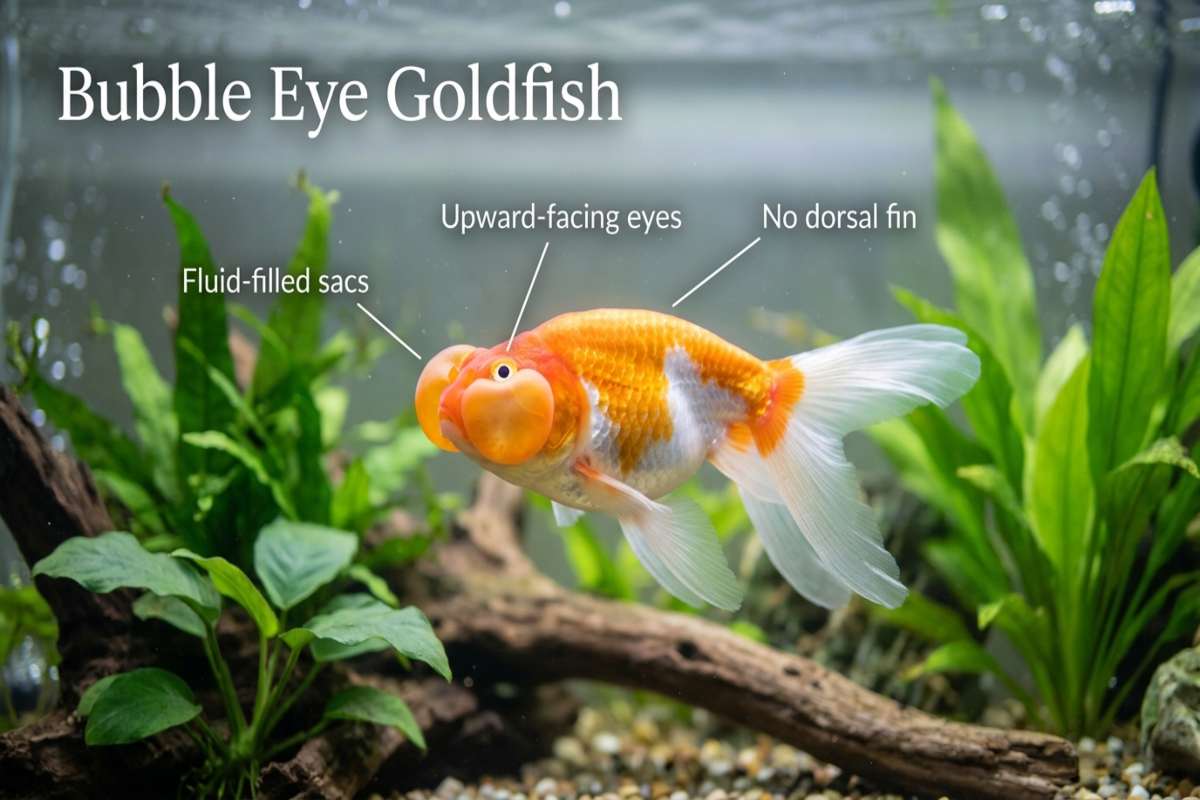
A bubble eye goldfish needs at least a 20-gallon (75-liter) tank for one fish, cool water between 65°F and 72°F (18°C to 22°C), a diet of soaked sinking pellets and gel food, and a tank with nothing sharp or rough that could tear the fluid-filled sacs under its eyes. With that setup, it can live 10 to 15 years, although many live far shorter lives because the sacs are easily injured and infected.
This is a rewarding fancy goldfish, but it is also one of the most delicate. Good care comes back to one idea: protect the sacs, keep the water spotless, and make feeding easy for a fish that cannot see well.
Key Takeaways
- Start with 20 gallons for one bubble eye and add about 10 gallons for each extra fancy goldfish.
- Use a gentle sponge filter, smooth decor, and silk or live plants. Rigid plastic plants, jagged rock, and high-suction intakes are the main causes of torn sacs.
- Keep ammonia and nitrite at zero, nitrate under 20 ppm, and temperature steady at 65°F to 72°F.
- Feed soaked sinking pellets and gel food in small portions, and make sure the fish actually finds the food.
- House bubble eyes alone or with equally slow fancy goldfish. Never keep them with fast or nippy fish.
What Is a Bubble Eye Goldfish?
The bubble eye is a fancy goldfish (Carassius auratus) bred in China, and it looks unlike almost any other variety. Its eyes point upward, and a thin-walled sac filled with fluid hangs beneath each one. The sacs wobble as the fish swims, which is where the name comes from.
Three traits shape how you care for it:
- Fluid-filled sacs. They are fragile, soft tissue, not air bubbles. A scrape or puncture can tear the skin and let bacteria in.
- No dorsal fin. Without a back fin, the fish swims slowly and is less stable, especially when the sacs are large.
- Upward-pointing eyes. The fish sees mostly what is above it, so it finds food by smell and by luck.
The sacs usually become noticeable as the fish grows and keep developing over the first year or so. They are never perfectly even in every fish, and slight asymmetry on its own is not a sign of illness.
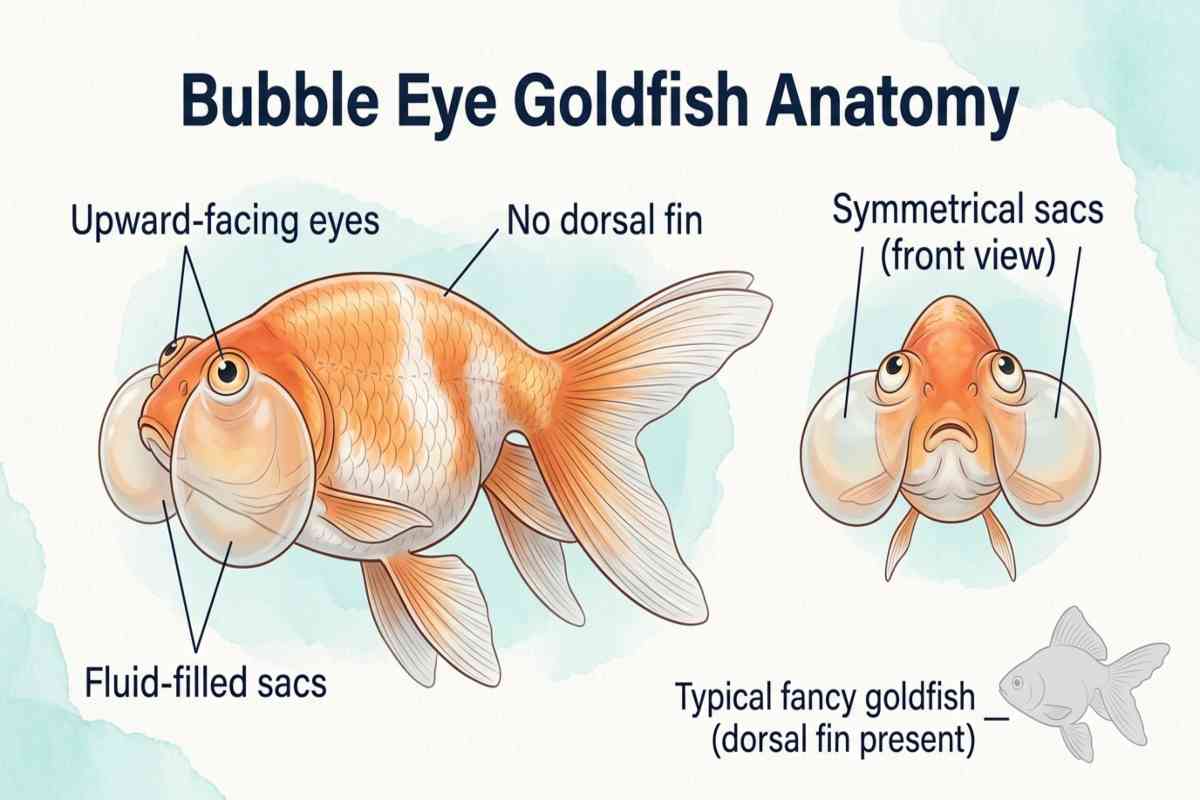 Unlike other fancy goldfish, the bubble eye has no dorsal fin and carries delicate fluid sacs under its eyes.
How Big Does a Bubble Eye Goldfish Get, and How Long Does It Live?
Most bubble eyes reach about 4 to 6 inches (10 to 15 cm) in body length, and some grow a little larger in roomy tanks. That is smaller than single-tailed goldfish, but they are still heavy waste producers for their size.
With excellent care, a lifespan of 10 to 15 years is realistic. In practice, many fish die earlier because of sac infections, poor water quality, or digestive problems. Lifespan depends far more on setup and water quality than on genetics alone.
| Care Factor | Bubble Eye Goldfish |
|---|---|
| Adult size | About 4 to 6 inches (10 to 15 cm) |
| Lifespan | Up to 10 to 15 years with good care |
| Minimum tank | 20 gallons (75 liters) for one fish |
| Temperature | 65°F to 72°F (18°C to 22°C) |
| pH | 7.0 to 7.5 |
| Diet | Sinking pellets, gel food, blanched greens |
| Temperament | Peaceful, slow, easily outcompeted |
How Big of a Tank Does a Bubble Eye Goldfish Need?
Plan on 20 gallons for the first fish, plus about 10 more gallons for each fancy goldfish you add. Goldfish eat a lot and produce a lot of waste, so more water helps keep ammonia and nitrate levels stable.
Tank shape matters too. A long tank with a wide footprint gives a slow swimmer room to move without constantly rising to the surface. Keep water depth moderate, since a weak swimmer with heavy sacs tires more easily in very tall tanks. Goldfish are not suited to bowls. Our guide to goldfish tank setup covers the general principles that apply here too.
What Should Go Inside a Bubble Eye Tank, and What Should Stay Out?
The safest bubble eye tank is also the plainest one. Anything the fish can bump into should be smooth, soft, or absent.
Which Substrate Is Safest?
A bare bottom is the lowest-risk choice because the sacs have nothing to drag across. Fine, smooth sand is a reasonable alternative if you want a more natural look. Avoid coarse or sharp gravel, which can scrape the sacs and also get swallowed.
Which Plants and Decorations Are Safe?
Choose silk plants, live plants such as anubias or java fern, and smooth resin or ceramic decor. Avoid stiff plastic plants, jagged rocks, rough driftwood branches, and narrow caves where fish can wedge themselves.
Use the nylon test on anything new. Run a piece of pantyhose over every surface and edge. If the fabric snags, the item can tear a sac and should stay out of the tank.
What Kind of Filter Is Best?
A sponge filter driven by an air pump is ideal. It provides gentle mechanical and biological filtration, adds oxygen, and has no strong suction. If you use a hang-on-back or canister filter, cover the intake with a fine sponge pre-filter and keep the outflow soft.
How Should You Handle a Bubble Eye?
Avoid nets. They snag on the sacs. Instead, guide the fish into a smooth container and move it as little as possible.
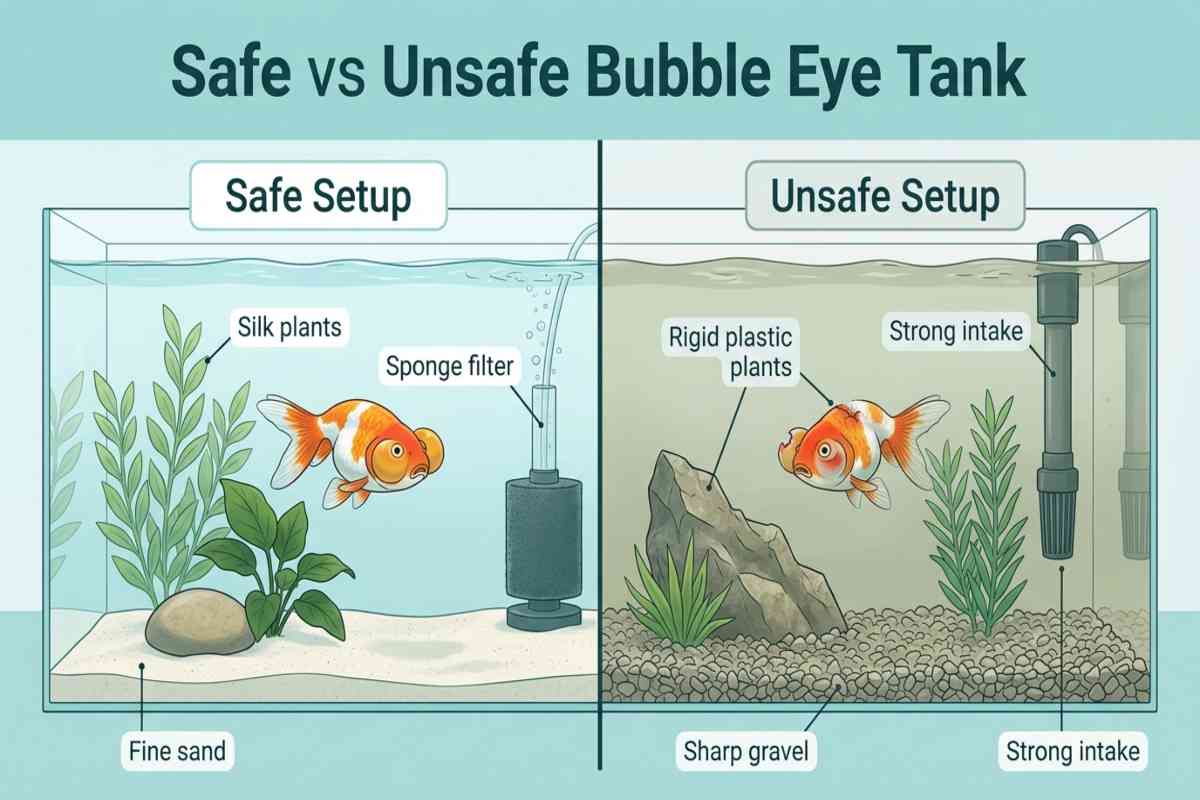 Smooth decor and a gentle sponge filter protect delicate sacs, while sharp gravel, rigid plants, and strong intakes put them at risk.
What Water Parameters Do Bubble Eye Goldfish Need?
Goldfish are cold-water fish, and fancy varieties do best in the cooler half of that range. Because they produce so much waste, a fully cycled tank is not optional. The Merck Veterinary Manual stresses that ammonia and nitrite are toxic to fish and that poor water quality underlies many fish health problems.
| Parameter | Target |
|---|---|
| Temperature | 65°F to 72°F (18°C to 22°C) |
| Ammonia | 0 ppm |
| Nitrite | 0 ppm |
| Nitrate | Under 20 ppm |
| pH | 7.0 to 7.5, kept stable |
Test with a liquid kit rather than strips, and do it weekly. Change 30 to 50 percent of the water weekly with dechlorinated water at the same temperature, increasing if nitrate climbs. Water full of waste is the biggest hidden risk for damaged sacs because irritated, infected tissue recovers slowly.
Most rooms hold the right temperature without help, but a heater with a guard can steady the tank in cold climates. Avoid warm water, which holds less oxygen and speeds up bacterial growth. FishBase confirms that goldfish tolerate a wide temperature range, but a wide tolerance does not mean every temperature is good for a delicate fancy variety.
What Do Bubble Eye Goldfish Eat?
Goldfish have no true stomach, so food passes through the gut quickly, and poorly digested meals cause trouble. Bubble eyes also swim awkwardly and see mainly upward, so feeding becomes a competition they usually lose.
A good routine looks like this:
- Sinking pellets, soaked for a minute or two before feeding. Floating flakes make fish gulp air at the surface, which can worsen swim bladder problems in deep-bodied fancy goldfish.
- Gel food, which is highly digestible and easy to portion.
- Blanched greens, such as shelled peas, spinach, or zucchini, a few times a week to help digestion.
- Occasional frozen foods, such as daphnia, for variety and fiber.
Feed small portions twice a day and stop when the fish slows down. To help a fish with limited sight, feed in the same spot every day and place food where it settles near the fish. Remove uneaten food within a few minutes so it does not foul the water.
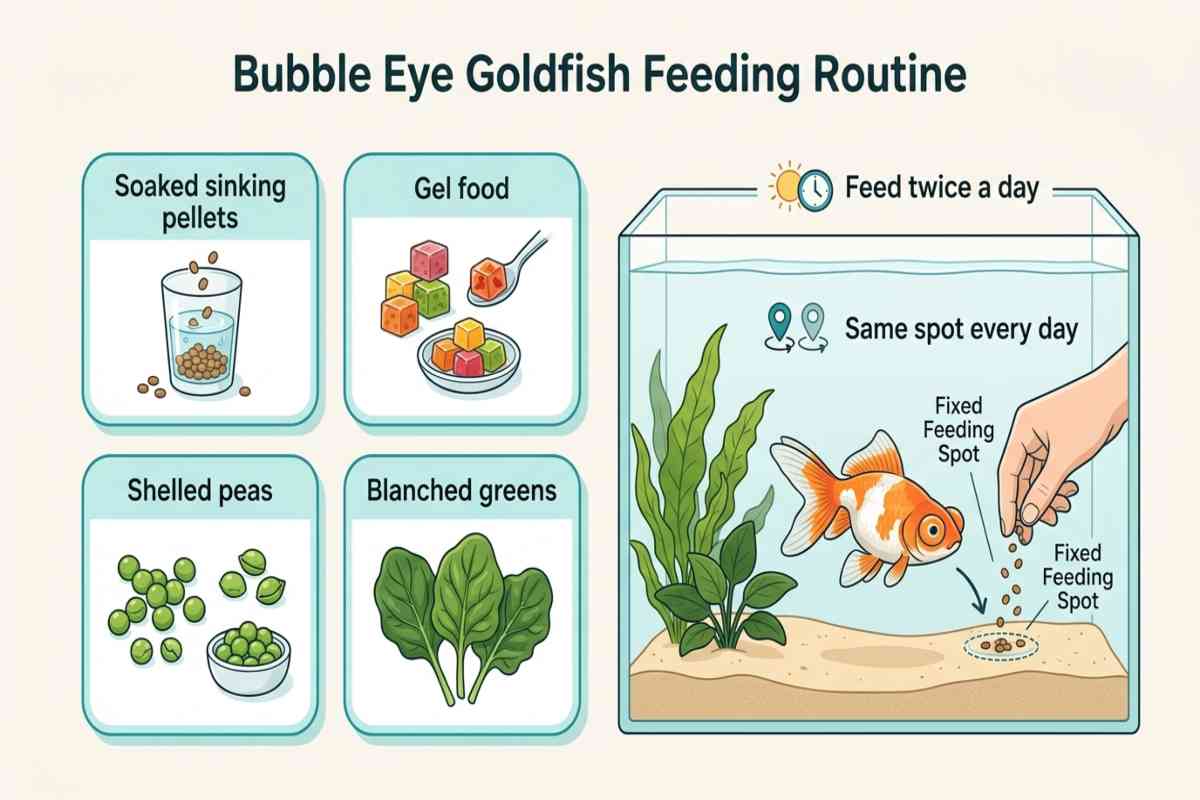 Soaked sinking pellets, gel food, and blanched greens, fed in the same spot, help a bubble eye find and digest its meals.
Can Bubble Eye Goldfish Live With Other Fish?
The safest setup is a tank with only one species. Bubble eye goldfish are slow, have poor vision, and carry fragile sacs, so almost any active tank mate is a risk.
| Tank Mate | Verdict | Why |
|---|---|---|
| Other bubble eyes | Good | Same pace and needs |
| Celestial eye goldfish | Good | Similarly slow, with upward-facing eyes |
| Other slow, short-bodied fancies | Usually fine | Needs the same careful feeding |
| Comets, shubunkins, orandas | Poor | Faster, win the food, grow larger |
| Barbs and other fin nippers | Avoid | Can bite and tear the sacs |
| Tropical fish | Avoid | Need warmer water |
When you add any new fish, quarantine it first for about four weeks to avoid bringing in parasites or bacteria that could infect damaged sacs.
Are Bubble Eye Goldfish Hard to Keep for Beginners?
They are not the easiest goldfish to start with. Their needs are not complicated, but the margin for error is small, and a single sharp decoration can cause a problem that takes weeks to fix. A hardier option is a better first step, and our list of the best goldfish for beginners is a good place to begin.
That said, a careful beginner who cycles the tank, chooses smooth decor, and keeps up with water changes can successfully keep a bubble eye. Selective breeding for an unusual look results in this variety, and its delicate build is the trade-off. At The Fish Care, we think knowing this upfront leads to better, more compassionate fishkeeping.
How Do You Prevent Sac Infections, and Can a Popped Sac Heal?
Prevention is far easier than treatment. Smooth decor, a gentle filter, clean water, and a species-only tank prevent most injuries.
What Does a Healthy Sac Look Like?
A healthy sac is clear or lightly translucent, evenly rounded, and free of redness, spots, or cloudy patches. Both sacs should move gently with the fish.
What Should You Do If a Sac Is Torn or Punctured?
A torn sac can heal, and the fluid often refills over weeks to months, but the sac may not look the same afterward. The real danger is infection, not the fluid loss itself.
- Find and remove whatever caused the injury.
- Test the water and fix any ammonia, nitrite, or high nitrate right away.
- Keep the water very clean with small, frequent changes.
- Watch for redness, white fuzzy patches, cloudiness, or bloody fluid, which suggest infection.
- Contact an aquatic veterinarian if you see signs of infection, because this fish needs guidance on medications and salt.
Do not pop or drain a sac at home, even if it looks swollen. The tissue is delicate, and home attempts usually cause infection. The Merck Veterinary Manual describes bacterial and fungal infections as common secondary problems after skin injury in fish, which is exactly the risk here.
Why Are My Bubble Eye Goldfish’s Bubbles Deflating?
Deflation usually means a rupture, a slow leak from a small puncture, or tissue damage. Look closely for a visible tear, check your decor with the nylon test, and review the filter intake. Watch a fish that has lost a sac for infection while the tissue recovers.
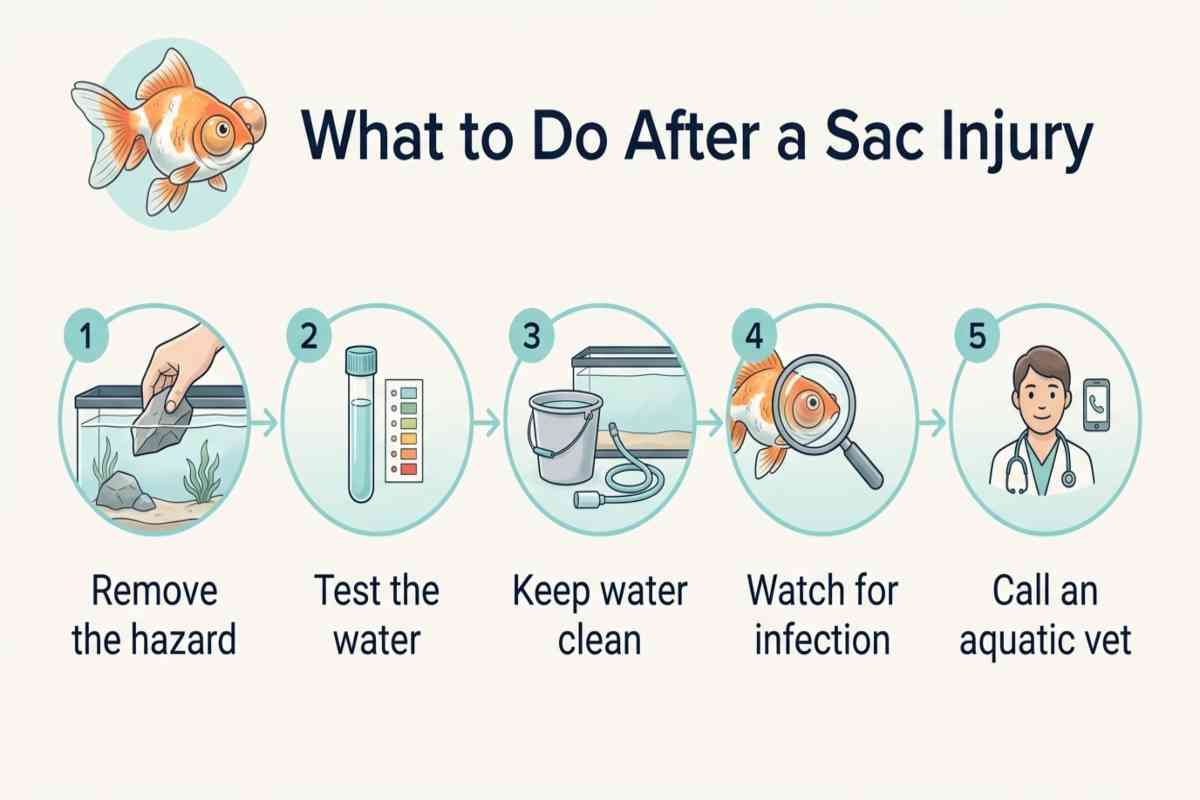 After a sac injury, remove the cause, fix the water, and watch closely for infection, calling an aquatic vet if signs appear.
Is a Bubble Eye Goldfish Right for You?
If you want a calm, unusual goldfish and are willing to keep a plain, spotless, carefully designed tank, a bubble eye can be a wonderful pet that lives for years. If you want a hardy fish for a busy community tank, another goldfish is a better match.
Readers who want to keep learning can explore more goldfish varieties before deciding which one suits their setup.
References
- FishBase. Species information on Carassius auratus: https://www.fishbase.se
- Merck Veterinary Manual. Fish water quality, husbandry, and disease: https://www.merckvetmanual.com