Yes. Peer-reviewed research shows that fish detect painful stimuli through nociceptors, produce measurable stress responses, learn from negative experiences, and change their behavior in ways consistent with fear, stress, and even positive emotional states. Fish don’t experience emotions exactly the way humans or dogs do, since they lack a neocortex. Still, the scientific consensus has moved firmly away from the old idea that fish are simple, feeling-free reflex machines.
This matters for anyone keeping fish at home. If a betta or goldfish can experience stress, discomfort, or well-being, then tank size, water quality, and enrichment directly affect an animal’s quality of life.
What Is the Difference Between Nociception, Pain, and Sentience?
Scientists can’t ask a fish how it feels, so researchers rely on measurable evidence instead: anatomy, physiology, behavior, and cognition. When several independent lines of evidence point in the same direction, that’s treated as strong support for an internal experience, the same standard used to establish pain and emotion in other non-verbal animals, including infants.
| Term | What It Means | Do Fish Have It? |
|---|---|---|
| Nociception | Automatic detection of tissue damage, which can occur without conscious awareness | Yes, well documented |
| Pain | A negative, felt experience that accompanies nociception and changes behavior | Strong evidence, especially in trout, carp, and zebrafish |
| Emotion/sentience | A broader capacity to feel states such as fear, stress, or contentment that shape decisions | Growing evidence, though scope is still debated |
This isn’t a fringe view anymore. In 2024, more than 40 leading animal cognition researchers signed the New York Declaration on Animal Consciousness, a formal scientific statement on the state of the evidence for consciousness across the animal kingdom. The declaration states:
“The empirical evidence indicates at least a realistic possibility of conscious experience in all vertebrates (including reptiles, amphibians, and fishes).”
That’s a significant shift for a field that, for decades, largely excluded fish from the conversation about animal consciousness entirely.
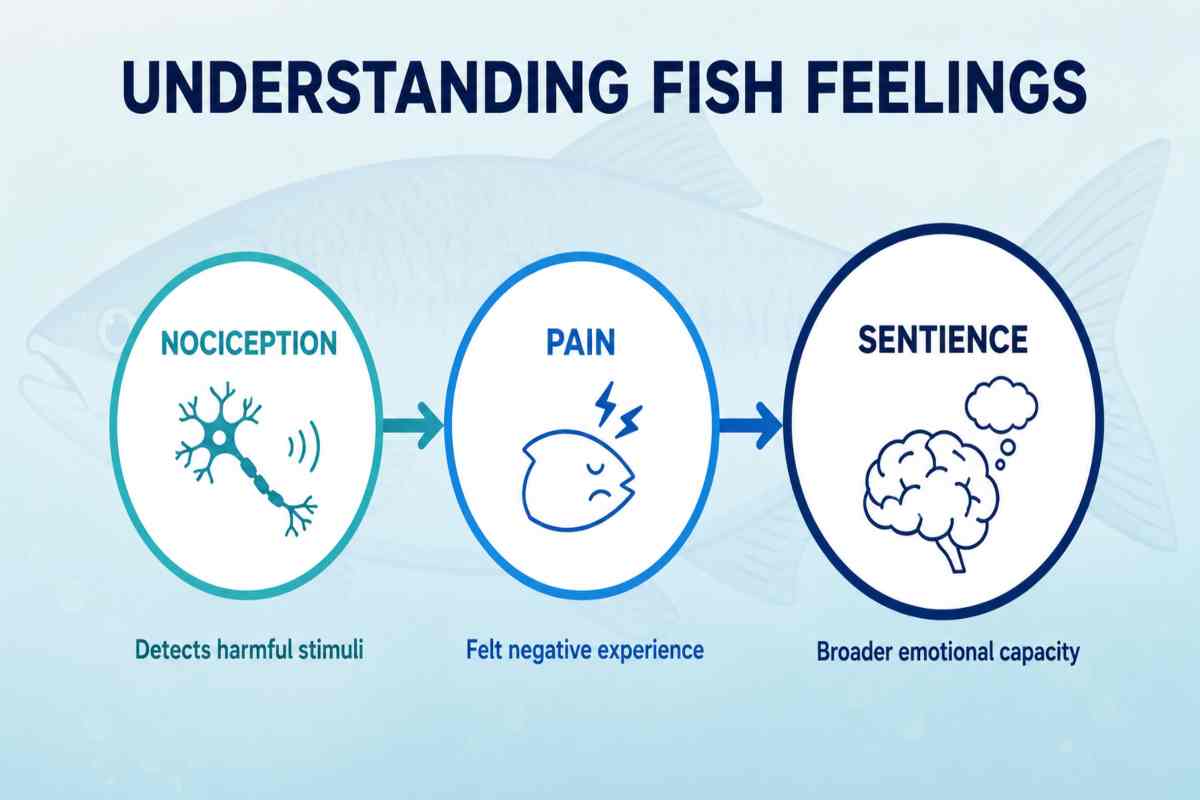 Nociception, pain, and sentience represent three distinct but connected levels of fish sensory experience.
What Evidence Shows That Fish Feel Pain?
Fish possess nociceptors, sensory neurons that detect harmful stimuli like heat, chemical irritants, and mechanical damage. This was confirmed in landmark research on rainbow trout led by biologist Lynne Sneddon, who found nociceptors on the trout’s face and head that responded to bee venom and acetic acid in ways strikingly similar to mammalian pain receptors. Reflecting on how far the science has come, Sneddon told The Guardian:
“My research has shown that fish have a strikingly similar neuronal system to mammals. Until 2002, it was generally believed fish did not have feelings.”
In that same research, trout injected with an irritant rubbed the affected area against the tank wall, stopped feeding, and breathed more rapidly. These behaviors reduced when the fish were given pain-relieving medication. Reflexes alone don’t explain a response that changes with painkillers; that pattern is a hallmark of a felt, negative state rather than a simple withdrawal reflex.
Biologist Victoria Braithwaite, who spent much of her career studying pain perception in fish, summarized the current scientific position plainly in Smithsonian Magazine:
“Fish do feel pain. It’s likely different from what humans feel, but it is still a kind of pain.”
Fish also learn to avoid locations where they experienced a negative stimulus, and they will trade off feeding opportunities against the risk of further discomfort, a pattern also used as evidence of pain in mammals.
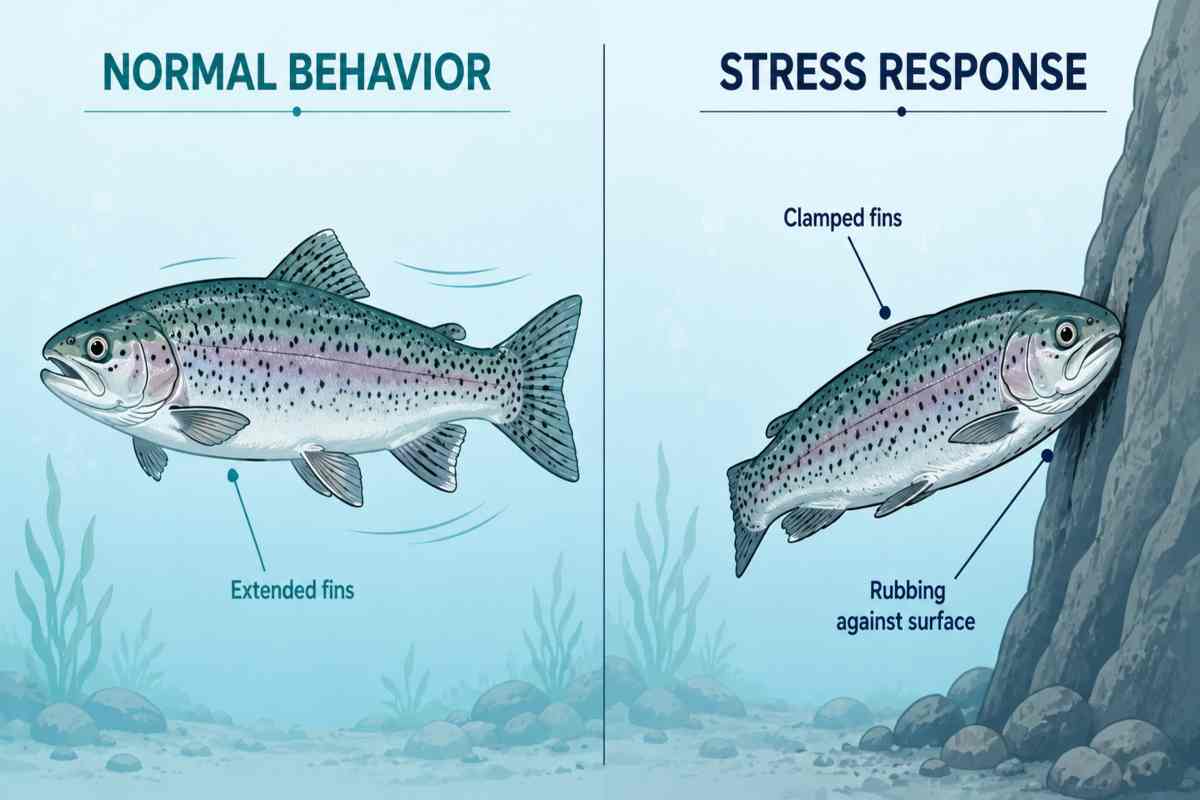 A relaxed fish swims with extended fins, while a stressed fish clamps its fins and rubs against surfaces for relief.
Do Fish Feel Fear and Stress?
Yes, and this is the best-documented emotional response in fish. When a fish perceives a threat, such as a predator, sudden movement, aggressive tankmate, or poor water conditions, it shows a coordinated stress response:
- Physiological: a spike in cortisol, the same primary stress hormone found in mammals
- Behavioral: freezing, darting, hiding, appetite loss, color darkening or paling
- Cognitive: fish that have been startled show a measurable “pessimistic” bias in decision-making tests, approaching ambiguous situations more cautiously, a pattern researchers use as an indicator of an anxiety-like state in other animals
Chronic stress in a home aquarium isn’t just an inconvenience. Prolonged cortisol elevation suppresses a fish’s immune system, making it more vulnerable to disease. A fish kept in a cycled, stable tank with appropriate tankmates is measurably healthier, not just calmer in a vague sense.
Do Fish Feel Pleasure or Positive Emotions?
This side of fish emotion has less direct evidence than pain or fear, largely because positive states are harder to measure in any animal. Still, several findings point toward positive or reward-driven states:
- Fish will work to access enriched environments over bare ones, suggesting a preference rather than a reflex.
- Cleaner fish and their “client” fish engage in cooperative, tactile interactions that some researchers interpret as having a rewarding component.
- Dopamine reward pathways, the same neurochemical system linked to pleasure and motivation in mammals, are present and functional in fish brains.
None of this proves fish experience joy the way humans do, but it does suggest their behavior is shaped by more than avoiding pain. Seeking out favorable conditions appears to be internally rewarding too.
What Are the Common Misconceptions About Fish and Feelings?
| Myth | Reality |
|---|---|
| Fish have a 3 second memory | False. Fish, including bettas and goldfish, retain learned associations for weeks to months, and some species show memory spans of a year or more in controlled studies |
| Fish can’t feel pain because they don’t scream | Vocalizing pain requires anatomy fish don’t have. Absence of a scream isn’t evidence of absence of pain; behavioral and physiological markers are the relevant evidence |
| A small brain means no real feelings | Emotional processing doesn’t require a neocortex. Fish use older brain structures, such as the telencephalon, to produce comparable stress and avoidance behaviors |
| All fish experience the world the same way | Species differ significantly. A betta’s territorial, reactive temperament is not the same as a goldfish’s more exploratory, social one |
What Does This Mean for Fishkeepers?
Because fish can experience stress, discomfort, and likely a form of wellbeing, everyday husbandry choices carry real welfare weight. Watching for behavioral changes is one of the most reliable ways to catch a problem before it becomes a health crisis.
Signs a fish may be stressed or in discomfort:
- Clamped fins held tightly against the body
- Rapid or labored gill movement
- Hiding far more than usual, or repeatedly swimming along the glass
- Loss of appetite or refusing normally favorite foods
- Color fading, darkening, or blotching
- Rubbing or “flashing” against decorations or substrate
- Lethargy, or in some cases, erratic darting
Water quality, tank size, and appropriate companionship are the biggest levers a keeper has. A betta kept in a cramped, uncycled bowl is under chronic stress in a way that is now measurable, not just assumed, which is why proper tank setup and water conditions matter from day one.
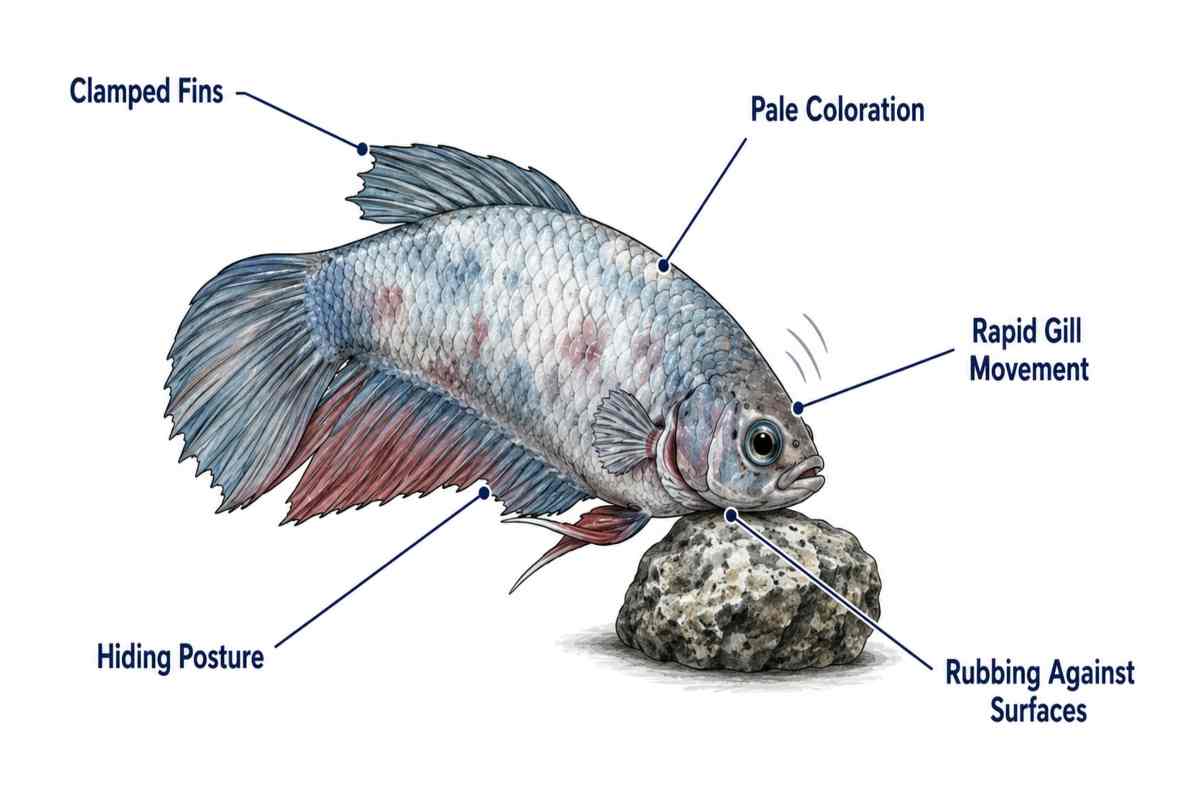 Clamped fins, pale coloration, and rubbing against rocks are visible warning signs of a stressed fish.
Do All Fish Species Respond the Same Way?
No. Emotional and cognitive complexity varies across species, just as it does across mammals. Bettas are highly territorial and show big individual behavioral differences: some are bold and reactive, others are shy and slow to acclimate. Goldfish tend to be more social and exploratory, and have been shown in lab studies to solve mazes and retain spatial memory over long periods.
This is one reason species-specific care matters more than generic advice. A stress response that’s normal for a goldfish adjusting to a new tank can look identical to a genuine medical issue in a betta, which is why understanding baseline behavior for your specific species is important.
Fish are not simple, unfeeling reflex machines, and they’re also not emotionally equivalent to mammals. The evidence-based position sits in between: fish detect harm, respond to it in ways consistent with a felt experience, learn from it, show measurable fear and stress responses, and likely experience some form of positive state when conditions are good. For anyone keeping fish, that’s a reason to take their environment and daily welfare seriously. At The Fish Care, that welfare-first lens is the foundation for every piece of care advice we publish.
FAQs (Frequently Asked Questions)
Do fish feel pain when hooked or handled?
Evidence strongly suggests yes. Nociceptor activation and stress hormone spikes occur during hooking and handling, and behavior returns to normal faster with gentler, quicker handling. This is a key reason careful, minimal stress handling matters even during routine tank maintenance or transport.
Can fish recognize their owner?
Some species, including certain cichlids and goldfish, have been shown in studies to distinguish between individual human faces and associate a specific person with feeding. This is better described as learned recognition than an emotional bond in the way we’d describe a pet dog.
Do fish get lonely?
It depends on the species. Schooling fish kept alone or in numbers too small to form a proper school show measurably higher stress markers. Solitary, territorial species like bettas don’t need company and can become stressed by tankmates instead.
Is it cruel to keep fish in a tank?
Not inherently, but it can be if the tank fails to meet the species’ physical and behavioral needs. The welfare science above is exactly why appropriate tank size, water parameters, and enrichment aren’t optional extras.