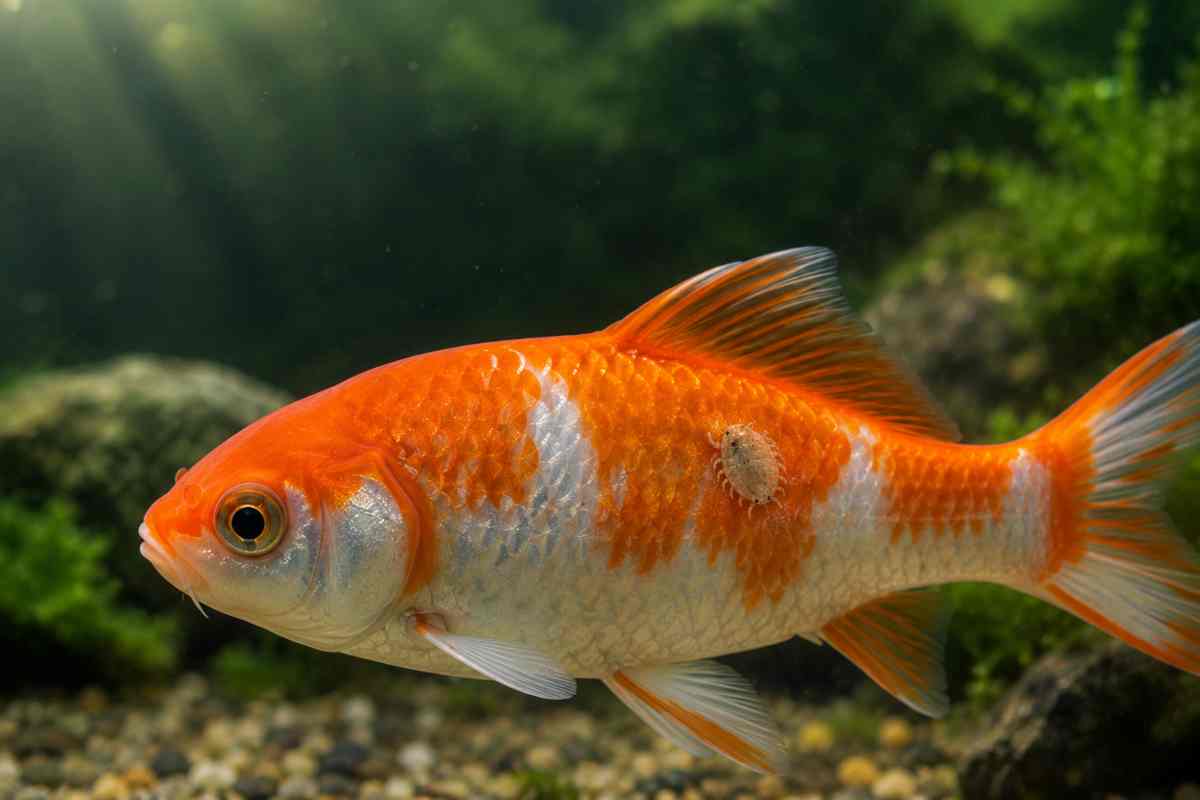
Fish lice are flat, disc-shaped parasites (genus Argulus) that attach to a fish’s skin, fins, or gills and feed on blood and body fluids. They are visible to the naked eye, usually 4 to 12 mm across, and look like small, pale green or gray “ticks” stuck to the fish. They are treatable with manual removal, medicated baths, and chitin synthesis inhibitors, but the tank must be treated too, since the parasite spends part of its life cycle off the fish.
That’s the short answer. The rest of this guide covers exactly how to confirm it’s fish lice and not something else, why your fish got them, and the full treatment process from start to finish.
Key Takeaways
- Fish lice (Argulus) are flat, disc-shaped crustacean parasites, not insects, and adults are usually visible to the naked eye at about 4 to 12 mm across.
- They spread mainly through new fish, plants, or contaminated equipment introduced without quarantine and are generally more common in outdoor ponds than closed aquariums.
- Flashing, darting, and rubbing against rocks or decorations are common early warning signs, often appearing before the parasite itself is noticed.
- Treatment should address the entire aquarium or pond, not just the affected fish, because eggs and developing stages can remain in the environment.
- A single treatment is rarely enough. Many infestations require two or more treatment rounds timed to the parasite’s hatching and molting cycle.
- Strict quarantine of new fish, plants, and potentially contaminated equipment is one of the most effective ways to prevent a fish lice outbreak.
What Are Fish Lice?
Despite the name, fish lice are not insects and are not related to the lice found on mammals. They are branchiuran crustaceans, distant cousins of shrimp and crabs. The most common genus affecting aquarium and pond fish is Argulus, with Argulus foliaceus and Argulus japonicus being the species most frequently reported in freshwater systems.
Under magnification, a fish louse has a flattened, translucent, oval body with two large compound eyes, four pairs of swimming legs, and a pair of suction-cup-like discs it uses to clamp onto the fish. A sharp, hollow spine called a stylet punctures the skin so the parasite can feed and inject digestive enzymes, which is what causes the intense irritation infected fish display.
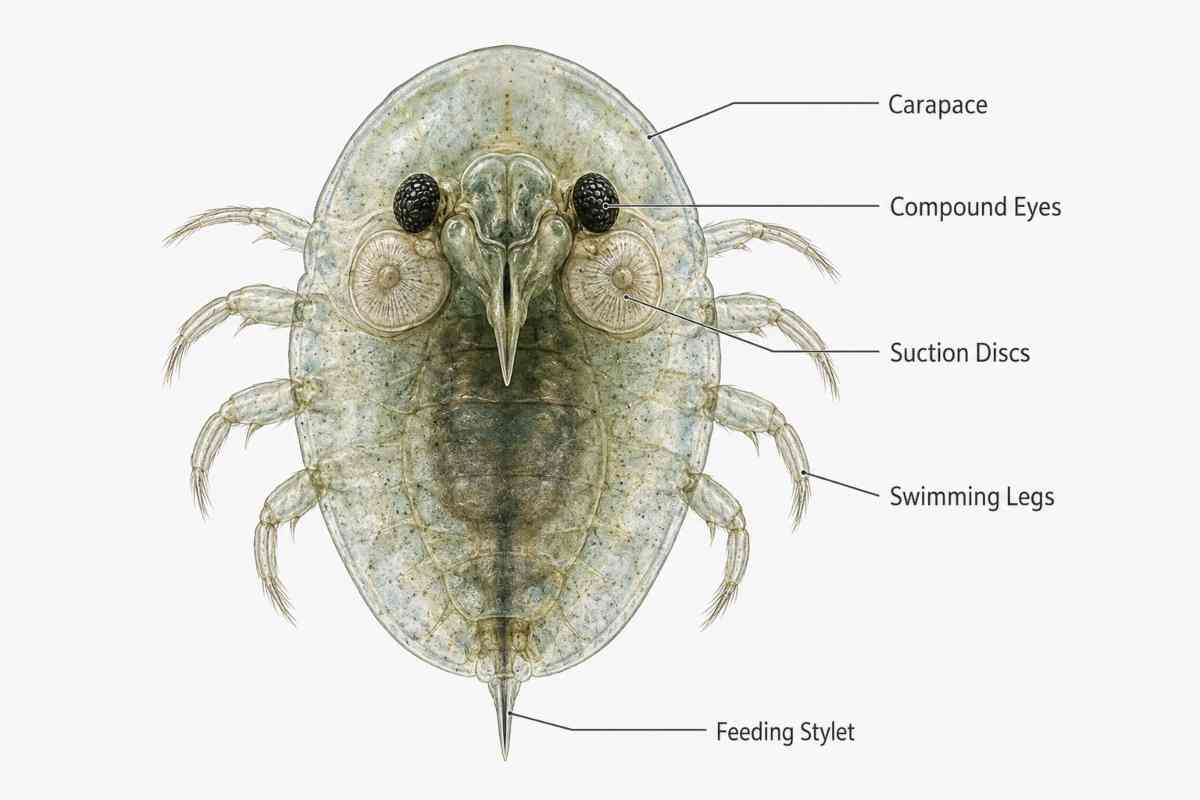 The key anatomical features that help you identify an adult fish louse under magnification.
How Do You Identify Fish Lice on a Fish?
Fish lice are large enough to see without a magnifying glass, which sets them apart from most other external parasites.
- Size and shape: Flat, round to oval, roughly 4 to 12 mm across depending on age and species.
- Color: Pale green, tan, or gray, often nearly translucent, which lets them blend in against the fish’s skin.
- Location: Most commonly found on the fins, flanks, and near the base of the gills, though they can attach anywhere on the body.
- Movement: Unlike anchor worms, fish lice are mobile. They can crawl and swim short distances between attachment sites, and you may see them shift position over a few hours.
- Attachment marks: Each feeding site often leaves a small red, inflamed spot, sometimes with a tiny hemorrhage where the stylet pierced the skin.
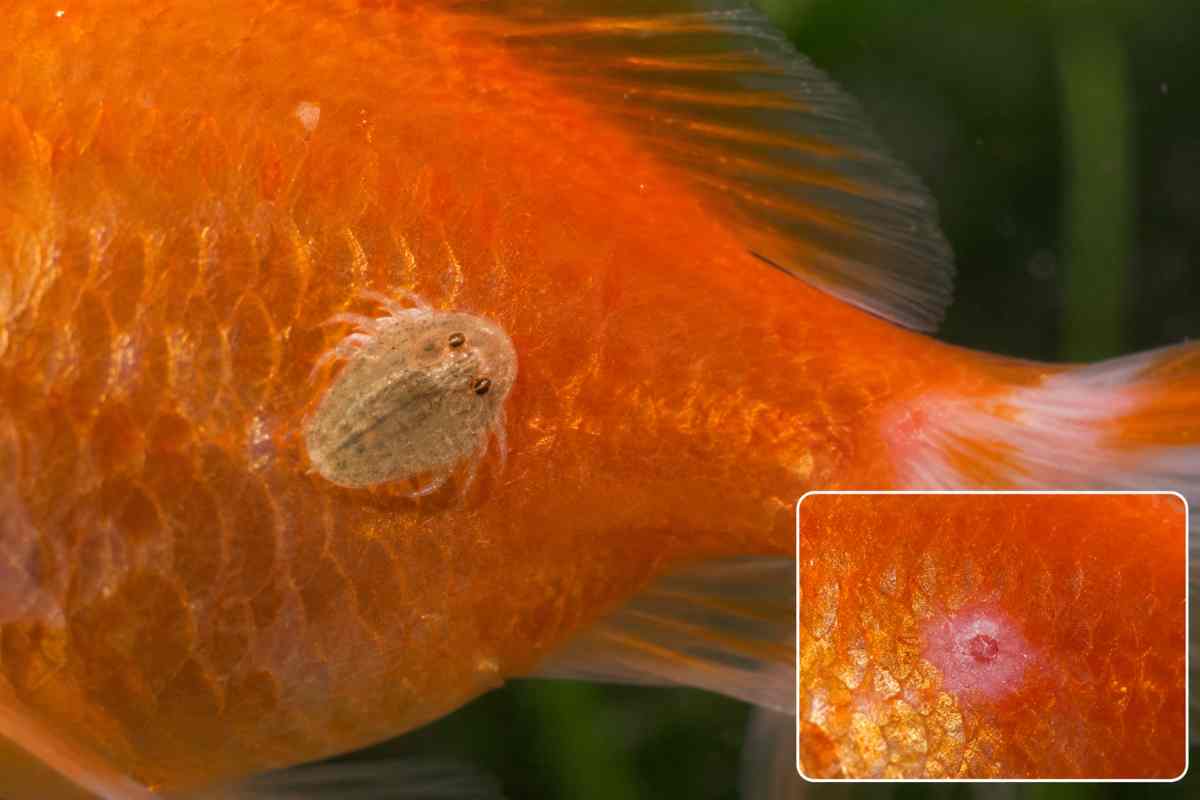 A fish louse feeding on a goldfish’s scales, compared with the inflamed spot it leaves behind once removed.
Fish Lice vs. Anchor Worms: How to Tell Them Apart
These two parasites are frequently confused because both are visible crustaceans that attach externally, but they look and behave differently.
| Feature | Fish Lice (Argulus) | Anchor Worms (Lernaea) |
|---|---|---|
| Shape | Flat, round to oval disc | Thin, thread-like worm with a forked tail |
| Mobility | Mobile, can crawl and swim | Anchored in place, does not move |
| Attachment | Suction discs on the skin surface | Head buried into the muscle tissue |
| Color | Pale green, tan, or gray | White to pale, with visible egg sacs |
| Visible size | 4 to 12 mm, disc-shaped | Up to 20 mm, string-like |
Both parasites are treated with similar medications, but manual removal technique differs slightly since anchor worms are embedded deeper in the tissue.
What Causes Fish Lice in an Aquarium?
Fish lice are not a water quality problem on their own. They are introduced, almost always through a new arrival.
- New fish added without quarantine. This is the single most common cause. Fish lice, including juvenile stages too small to see easily, hitchhike in on infected fish.
- Live plants sourced from ponds or outdoor systems. Eggs can be laid on plant surfaces and hard substrates, not just on fish.
- Water or equipment shared between tanks or ponds. Nets, buckets, and siphons moved between systems can transfer eggs or juveniles.
- Fish moved from outdoor ponds. Argulus is far more common in pond settings, so pond-raised goldfish and koi brought indoors are a frequent source.
Which Fish Are Most at Risk?
Fish lice show little host specificity, meaning they will attach to almost any freshwater species, but they are reported most often on goldfish, koi, and other pond fish. Community aquarium fish such as bettas, tetras, and livebearers can also be affected if lice are introduced, and heavy infestations are more dangerous for smaller-bodied fish since the relative blood loss and stress are greater.
What Are the Symptoms of a Fish Lice Infestation?
- Visible flat, disc-shaped parasites on the skin or fins
- Flashing, or rubbing the body against gravel, rocks, and decorations
- Darting, erratic swimming, or sudden bursts of speed
- Small red or inflamed spots where parasites have fed or detached
- Clamped fins and general lethargy in moderate to heavy infestations
- Labored or rapid gill movement if lice have attached near or inside the gill chamber
- Reduced appetite and weight loss in prolonged, untreated cases
A single louse on an otherwise healthy fish usually causes mild irritation. Heavier infestations are far more serious, since repeated puncture wounds create entry points for secondary bacterial and fungal infections, and severe cases can be fatal, particularly in small or already stressed fish.
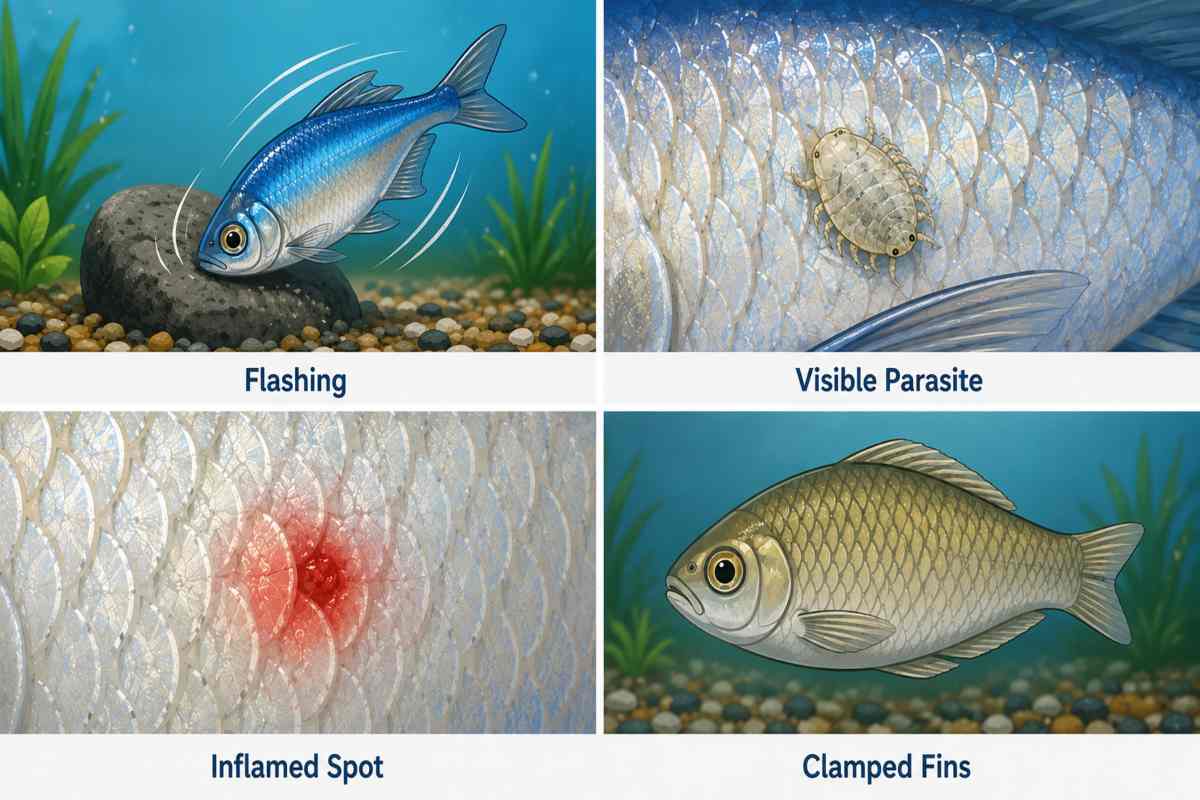 Four common warning signs that can help you quickly spot a fish lice infestation.
How Do You Diagnose Fish Lice Correctly?
- Observe the fish’s behavior first. Persistent flashing or darting is often the earliest clue, sometimes appearing before you can see the parasite itself.
- Examine the fish closely under good lighting, checking the fins, flanks, gill covers, and belly, since lice tend to favor these areas.
- Use a magnifying glass for juvenile stages, which are much smaller and harder to spot than adults.
- If a fish can be safely and briefly netted, check the underside and gill margins, where lice are easy to miss during a casual glance through the glass.
- Rule out anchor worms and other visible parasites using the comparison table above before starting treatment, since the details of treatment differ.
How Do You Treat Fish Lice? Step-by-Step
Treatment has two parts that need to happen together: treating the fish, and treating the tank or pond. Skipping the second step is the most common reason infestations come back.
Step 1: Quarantine Affected Fish
Move visibly infested fish to a bare-bottomed quarantine tank if possible. This makes lice and their eggs easier to spot and removes the fish from a system where other fish may also be silently carrying juvenile parasites.
Step 2: Remove Visible Adult Lice Manually
For fish that can be handled briefly and safely, adult lice can sometimes be removed with fine tweezers while the fish is held in a wet, soft net or a shallow container of tank water. Grip the parasite, not the fish’s skin, and pull gently in the direction away from the attachment point. Manual removal helps reduce the parasite load quickly but will not eliminate eggs or juveniles already in the water, so it is a supplement to medication, not a replacement for it.
Step 3: Treat With an Appropriate Medication
- Diflubenzuron: A chitin synthesis inhibitor and one of the most consistently effective treatments against Argulus. It works by preventing the parasite from forming a new shell after molting, which kills it at its next molt rather than instantly. It is typically dosed as a single treatment and repeated according to the product’s label, since it targets molting stages rather than adults directly.
- Lufenuron: Another chitin synthesis inhibitor, sometimes used off-label, with a similar mode of action to diflubenzuron.
- Potassium permanganate: Used as a short bath treatment in some cases, though it requires careful dosing since it is oxidizing and can stress or burn fish and plants if overdosed.
- Organophosphates: Effective against fish lice but restricted from use in food fish and outdoor ponds in many regions due to environmental and safety concerns; these should only be used under professional guidance.
There is no over-the-counter medication approved specifically for Argulus in every region, and many general “parasite” treatments are only effective against juvenile stages, not armored adults. If lice persist after one round of treatment, a second treatment timed to the parasite’s molting cycle is usually needed rather than switching products immediately.
Step 4: Treat the Whole Tank or Pond, Not Just the Fish
Because adult female lice detach from the fish to lay eggs on plants, decorations, and hard surfaces, medicating only the fish leaves eggs and free-swimming juveniles behind. The entire system needs to be dosed according to the chosen medication’s instructions, and this usually needs to be repeated, since eggs hatch at staggered intervals depending on temperature.
Step 5: Repeat Treatment on a Schedule
A single treatment rarely clears an infestation completely, because eggs and larval stages are naturally more resistant to many medications than adults. Most successful protocols involve two to three treatments spaced roughly a week apart, timed to catch newly hatched lice before they mature enough to reproduce again.
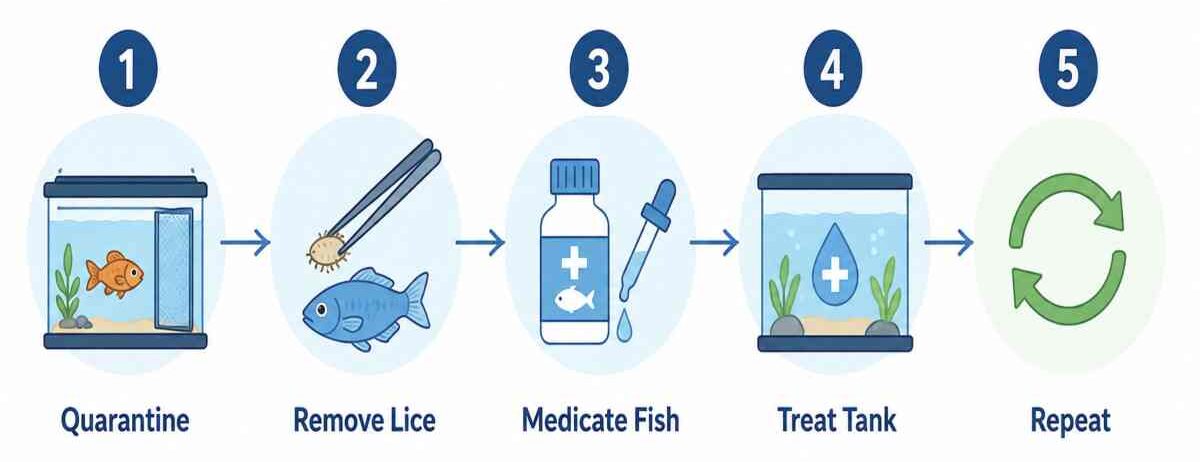 The full treatment sequence for clearing a fish lice infestation from start to finish.
Fish Lice Treatment Comparison
| Treatment | Effective Against | Notes |
|---|---|---|
| Manual removal | Visible adults | Fast but incomplete; does not treat eggs or larvae |
| Diflubenzuron | Molting stages (juveniles and adults at next molt) | Considered the most reliable option; repeat dosing needed |
| Lufenuron | Molting stages | Similar mechanism to diflubenzuron, used off-label |
| Potassium permanganate | Adults on contact | Requires precise dosing; risk to fish and plants if overdosed |
| Organophosphates | Adults and juveniles | Restricted in many regions; not for ponds or food fish |
What Does Home Care Look Like During Treatment?
- Maintain excellent water quality throughout treatment. Stressed fish with compromised skin are far more vulnerable to secondary infection while recovering.
- Watch feeding sites and any open wounds for signs of fungus or bacterial infection, such as cottony growth or reddened, ulcerated patches.
- Reduce handling and netting to a minimum outside of what treatment requires, since damaged fish are already under stress.
- Keep quarantine or hospital tanks simple, with a bare bottom or easy-to-clean substrate, so leftover eggs and shed exoskeletons are easier to remove during water changes.
- Continue observing fish daily for at least two to three weeks after the last visible louse is gone, since eggs can hatch well after adults appear to be cleared.
How Long Does Recovery Take?
Most fish begin showing reduced flashing and improved appetite within a few days of the first successful treatment, once the active parasite load drops. Full clearance of an infestation, including eggs and juvenile stages, typically takes two to four weeks with repeated treatments spaced to match the parasite’s life cycle. Skin damage from feeding sites usually heals within one to two weeks in fish with good water quality and no secondary infection, though scarring can persist longer in more severe cases.
How Can You Prevent Fish Lice?
- Quarantine every new fish for a minimum of two to four weeks before adding it to an established tank or pond.
- Inspect new fish closely under good lighting before and during quarantine, checking fins, flanks, and gill margins.
- Quarantine or thoroughly rinse new live plants, especially anything sourced from outdoor ponds, since eggs can be laid on leaves and stems.
- Avoid sharing nets, siphons, and buckets between different tanks or ponds without cleaning and drying them first.
- Be extra cautious with pond-raised goldfish and koi moved indoors, since Argulus is significantly more common in outdoor pond systems.
What If Treatment Fails?
If lice persist after two or three properly timed treatment rounds, a few things are usually to blame. The most common issue is under-dosing relative to tank volume, so double-check calculations against the actual water volume rather than the tank’s advertised size. The second most common issue is treating the fish but not the full system, which leaves eggs and juveniles to reinfect treated fish. If the infestation still doesn’t resolve, or if fish develop worsening secondary infections, ulcers, or labored breathing, it’s time to consult an aquatic veterinarian, since some medications effective against Argulus require professional oversight or are not available over the counter in every region.
Common Mistakes When Treating Fish Lice
- Treating only the visibly affected fish and leaving the rest of the tank or pond untreated
- Stopping treatment after the first round because visible adults are gone, without addressing eggs and juveniles
- Using a general “ich” or protozoan medication that has no effect on crustacean parasites
- Skipping quarantine for new fish, which is how most infestations start in the first place
- Overdosing potassium permanganate or other oxidizing treatments in an attempt to speed up results
At The Fish Care, we recommend combining early visual inspection with a strict quarantine routine as the single most effective way to avoid a fish lice outbreak altogether, since prevention is far simpler than treatment.
Frequently Asked Questions (FAQs)
Can fish lice spread to other fish in the tank?
Yes. Adult females detach to lay eggs in the environment, and juveniles hatch and actively seek out any available fish host, so an untreated tank will typically see the infestation spread over time.
Are fish lice dangerous to humans?
No. Argulus is a fish parasite and does not infest or bite humans or other mammals.
Can fish lice kill fish?
Yes, particularly in heavy infestations or on small, already-stressed fish. Death is usually caused by blood loss, secondary infection at feeding sites, or gill damage rather than the parasite itself.
Do fish lice go away on their own?
Rarely. Without treatment, lice reproduce and the infestation typically worsens, especially in warmer water where their life cycle moves faster.
How do fish lice get into a closed aquarium with no pond connection?
Almost always through a new fish, plant, or piece of equipment that was previously in contact with an infected system.
Is salt effective against fish lice?
General aquarium salt is not considered a reliable standalone treatment for Argulus. It may offer some supportive benefit for fish stress and mild secondary infection, but it should not replace a medication targeted at the parasite itself.
References
- Merck Veterinary Manual, Parasitic Diseases of Fish: https://www.merckvetmanual.com/exotic-and-laboratory-animals/aquarium-fish/parasitic-diseases-of-fish
- University of Florida IFAS Extension, Argulus (Fish Louse) Infections in Fish: https://edis.ifas.ufl.edu/