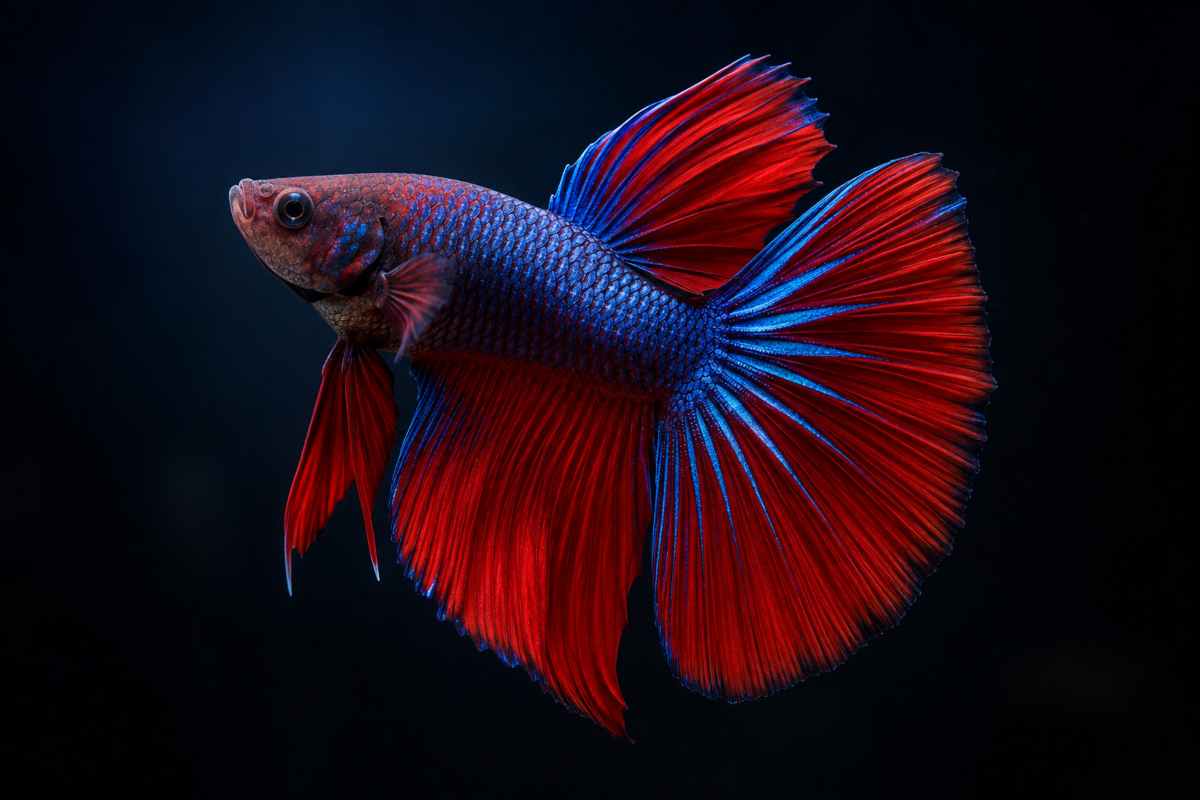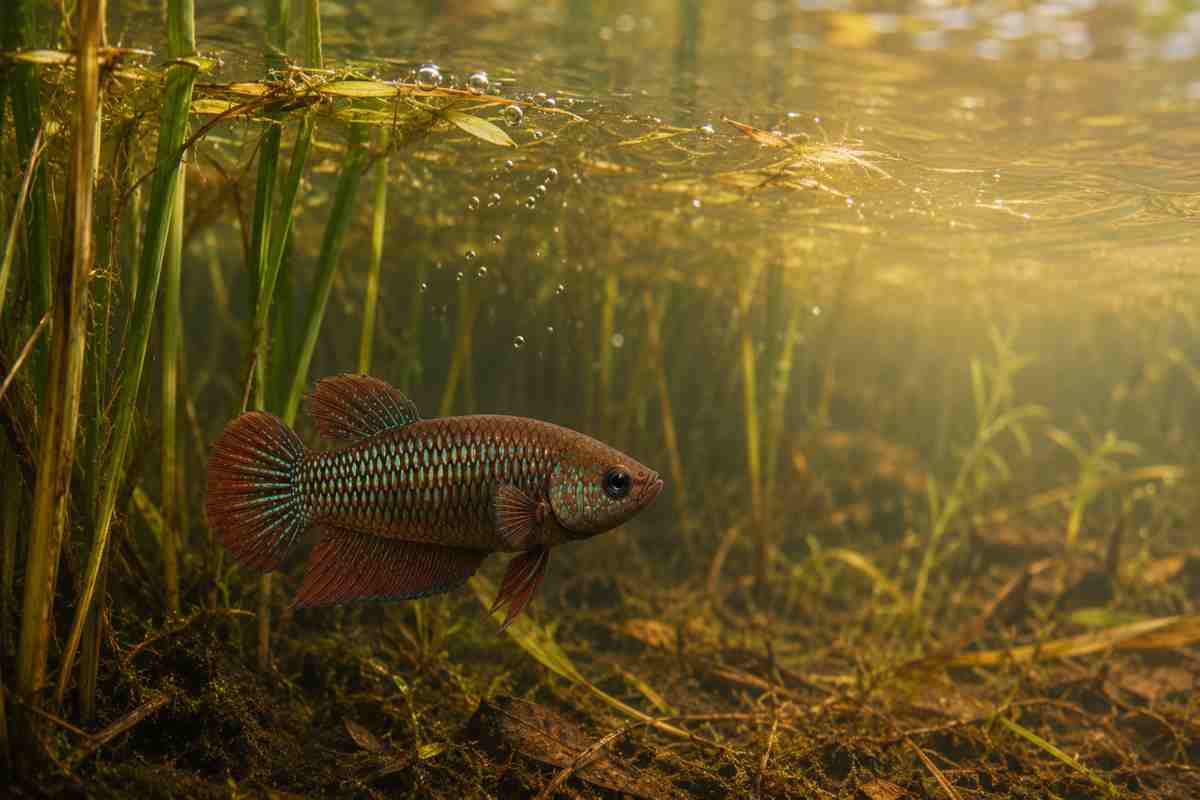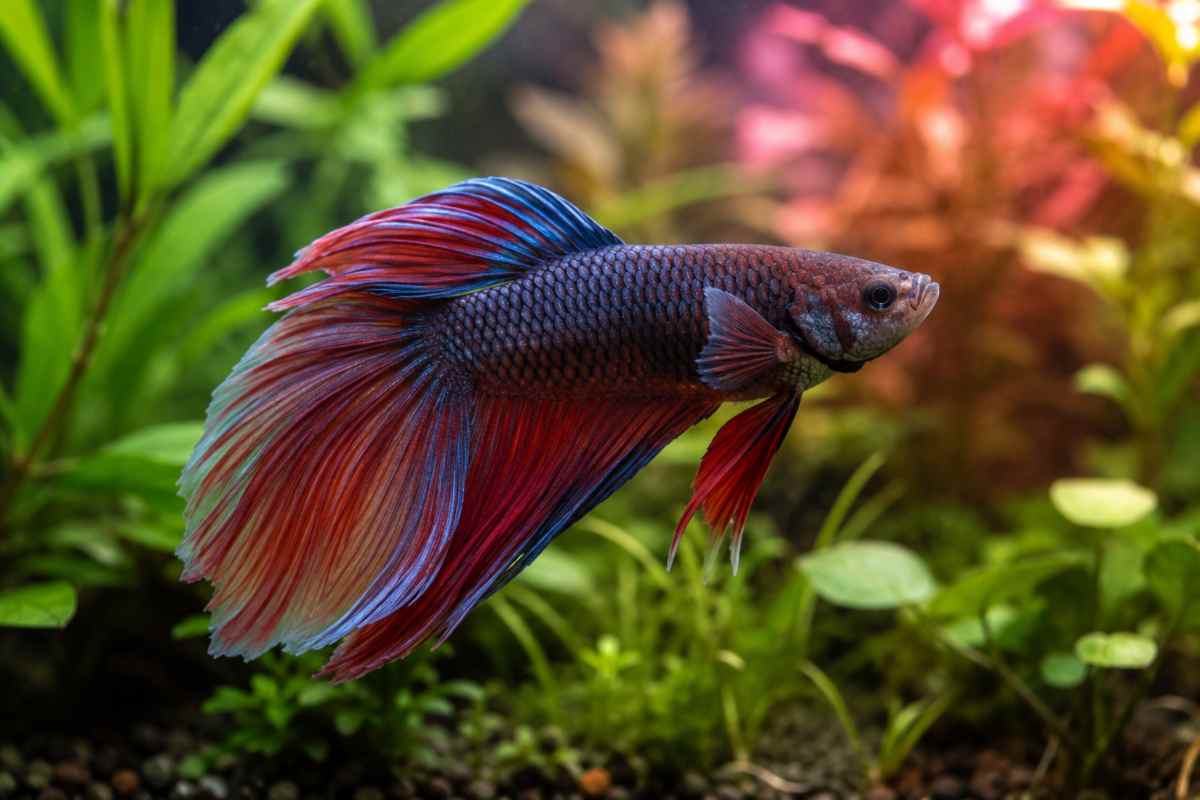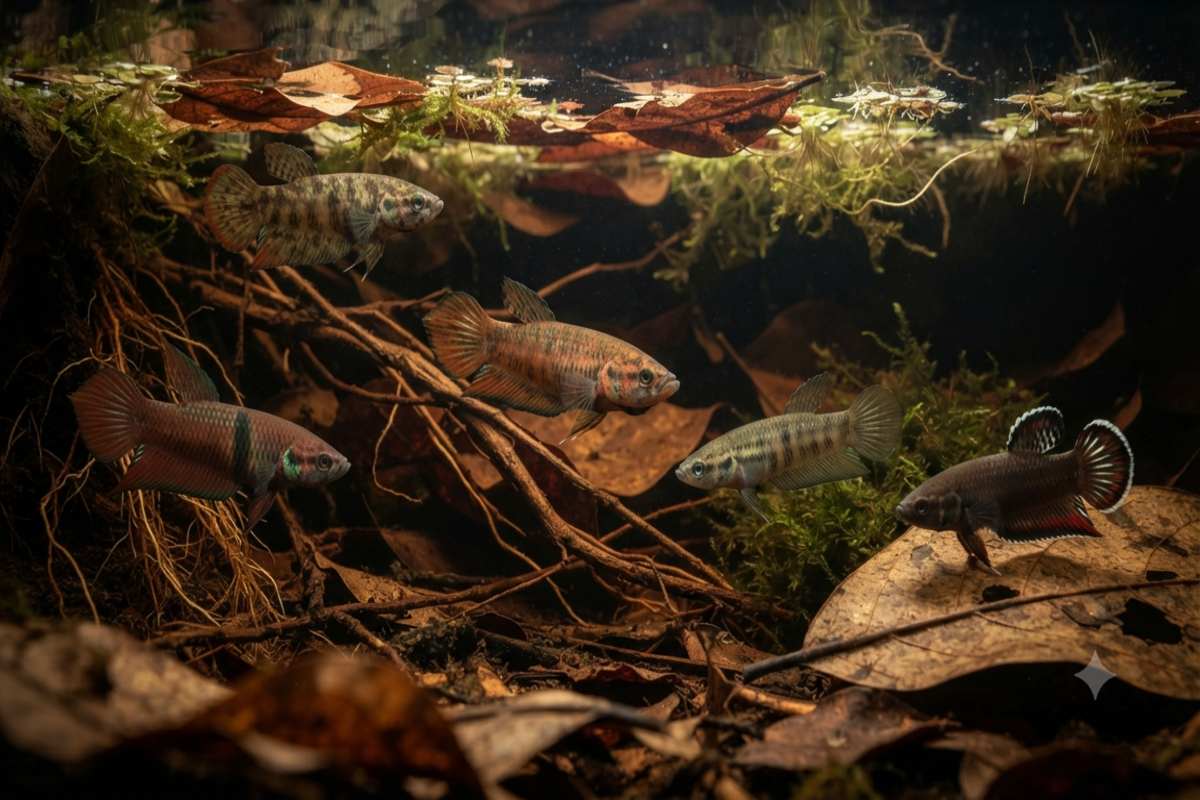
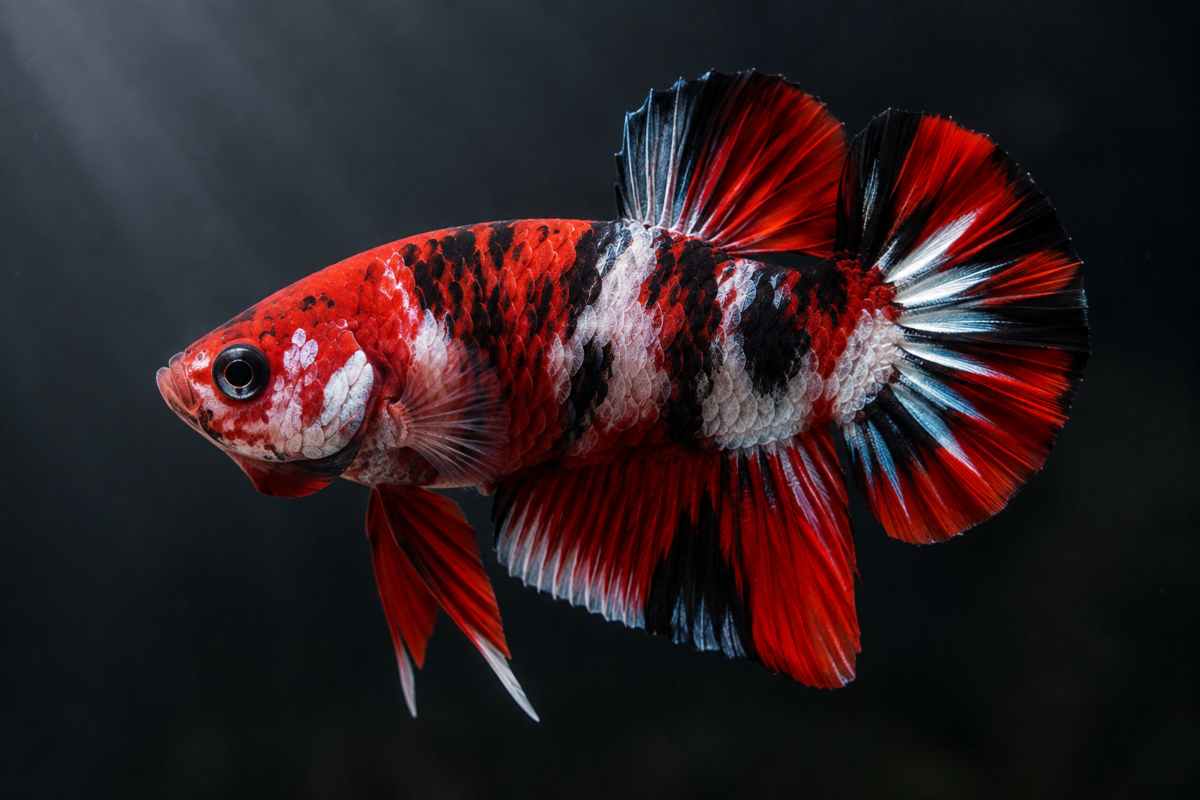
A Koi Betta is a Betta splendens with a broken, multicolored pattern that resembles the markings of koi carp. It usually has red, black, orange, and white patches over a pale or metallic base. It isn’t a separate species or a fixed breed. It’s a marbling-pattern variety that can appear on any tail type, though it’s most commonly seen on Plakats (short-finned bettas).
Because the marbling gene is genetically unstable, a Koi Betta’s colors can continue to shift throughout its life. That single fact- that the pattern keeps changing after purchase- is the detail most buying guides leave out. It’s usually the first surprise new owners run into.
The sections below explain what causes it, how to tell a genuine Koi Betta from a look-alike, and what it actually takes to keep one healthy.
What Makes a Betta a “Koi Betta”
“Koi Betta” is a marketing term coined by breeders, not a term used in formal betta classification. It describes bettas carrying the marble gene, a naturally occurring genetic trait in Betta splendens. That gene causes patches of color to appear, disappear, and shift location on the body and fins over time. It’s the same instability responsible for the mottled patterns seen in koi carp, hence the name.
To be marketed as a true Koi Betta, a fish generally needs three things:
- A pale, often metallic or “matte” base color (white, pastel blue, or yellow)
- At least two contrasting patch colors, typically red and black, though orange, blue, and yellow patches also occur
- Visible black speckling or stippling on the body, similar to a Galaxy Koi pattern
A betta with only two colors and no black speckling is often just called a marble or bi-color betta rather than a true Koi Betta. The terms overlap heavily in the pet trade, and many sellers use them loosely.
Koi Betta Color Varieties
Breeders have named several recognizable Koi patterns. These aren’t official IBC (International Betta Congress) classes; they’re trade names that help buyers describe what they’re looking for.
| Variety | Typical Pattern | Notes |
|---|---|---|
| Galaxy Koi | Red and black patches with heavy metallic blue or green speckling across the entire body | Considered one of the most prized and expensive Koi Betta varieties |
| Nemo Koi | Bright orange and red patches with black marbling, resembling a clownfish pattern | Popular among beginners due to its vivid and eye-catching colors |
| Candy Koi | Soft pastel patches of pink, orange, and yellow with light marbling | Has a softer, less contrasted appearance compared with other Koi patterns |
| Fancy Koi | Three or more solid, well-separated color blocks, commonly red, white, and black | Closest in appearance to traditional koi carp patterns |
| Black Koi | A pattern dominated by black patches over a white or pale base color | Creates a dramatic, high-contrast appearance |
Because marbling continues to express itself with age, a fish sold as a young “Nemo Koi” can develop into something closer to a “Fancy Koi” pattern a year later. No breeder can guarantee the adult pattern will match the juvenile fish you see for sale.
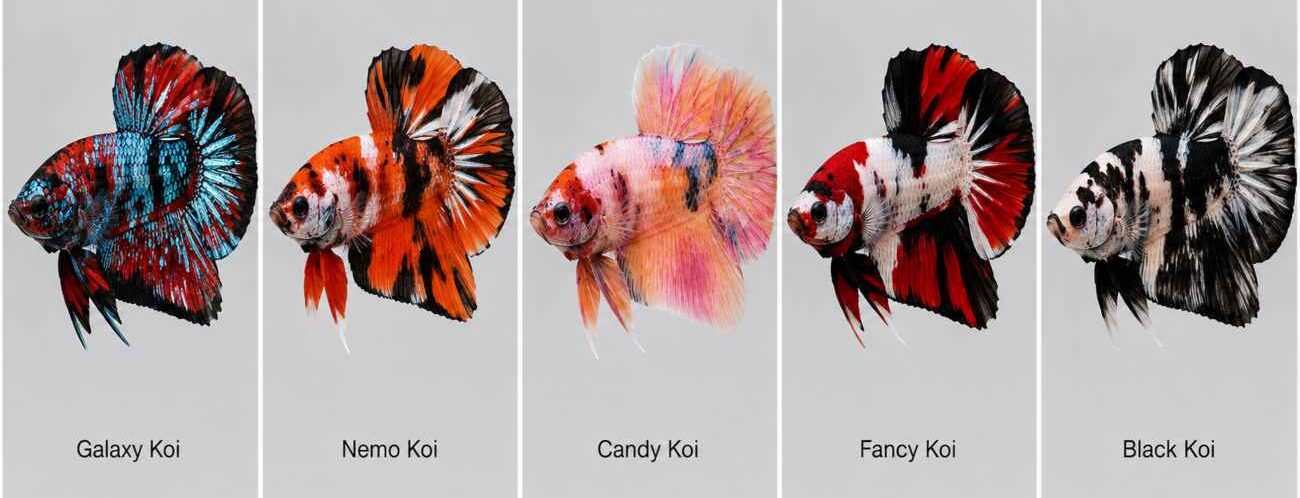 Five Koi Betta pattern varieties side by side, showing how differently the marble gene can express across individual fish.
Why the Colors Keep Changing (The Marble Gene, Explained Simply)
The marble gene is a transposable element, essentially a “jumping gene,” first documented in Betta splendens color research. Unlike most inherited traits, it doesn’t sit still in the DNA. It can switch pigment-producing genes on or off in different skin cells at different times. That’s why marbled bettas keep shifting patches throughout their lives instead of settling into one fixed look after maturity.
This is genetics, not disease. A Koi Betta that develops new red patches, loses a black patch, or gradually turns more solid-colored over 12 to 18 months is behaving exactly as expected. It is not, on its own, a sign of stress, illness, or poor water quality.
Common misconception: many first-time owners assume color loss means their fish is sick. Here’s the practical distinction. New patches appearing over months, or colors slowly shifting and fading with age, are simply the marble gene doing what it does. No action is needed.
What deserves attention is a sudden, overall paling within days. That usually points to stress or a water quality issue and is worth a test-strip check. Fading that shows up alongside clamped fins and lethargy can signal early illness such as fin rot or parasites, and warrants closer observation, a water change, and quarantine if symptoms progress.
Koi Betta vs. Other Betta Varieties
Koi Bettas often get confused with two other patterned varieties, and knowing the difference helps set the right expectations before you buy.
A marble betta is the closest relative and technically has the same underlying genetics. It just lacks the black speckling that qualifies a fish as a Koi specifically. Both are unstable in color and will keep shifting patches for years, so if you want a pattern that settles down, neither is the right choice. A dragon scale betta, by contrast, gets its look from a thick, metallic scale coating rather than the marble gene. Once that fish matures, its pattern locks in and stays put, making it the better pick for someone who wants a fixed, dramatic appearance without surprises.
A standard solid-color betta sits at the other end entirely: one stable color, the lowest price point (typically $5 to $15), and the most predictable choice for a first-time owner.
Koi Bettas mostly show up as Plakats, though Halfmoon and Veiltail Koi patterns exist too. They generally command more than solid or dragon-scale fish, precisely because the pattern is a moving target breeders can’t fully control.
Size, Lifespan, and Temperament
A Koi Betta is the same species and body plan as any other Betta splendens. The koi pattern is cosmetic, not a marker of a distinct breed with different biology.
- Size: 2.5 to 3 inches (6 to 7.5 cm) as an adult, slightly smaller for Plakat forms
- Lifespan: 3 to 5 years with consistent water quality and diet; some individuals reach 6+ years
- Temperament: Territorial and aggressive toward other bettas and toward long-finned, brightly colored fish, the same as any Betta splendens. Individual personality varies from bold and food-driven to shy and reclusive.
Male Koi Bettas are the most commonly sold, since males show the pattern more vividly and develop longer fins. Female Koi Bettas exist and carry the same genetics, but they’re marketed less often under the Koi name.
Is a Koi Betta Good for Beginners?
Yes, and the reason is simple: nothing about the koi pattern changes what the fish needs to thrive.
The real risk isn’t the fish; it’s the shopping experience. Striking patterns and higher price tags can nudge new owners toward impulse buys from sellers who don’t quarantine or acclimate stock properly. Source the fish carefully, and the care itself is exactly as approachable as any other betta.
Tank Setup and Water Parameters
| Parameter | Requirement |
|---|---|
| Minimum tank size | 5 gallons (19 L); 10 gallons preferred |
| Temperature | 76 to 82°F (24 to 28°C) |
| pH | 6.5 to 7.5 |
| Water hardness | Soft to moderately hard (5 to 20 dGH) |
| Filtration | Gentle flow; bettas’ long fins can struggle against strong currents |
| Substrate | Sand or smooth gravel |
| Cover | Tight-fitting lid; bettas are strong jumpers |
If you’re reusing an odd-shaped tank or one without a listed capacity, our aquarium volume calculator will tell you exactly how many gallons you’re working with before you buy a heater or filter sized for it.
Setup checklist:
- Cycled tank with an established nitrogen cycle before adding the fish
- Heater with a thermostat (bettas are tropical fish and cannot tolerate unheated tanks)
- Sponge filter or adjustable-flow filter
- Live or silk plants and floating cover to reduce stress
- Smooth decor with no sharp edges that could tear delicate fins
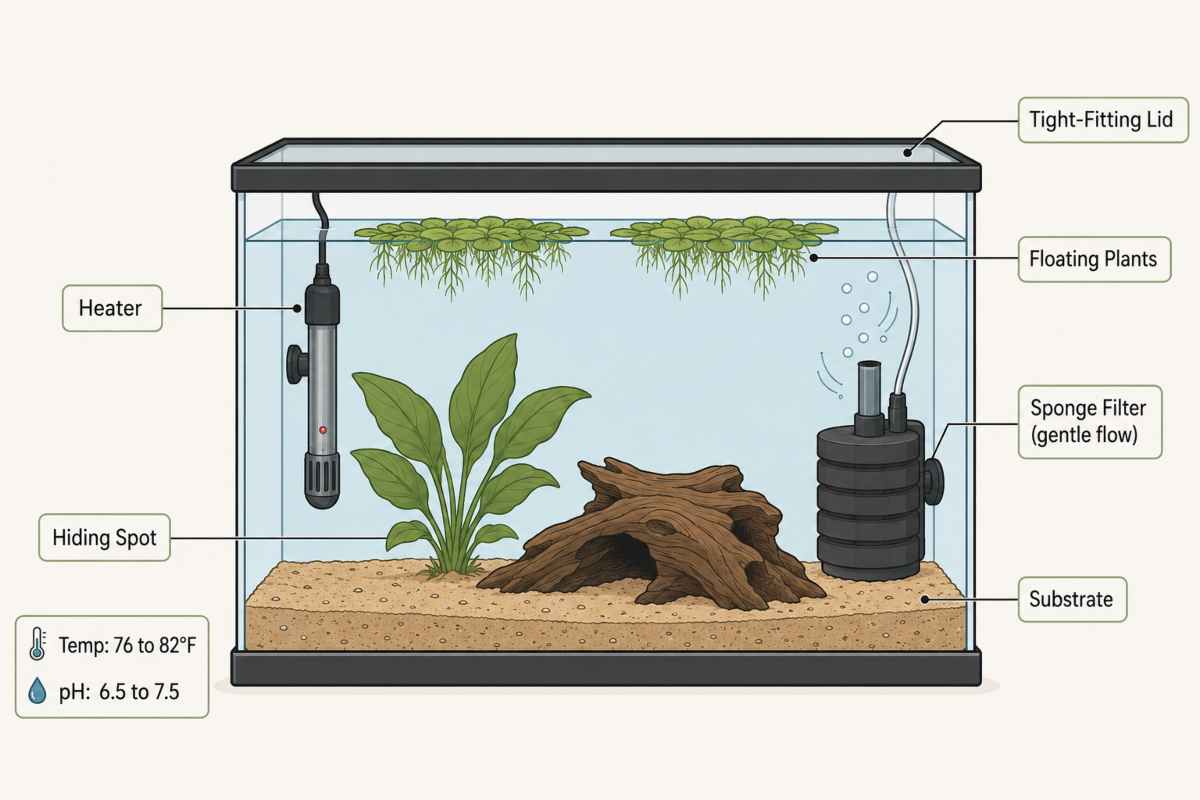 A properly equipped 10-gallon Koi Betta tank, with ideal temperature and pH ranges labeled for quick reference.
Diet and Feeding
Koi Bettas are carnivores and need a protein-rich diet, the same as any betta:
- High-quality betta pellets as a staple (look for fish meal or whole Fish as the first ingredient)
- Frozen or live foods two to three times a week: bloodworms, brine shrimp, daphnia
- Feed only what the Fish can finish in one to two minutes, once or twice daily
- Occasional fasting (one day per week) helps prevent bloating and constipation
Overfeeding is the most common husbandry mistake with bettas of every color variety, and it directly contributes to swim bladder problems.
Tank Mates
Koi Bettas carry the same territorial temperament as other bettas, so tank mate choices follow the same rules regardless of color pattern.
Generally compatible (in a tank of 10+ gallons with hiding spots):
- Nerite or mystery snails
- Amano or cherry shrimp (in a species-only setup, since bettas may hunt smaller shrimp)
- Corydoras catfish
- Small, fast, dull-colored schooling fish like harlequin rasboras
Avoid:
- Other bettas of either sex in the same tank
- Long-finned or brightly colored Fish (guppies, fancy tetras) that can trigger aggression
- Fin-nipping species like tiger barbs
Breeding Koi Bettas
Breeding for Koi patterns is possible but unpredictable, because the marble gene’s expression varies even among fry from the same spawn.
- Condition a healthy male and female separately on live or frozen food for one to two weeks
- Introduce the female to the male’s tank using a divider or breeding box so they can see each other before direct contact
- The male builds a bubble nest; spawning follows once the female is receptive
- Remove the female immediately after spawning; the male guards the eggs and fry alone
- Fry hatch in 24 to 36 hours and become free-swimming around day 3 to 4
- Start fry on infusoria or liquid fry food, moving to baby brine shrimp within one to two weeks
Fry from two Koi Betta parents will not all display koi patterns. Some may hatch solid-colored, and marbling in the ones that do carry it often doesn’t become visible until 3 to 6 months of age.
This unpredictability is part of why distinctive Koi patterns command higher prices. Breeders can’t guarantee outcomes, only probabilities based on the parents’ genetic history.
How Much Does a Koi Betta Cost?
Price tracks pattern quality far more than the Fish’s health or hardiness, so it’s worth knowing what you’re actually paying for before you shop.
Pet-store grade: $10 to $20. Sold at big box pet retailers, usually with a basic pattern and limited color contrast. Fine for a beginner who wants the koi look without chasing a specific variety.
Breeder-grade, good pattern: $25 to $50. Available through local fish stores and online betta breeders. Better fin quality, cleaner patches, and a pattern closer to a named variety like Nemo or Candy.
Show-quality Galaxy Koi: $50 to $150+. Sold through specialty breeders and betta auctions, often imported from Thailand. Expect high-contrast patching, dense metallic speckling, and premium fin conformation.
Pattern contrast, fin quality, and body conformation drive the price more than anything else. Imported Fish tend to cost more simply because of the added shipping and quarantine involved.
Where to Buy a Healthy Koi Betta
Look for these signs of a reputable seller, whether local or online:
- Clear water with no ammonia smell in holding cups or tanks
- Fish is alert, flares readily, and has fully intact fins
- Seller can answer basic questions about the Fish’s age and diet
- No visible fin rot, white spots (ich), or bloating
- For online betta breeders, look for shipping guarantees and acclimation instructions
Avoid buying a fish that’s clamped, floating oddly, gasping at the surface, or kept in visibly dirty water. Cosmetic pattern quality matters far less than baseline health.
Established retailers with published health guarantees are a safer bet than unverified marketplace listings. Thailand Betta Fish, a specialty exporter known for direct sourcing from Thai breeding farms, maintains a dedicated Koi Betta collection worth browsing for pattern variety and current stock.
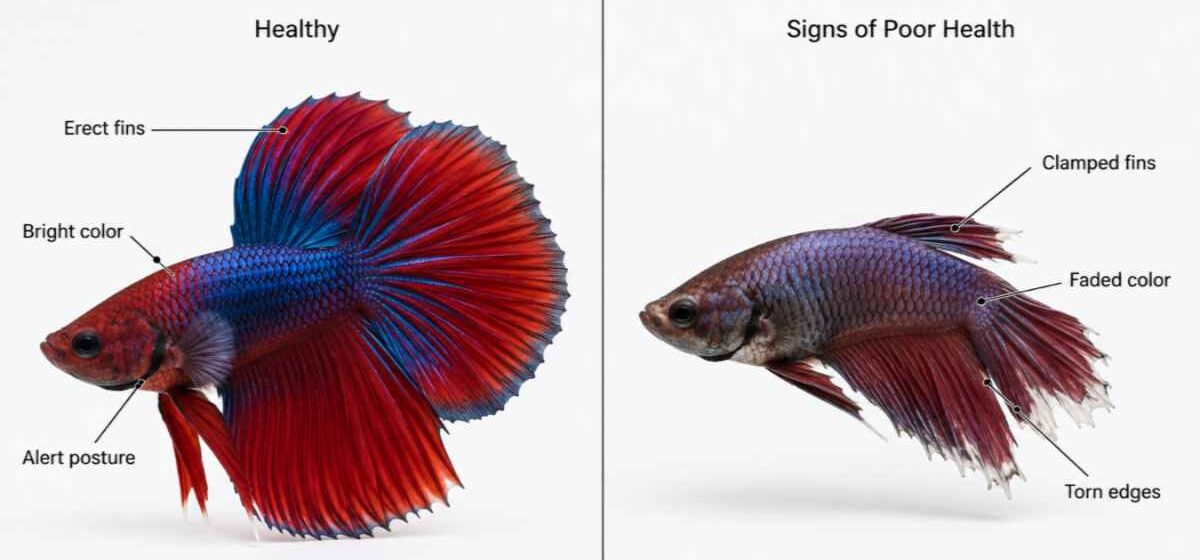 Key visual differences between a healthy betta and one showing signs of poor health, useful for evaluating a fish before purchase.
Frequently Asked Questions
Is a Koi Betta a rare fish?
No. Marble-patterned bettas are common in the aquarium trade. What’s rare and expensive is a fish with high-contrast, well-balanced Galaxy or Fancy Koi patterning specifically.
Will my Koi Betta’s colors keep changing forever?
Color drift is most active in the first one to two years and tends to slow as the fish matures, though some individuals continue shifting patches throughout their lives.
Can two Koi Bettas be kept in the same tank?
No, regardless of color pattern. Two bettas of either sex housed together will fight, often fatally. Bettas must be housed alone or in a species-only sorority of multiple females with careful monitoring.
Related: Can Male and Female Betta Fish Live Together?
Is a Koi Betta the same as a Nemo Betta?
Nemo is one specific Koi pattern (orange, red, and black resembling a clownfish), not a separate category. All Nemo Bettas are Koi Bettas, but not all Koi Bettas are Nemo-patterned.
Do Koi Bettas need different water parameters than other bettas?
No. Color pattern does not affect physiological needs. Temperature, pH, and tank size requirements are identical across all betta color and pattern varieties.
Why did my Koi Betta turn almost solid-colored?
This can happen as the marble gene continues expressing with age, sometimes covering most patches with a single dominant color. It’s usually cosmetic, not a health issue, unless clamped fins, lethargy, or appetite loss accompany it.
Key Takeaways
- Koi Betta is a marbling color pattern, not a species or fixed breed
- The marble gene causes ongoing, unpredictable color changes throughout the fish’s life
- Care requirements are identical to any other Betta splendens
- Pattern names like Galaxy, Nemo, Candy, and Fancy Koi are trade terms, not official classifications
- Buy based on visible health, not just pattern; color quality doesn’t reflect wellness
Understanding the biology behind the marble gene makes owning a Koi Betta far less confusing, and that clarity is really the goal behind everything The Fish Care publishes on betta varieties.
References
- Fenner, R., et al., Betta splendens species information, FishBase: https://www.fishbase.se/
- International Betta Congress, Betta color and pattern classification standards: https://ibcbettas.org/