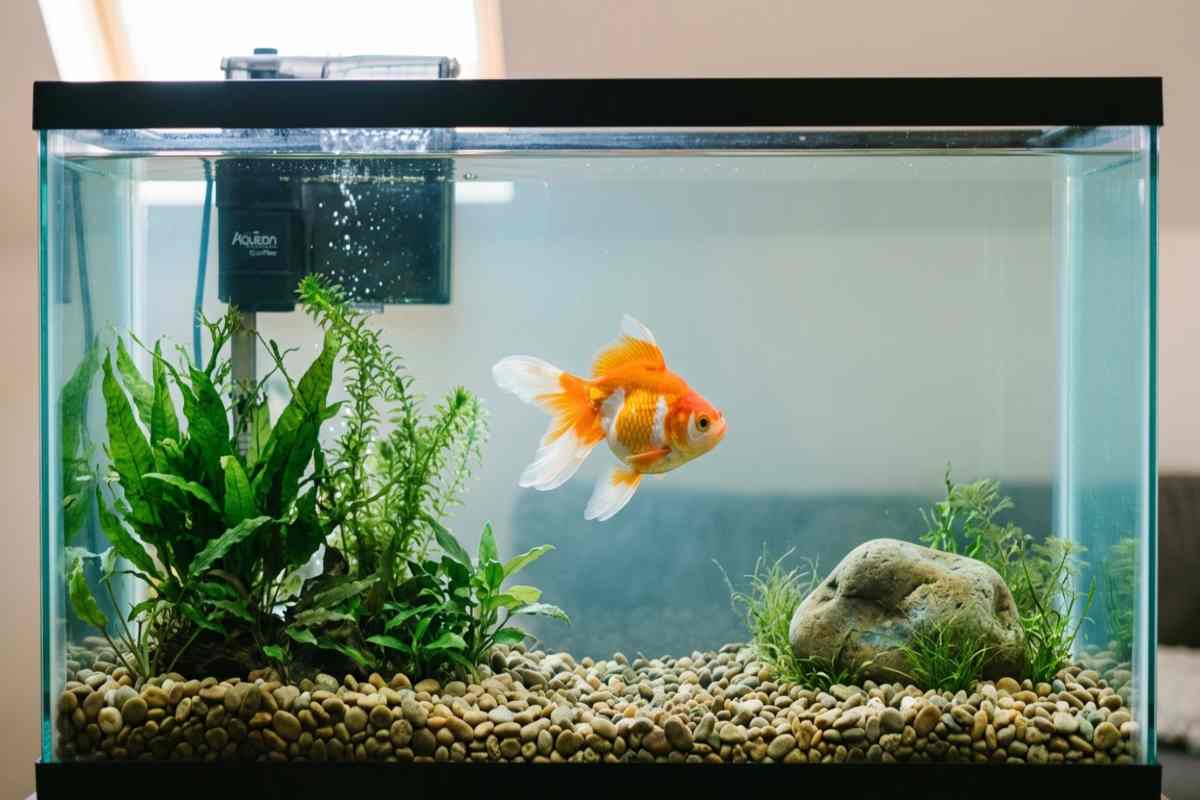
A healthy goldfish tank setup starts with a filtered aquarium of at least 20 gallons for a single fancy goldfish or 30 to 40 gallons for a single common or comet goldfish, cycled for two to six weeks before adding any fish, kept between 65 and 72°F, with weekly partial water changes. Everything else, from substrate to plants to filtration strength, exists to support that foundation.
Key Takeaways
- Goldfish are coldwater fish that need more swimming space and stronger filtration than many tropical aquarium fish.
- Your aquarium should be fully cycled before adding goldfish to prevent toxic ammonia and nitrite from building up.
- Fancy goldfish need at least 20 gallons for the first fish, with 10 additional gallons for each extra fish; single-tailed goldfish require more space as they grow larger.
- Choose filtration rated for about two to three times the aquarium’s actual volume because goldfish produce a heavy bioload.
- Regular 25–50% weekly water changes are essential for maintaining good water quality and supporting long-term goldfish health.
Why Does Goldfish Tank Setup Differ From a Typical Aquarium?
Goldfish (Carassius auratus) are carp, not typical tropical aquarium fish. They are coldwater fish, meaning they thrive at cooler, more stable temperatures than bettas or tetras and don’t need a heater in most homes. They also eat constantly, grow continuously throughout their lives, and produce far more ammonia-rich waste per inch of body length than most other freshwater species.
That combination- cold tolerance, high waste output, and long-term size- is why a goldfish aquarium setup that copies a standard tropical fish tank almost always fails within the first year. The tank looks fine on day one and becomes cloudy, stressed, and disease-prone by month six because it was never built with goldfish biology in mind.
What Size Tank Do Goldfish Actually Need?
Tank size is the most common mistake in goldfish keeping, largely driven by the misconception that goldfish only grow to the size of their container. They do not. A common or comet goldfish kept correctly can reach 10 to 12 inches, and even fancy varieties routinely reach 6 to 8 inches with a rounded body that needs real swimming volume. Working out the right volume for your specific setup is easier with an aquarium volume calculator, since gallon requirements shift once you factor in substrate depth, decor, and water displacement.
Aquatic veterinary organizations and most experienced goldfish keepers base their guidelines on body type rather than a flat number, since a slim-bodied common goldfish and a rounded fancy goldfish have very different space and waste-management needs.
| Goldfish Type | Minimum Tank Size (First Fish) | Additional Gallons Per Fish | Adult Size |
|---|---|---|---|
| Fancy goldfish (fantail, oranda, ryukin, etc.) | 20 gallons | +10 gallons | 6–8 inches |
| Common or comet goldfish | 30–40 gallons | +15–20 gallons | 10–12+ inches |
| Common goldfish, long-term or pond-bound adults | 55+ gallons or a pond | +20 gallons | Up to 14 inches |
A good rule of thumb beyond raw gallons is tank length. The tank’s length should be at least four to six times the goldfish’s expected adult body length, since goldfish are strong, active swimmers and a tall, narrow tank restricts movement even when the total water volume looks adequate. This is also why bowls and tanks under 10 gallons are never appropriate for goldfish of any age, including the small “feeder-size” fish sold in stores.
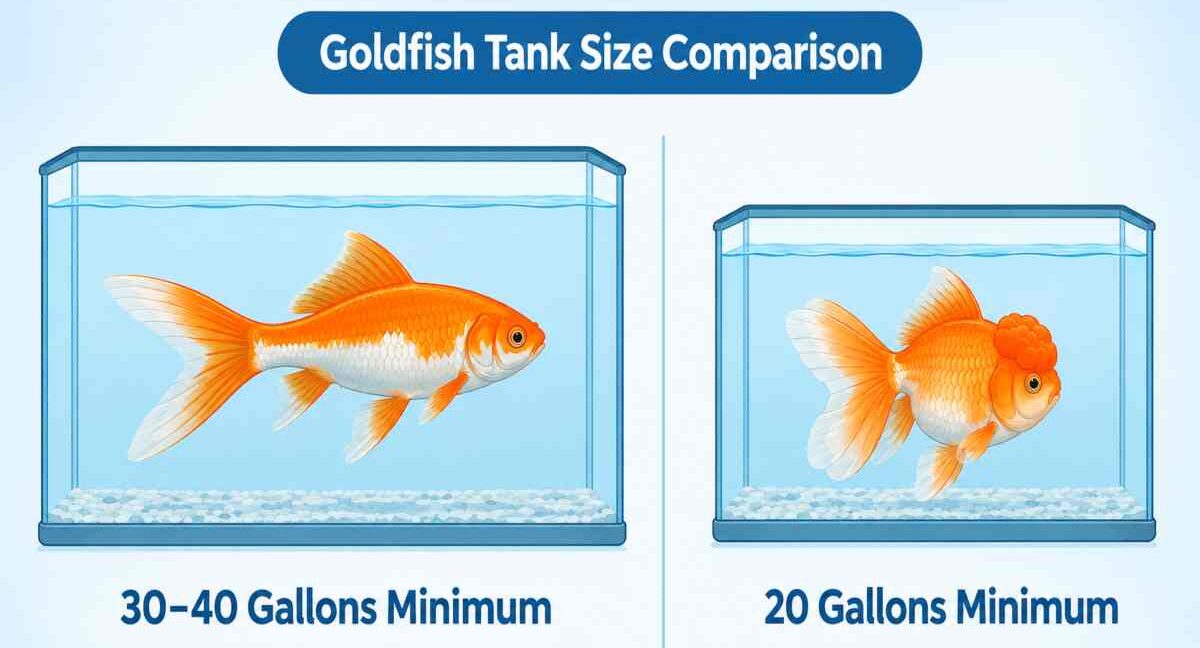 Common goldfish need more swimming room than rounder-bodied fancy varieties.
What Equipment Does a Goldfish Tank Setup Need?
A functional goldfish aquarium setup for beginners needs a shorter equipment list than most people expect, but each item has to be sized correctly rather than chosen for looks.
What Filter Does a Goldfish Tank Need?
Filtration is where most goldfish tanks fail. Because goldfish generate a heavy bioload, rate filtration for roughly two to three times the tank’s actual gallon capacity, not just the tank size printed on the box. A hang-on-back (HOB) filter works well for tanks up to about 40 gallons. In contrast, a canister filter is usually the better choice for larger setups because it holds more media and provides stronger mechanical and biological filtration in one unit.
The filter’s biological media is where beneficial bacteria colonize and convert ammonia into less harmful compounds, so you should never rinse it under tap water or replace it all at once. Rinsing media in removed tank water during routine cleaning protects that bacterial colony.
Do Goldfish Need a Heater?
Most goldfish, especially common, comet, and shubunkin varieties, do not need a heater and do well at stable room temperature. Fancy goldfish with rounder bodies and reduced swim bladder efficiency, such as orandas and ranchu, benefit from a stable temperature in the mid-60s to low 70s°F, which sometimes calls for a low-wattage heater in homes with fluctuating room temperatures rather than for warmth itself.
What Substrate Is Safest for a Goldfish Tank?
Sand and smooth, rounded gravel are both safe options, and the right choice depends on how the fish forage. Goldfish sift through substrate constantly while looking for food, so sharp or small gravel can injure their mouths or get swallowed and contribute to digestive blockages.
| Substrate | Pros | Cons |
|---|---|---|
| Fine sand | Safe for foraging, easy to spot-clean, mimics a natural riverbed | Can compact and trap gas pockets if not stirred occasionally |
| Smooth, rounded gravel (medium grain) | Provides good bacterial surface area and is widely available | Avoid sharp or very small pieces that could be ingested |
| Bare bottom | Easiest to keep clean; ideal for quarantine or grow-out tanks | Less natural appearance and no rooting medium for plants |
Whichever substrate is chosen, it should be rinsed thoroughly before adding it to the tank and vacuumed gently during water changes to prevent waste and uneaten food from accumulating underneath it.
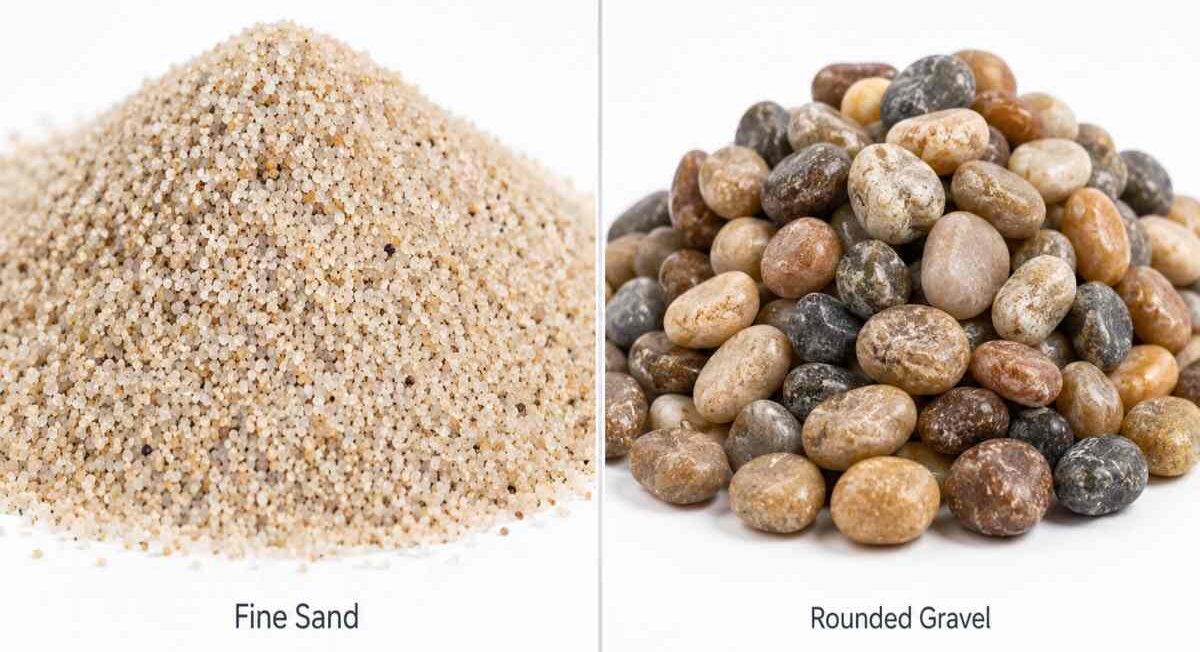 Both are goldfish-safe, but grain shape affects foraging comfort and cleaning ease.
What Decorations Are Safe for a Goldfish Aquarium?
Smooth ceramic caves, rounded river rock, and soft silicone plants are safer choices than sharp resin ornaments or rough rockwork, since goldfish are fast, sometimes clumsy swimmers with delicate fins and prominent eyes in some varieties. Arrange decorations with open swimming lanes in mind rather than packing them densely, since goldfish need room to cruise rather than weave through obstacles.
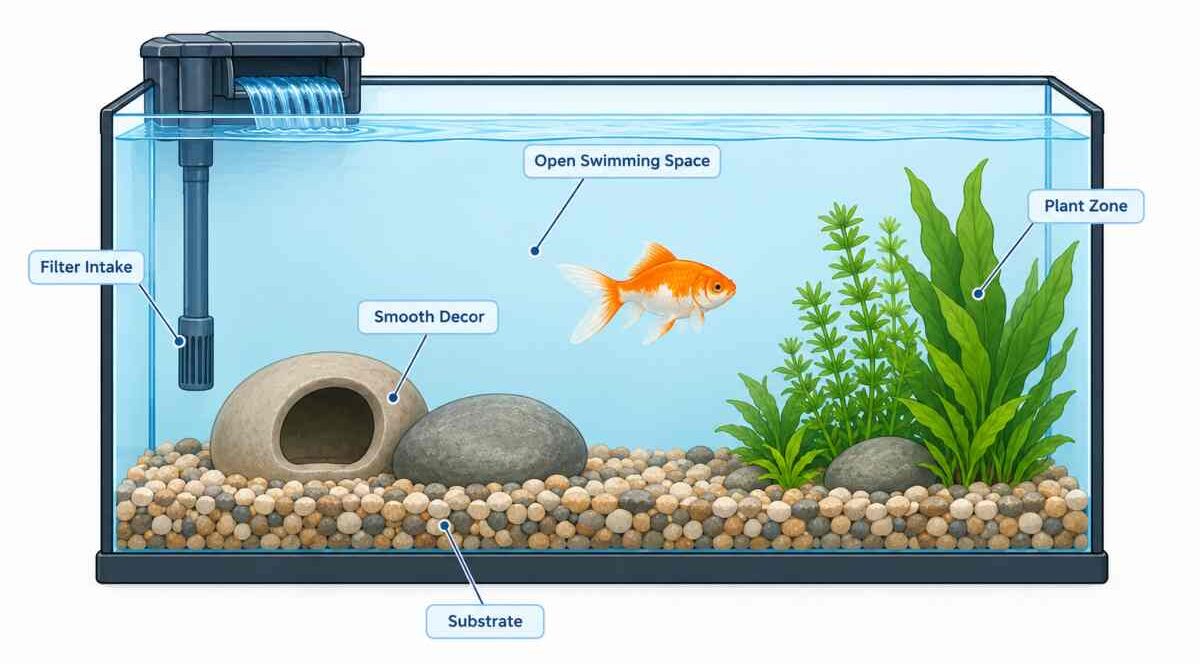 Every element here is chosen and placed with goldfish safety and swimming room in mind.
Which Live Plants Survive Goldfish Grazing?
Goldfish graze on soft plant matter, so many popular aquarium plants get shredded within days. A handful of species are tough or fast-growing enough to survive and even help absorb excess nutrients from the goldfish’s heavy waste output.
Java fern, Anubias, and Amazon sword hold up well because their leaves are thick and less appealing to nibble. Anacharis and hornwort are excellent choices even though goldfish do eat them, since both grow fast enough to outpace the grazing and double as a natural nutrient export that helps buffer ammonia spikes between water changes.
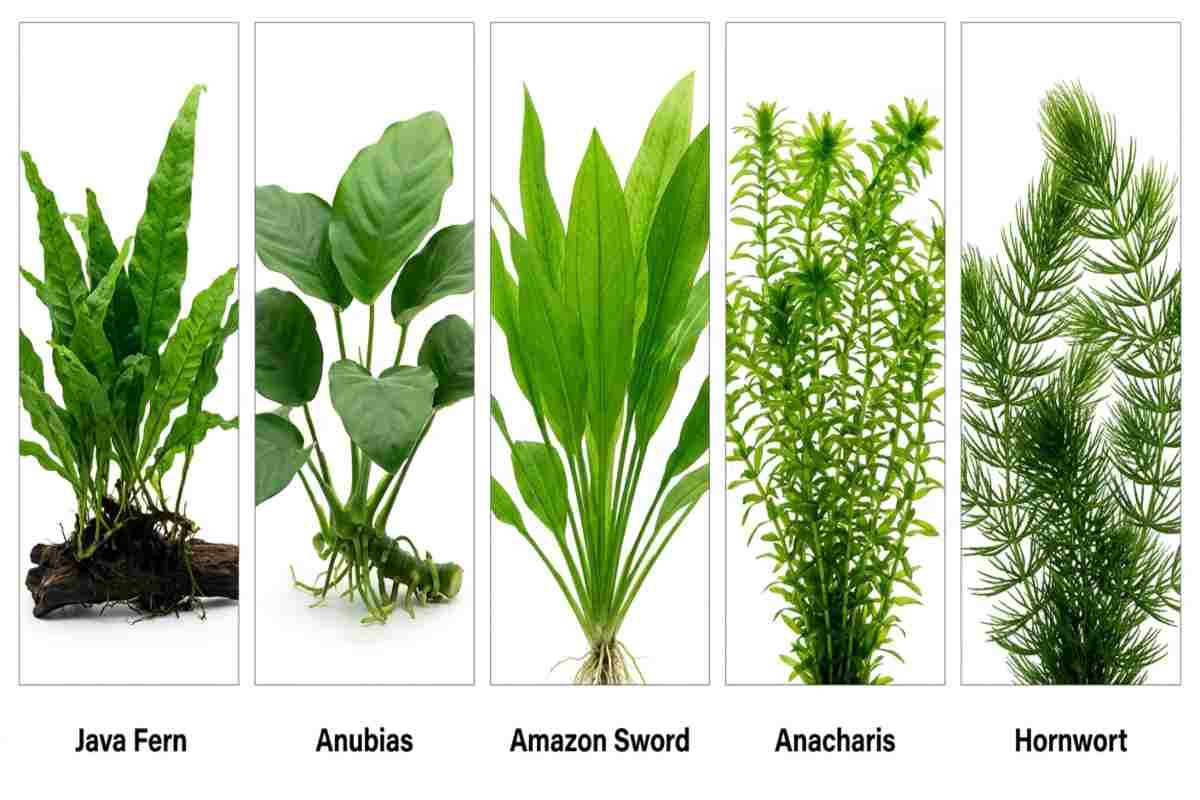 These five species hold up best against a goldfish’s constant grazing and digging.
How Do You Cycle a New Goldfish Tank Before Adding Fish?
Cycling is the process of growing a stable colony of beneficial bacteria that converts toxic ammonia into nitrite and then into far less harmful nitrate. You must establish this nitrogen cycle before adding any goldfish, because an uncycled tank has no biological filtration and ammonia can build up to lethal levels within days.
The safest method is a fishless cycle, using a pure ammonia source instead of live fish to feed the process. It generally unfolds in three overlapping stages.
- Add a small dose of pure ammonia to raise the level to roughly 2 to 4 ppm, then test daily with a liquid-reagent aquarium water test kit.
- Watch ammonia fall as nitrite rises, which shows that ammonia-oxidizing bacteria have established. Continue dosing ammonia to keep feeding the colony.
- Wait for nitrite to fall to zero as nitrate rises, which confirms the second group of bacteria has established. Once the tank can process a full ammonia dose to zero ammonia and zero nitrite within 24 hours, the cycle is complete, and you can add fish gradually.
This process typically takes two to six weeks. Products containing live nitrifying bacteria can shorten it, but they do not replace it entirely. A useful way to think about ammonia and nitrite during this stage is that both are actively toxic to fish gills and tissue. At the same time, nitrate is comparatively low-risk until it accumulates over many weeks without water changes, as described in general aquarium husbandry guidance from the Merck Veterinary Manual.
If fish are already in an uncycled tank, manage ammonia and nitrite spikes with daily testing, a detoxifying water conditioner, and small, frequent water changes until the cycle catches up.
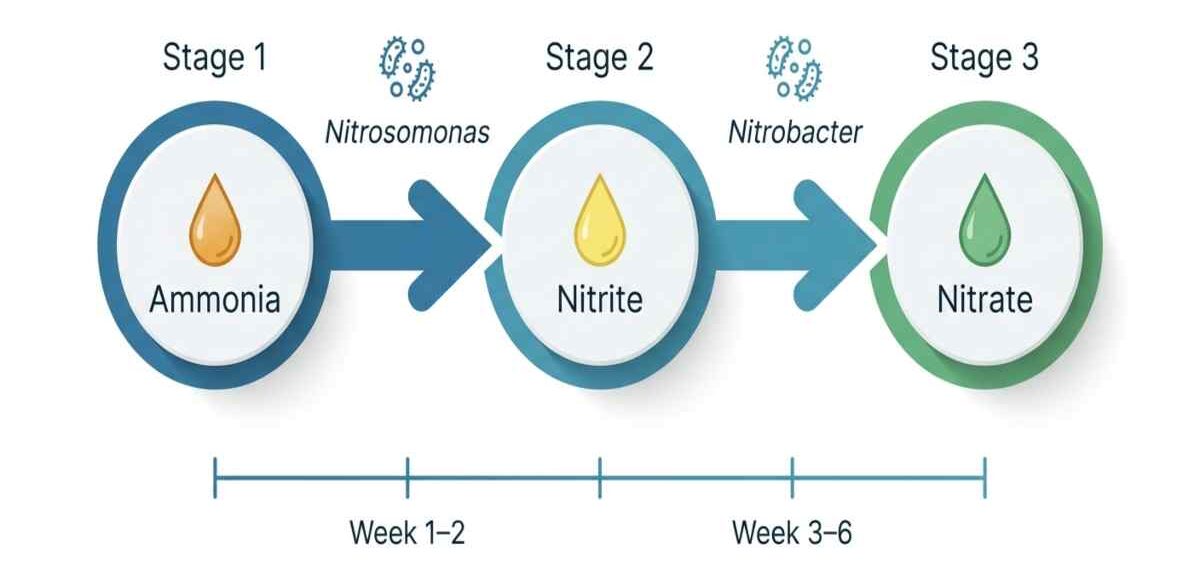 Nitrosomonas and Nitrobacter bacteria drive each stage of this conversion process.
What Water Parameters Do Goldfish Need?
Goldfish are more forgiving of temperature swings than tropical fish, but they are just as sensitive to ammonia, nitrite, and unstable pH as any other freshwater species.
| Parameter | Ideal Range | Notes |
|---|---|---|
| Temperature | 65–72°F (18–22°C) | Fancy varieties do best on the higher end of this range |
| pH | 7.0–8.0 | Goldfish tolerate slightly alkaline water well |
| Ammonia | 0 ppm | Any detectable ammonia is a warning sign |
| Nitrite | 0 ppm | Toxic even in small amounts |
| Nitrate | Under 20–30 ppm | Controlled through weekly water changes |
| Dissolved oxygen | Well-oxygenated | Supported by surface agitation or an air stone |
Tap water almost always contains chlorine or chloramine, so add a water conditioner or dechlorinator before or as new water enters the tank. Because goldfish tanks are heavily stocked relative to their bioload, an air stone or a filter outlet that agitates the surface helps maintain dissolved oxygen levels, especially in summer when warmer water holds less oxygen.
How Do You Set Up a Goldfish Tank Step by Step?
Once you’ve chosen the tank, filter, and substrate, assembly follows a fairly fixed order.
- Rinse the substrate thoroughly and add it to the empty tank, then rinse and place any decorations.
- Fill the tank with dechlorinated water, treating it with a water conditioner as it fills.
- Install and start the filter, along with an air stone if the tank will be heavily stocked.
- Add any live plants once the water has settled and cleared.
- Begin the fishless cycle using pure ammonia, testing every one to two days with a liquid test kit.
- Once ammonia and nitrite both read zero after a full ammonia dose, do a partial water change and add the first one or two goldfish.
- Continue testing two to three times a week for the first month, adding any remaining fish gradually rather than all at once.
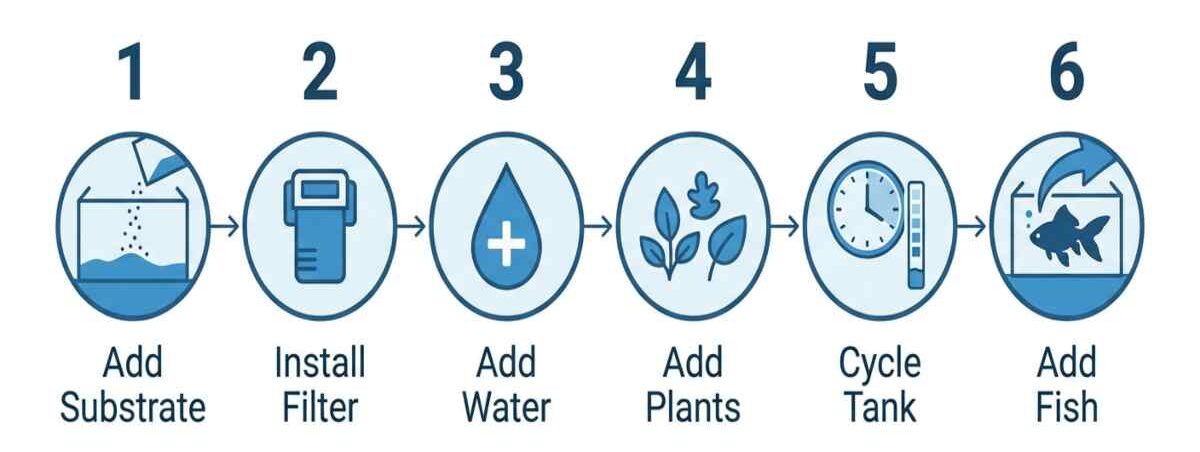 Following this order in sequence prevents the most common early setup mistakes.
How Do You Maintain a Goldfish Tank Long-Term?
A cycled tank is the starting line, not the finish line. Because goldfish produce a heavy bioload throughout their lives, ongoing maintenance keeps the nitrogen cycle stable.
Weekly water changes of 25 to 50 percent are the core of long-term goldfish tank maintenance, since even a fully cycled tank cannot remove nitrate on its own. Each water change should include gently vacuuming the substrate to remove uneaten food and waste without disturbing the bacteria colony living in the filter media.
Filter media should be rinsed in removed tank water, never tap water, roughly once a month, and only partially replaced at a time if using disposable cartridges, so the bacteria colony is never wiped out all at once. Glass or acrylic walls benefit from a weekly algae scrape, and testing ammonia, nitrite, pH, and nitrate every one to two weeks helps catch problems before fish show symptoms.
What Mistakes Do Beginners Make When Setting Up a Goldfish Tank?
The most common mistake is buying a small bowl or tank based on the fish’s current size rather than its adult size, which can lead to stunted growth and chronically poor water quality. A close second is skipping the cycling process entirely and adding fish to fresh, untreated water, which exposes them to an ammonia spike in the first week.
Undersized or mismatched filtration is another frequent problem, often caused by trusting a filter’s advertised tank-size rating instead of sizing it to goldfish-level bioload. Sharp decorations, small gravel that can be swallowed, and overcrowding a tank because “they looked small at the store” round out the mistakes that most often show up in stressed or sick goldfish down the line.
What Tank Mates Are Compatible With Goldfish?
Goldfish do best with other coldwater fish that share their temperature range and calm temperament, such as other goldfish varieties, white cloud mountain minnows, and hillstream loaches in larger, well-oxygenated setups. Most tropical community fish, along with fin-nipping or aggressive species, are poor matches because goldfish are slow-mouthed grazers that cannot compete for food and have fins that are easy targets. Stocking decisions should always come back to the tank size guidelines above, since adding tank mates increases the bioload the filter and water-change schedule must support.
Goldfish reward the effort of a properly sized, filtered, and cycled tank with a lifespan that can stretch well past a decade, sometimes two, which makes goldfish tank setup one of the few areas in fishkeeping where getting it right the first time genuinely pays off for years. The Fish Care will keep this guide updated as filtration and water-testing standards evolve.
Frequently Asked Questions
Do goldfish need a filter?
Yes. Goldfish produce enough waste that an unfiltered tank will build up ammonia dangerously fast, regardless of tank size.
Can I use a goldfish tank setup checklist to shop faster?
Yes. At minimum, budget for a tank sized to the adult fish, a filter rated for two to three times that volume, substrate, a water conditioner, a liquid test kit, and an air stone if the tank is heavily stocked.
How long does it take to cycle a goldfish tank?
A fishless cycle typically takes two to six weeks, depending on water temperature, consistent ammonia dosing, and whether you use a bacterial starter product.
Is sand or gravel better for a goldfish tank?
Both are safe when the substrate is fine or smooth. The deciding factor is ease of cleaning and whether live plants will be rooted, not safety, since goldfish can forage in either.
Can fancy goldfish live in the same tank as common goldfish?
It is not recommended long-term. Common and comet goldfish are faster swimmers and will consistently outcompete slower, rounder-bodied fancy goldfish for food.