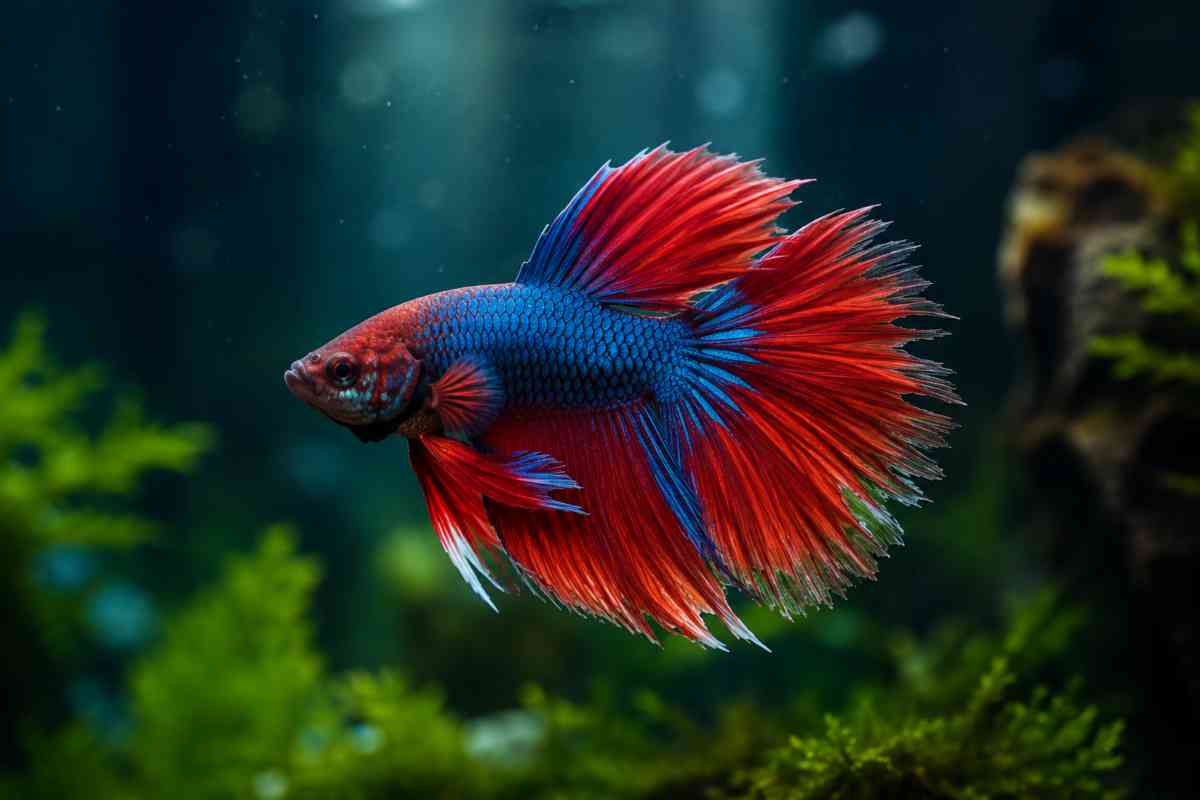
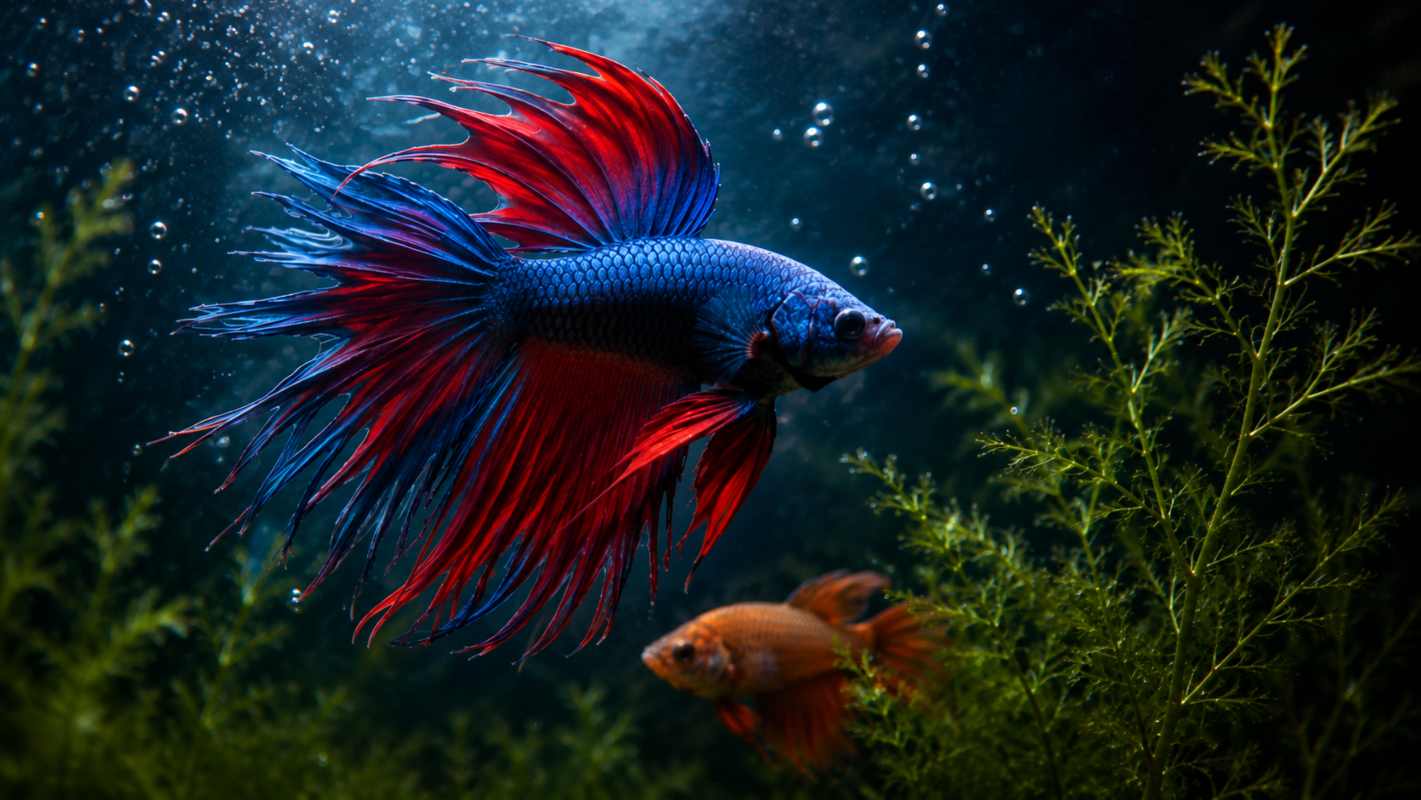
Yes, but only under specific conditions, and “living together” means very different things depending on your setup. A male and female betta can share a large, heavily planted tank (30 gallons or more) with visual breaks and multiple hiding spots, provided you introduce them carefully and watch closely for aggression. What they cannot do is share a small, sparse tank or stay together unsupervised during breeding. That combination is one of the most common ways new betta keepers accidentally kill a fish. The real question isn’t “can they,” it’s “should you, and under what conditions will it actually work.
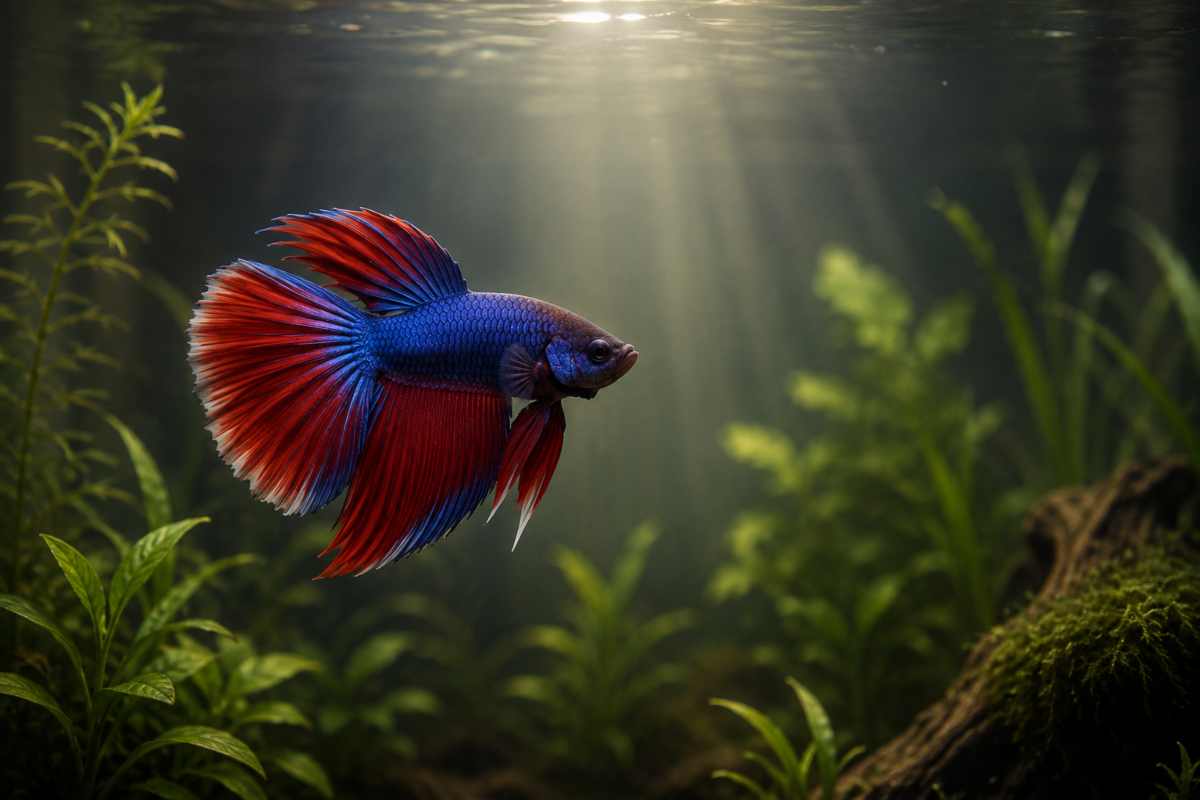
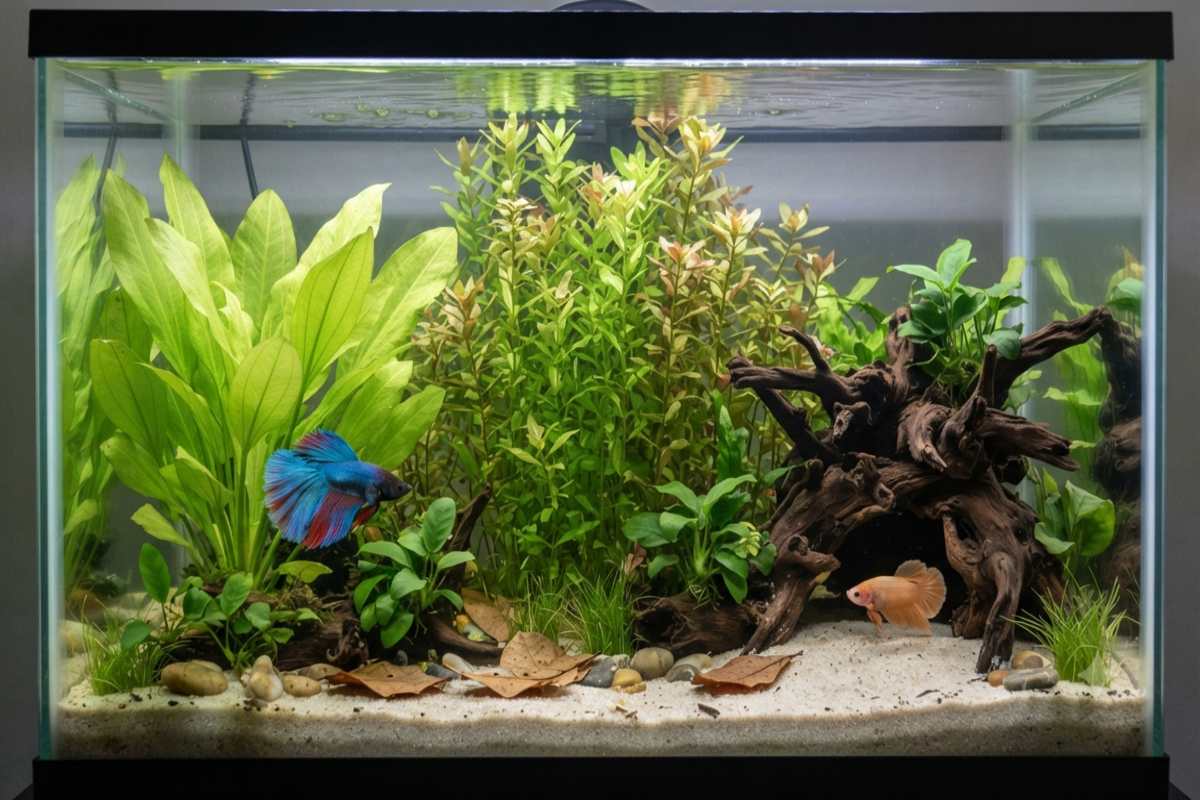 A male betta rests near leafy plants while the female stays near her own driftwood cave on the opposite side.
Why Bettas Behave the Way They Do
To understand whether a male and female betta can live together, it helps to know why bettas are territorial in the first place. Their aggression isn’t random—it’s an adaptation shaped by their natural environment.
Betta splendens evolved in the shallow rice paddies, floodplains, and slow-moving waters of Thailand, Cambodia, Vietnam, and Laos. During dry seasons, these habitats often break into small, oxygen-poor pools. Bettas survived by developing a labyrinth organ that allows them to breathe air from the surface. Still, the limited space also meant they frequently competed for territory, food, and breeding sites.
This history explains two important behaviors:
- Male-to-male aggression is highly territorial and almost always results in fighting, as males naturally compete to control breeding territory.
- Male-to-female aggression is less predictable. A male may tolerate or court a female during breeding, but his behavior can quickly change—especially after building a bubble nest, when he becomes protective of his eggs.
The key takeaway is that male bettas are conditionally tolerant rather than naturally social. Whether they can live with a female depends largely on the tank setup, breeding condition, and each fish’s individual temperament.
The Short-Term vs. Long-Term Distinction (This Is the Part People Get Wrong)
Most of the confusion around this topic comes from conflating two completely different scenarios:
| Scenario | Duration | Purpose | Risk Level |
| Breeding introduction | Hours to a few days | Spawning | High (requires constant supervision) |
| Permanent cohabitation | Months to years | Community living | Moderate to high (requires ideal tank conditions) |
| “Just trying it to see” | Unplanned/indefinite | None | Highest (no plan means no exit strategy) |
A male and female betta fish introduced purely for breeding are together for a narrow window and removed (specifically the female) as soon as spawning finishes, because the male’s aggression toward her spikes sharply once he’s guarding fertilized eggs. This is a supervised, temporary pairing, not cohabitation in the pet-keeping sense.
Permanent cohabitation, by contrast, is a long-term commitment that depends entirely on tank size, layout, and the individual fish’s temperament. Some bettas are simply calmer than others, the same way some dogs are friendlier than others of the same breed. There’s no guarantee, only better and worse odds.
Can They Actually Live Together Long-Term? A Realistic Breakdown
Here’s the honest, nuanced picture, broken down by setup type:
1. Small tank (under 15 gallons), no barriers
Verdict: No. This is almost guaranteed to end in torn fins, chronic stress, or a dead fish. There isn’t enough space for the female to escape the male’s territory, and bettas can’t “agree to disagree” the way some community fish can.
2. Medium tank (15–29 gallons), heavily planted
Verdict: Risky, fish-dependent. Some pairs do fine; others don’t. This size can work if the male has a notably calm temperament and the tank has dense plant cover, but it’s not a setup we’d recommend for a first attempt.
3. Large tank (30+ gallons), densely planted with visual breaks
Verdict: Best realistic chance of success. This is the size most experienced keepers cite as the minimum for sustainable cohabitation, because it gives the female enough room to establish her own territory away from the male and to retreat when he flares.
4. One male with a female “sorority” (group of females)
Verdict: An underrated alternative worth considering. Rather than a single pair, some keepers house one male with a small group of unrelated females (a female betta group is often informally called a sorority when kept without a male, but the same social dynamic principle, safety and hierarchy in numbers, applies here). This spreads the male’s attention rather than concentrating it on one female, and it’s often more stable than a single pair, provided the tank is large enough to support the extra bioload and territories.
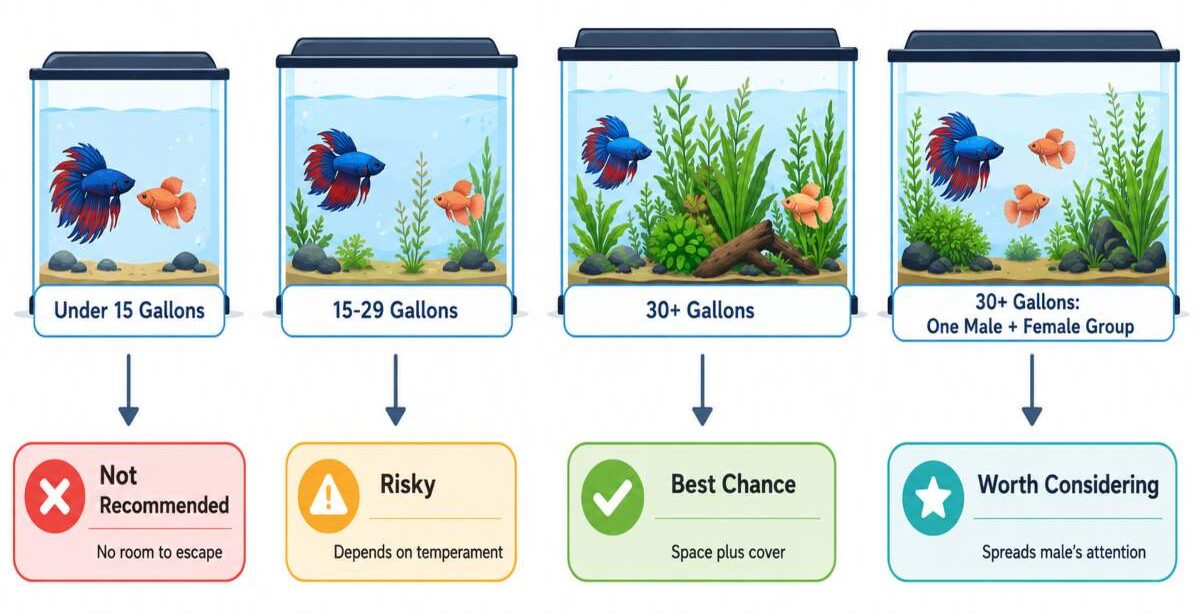 Tank size is the single biggest factor in whether a male and female betta can safely live together.
What a Safe Setup Actually Requires
If you’ve decided the odds are worth it, here’s what separates a setup that works from one that doesn’t.
1. Tank Size and Shape
A minimum of 30 gallons is the widely recommended starting point for permanent male-female cohabitation, with length mattering more than height, since bettas need horizontal territory to retreat into rather than vertical space.
2. Dense Planting and Visual Barriers
Live or silk plants (avoid sharp plastic plants, which tear fins), driftwood, and caves break sightlines. This matters more than almost any other factor: bettas that can’t constantly see each other flare and posture far less, because a huge amount of betta aggression is triggered by visual confrontation rather than actual physical contact.
3. Multiple Hiding Spots: More Than the Number of Fish
The rule of thumb is to provide at least one more hiding spot than you have bettas, so there’s always an unclaimed retreat available. If there are two fish and only one good cave, that cave becomes a contested resource and a flashpoint.
4. Soft, Rounded Décor
Smooth-edged decorations reduce the risk of torn fins during chases, which matters even in low-aggression pairings, since mild chasing still occurs.
5. Stable Water Parameters
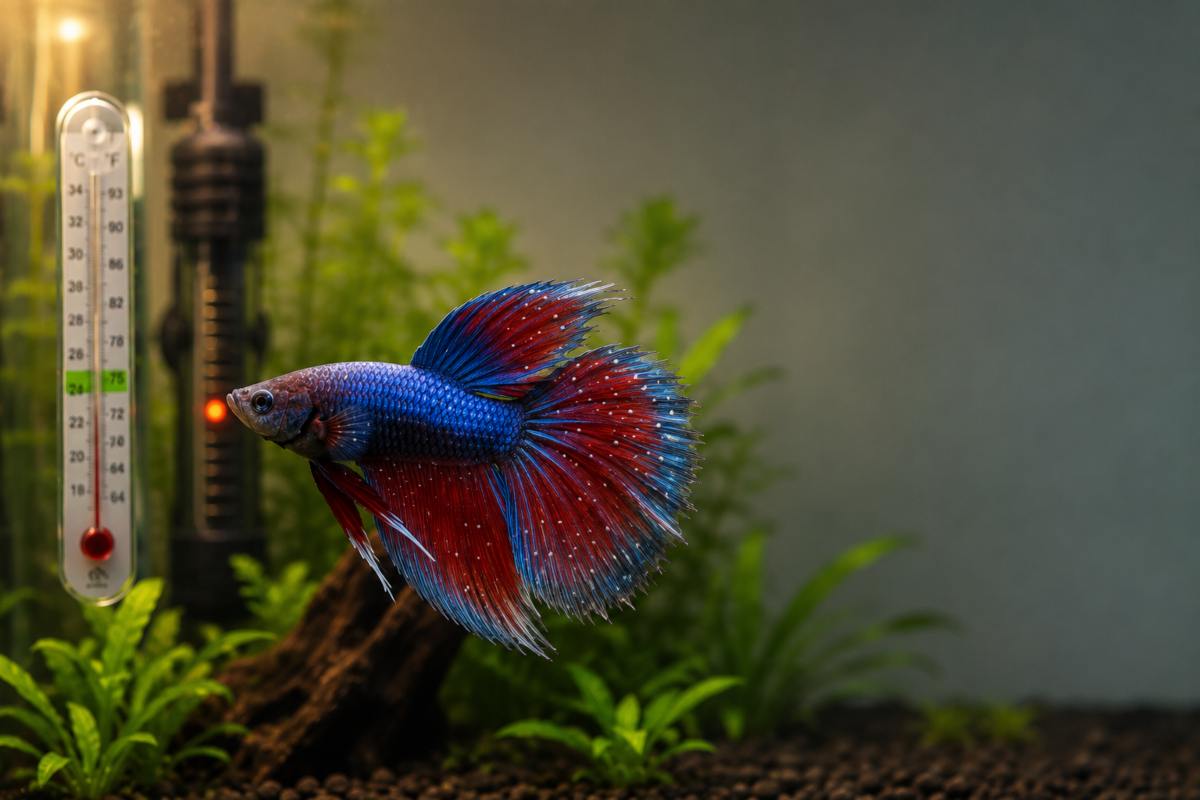
Bettas are more prone to stress-related illness, including susceptibility to conditions like ich, when water quality fluctuates, and a stressed, cohabitating pair is already running a higher baseline stress level than a solo betta. Keeping ammonia at zero, temperature stable around 76–82°F (24–28°C), and doing regular partial water changes isn’t optional here; it’s a bigger deal than in a single-betta tank.
How to Introduce a Male and Female Betta Safely
Rushing the introduction is one of the biggest mistakes you can make. Follow these steps to give your fish the best chance of coexisting peacefully:
- Quarantine First: Keep both fish in separate tanks for 2–4 weeks to ensure neither is carrying diseases or parasites into the shared aquarium.
- Prepare the Tank: Fully cycle the aquarium and allow plants and decorations to settle before introducing either fish. Stable water conditions reduce stress from the start.
- Use a Divider: Place a clear divider between the fish for 1–2 weeks so they can see each other without making contact. This helps them adjust gradually.
- Introduce the Female: Add the female to the male’s established tank rather than moving both fish into a new aquarium, which can trigger territorial disputes.
- Monitor Closely: Watch the pair carefully during the first 48–72 hours. Brief flaring and short chases are normal, but persistent aggression or repeated attacks are signs they should be separated.
- Have a Backup Plan: Keep a spare tank or divider ready before the introduction. Even calm bettas can become aggressive without warning, so be prepared to separate them immediately if needed.
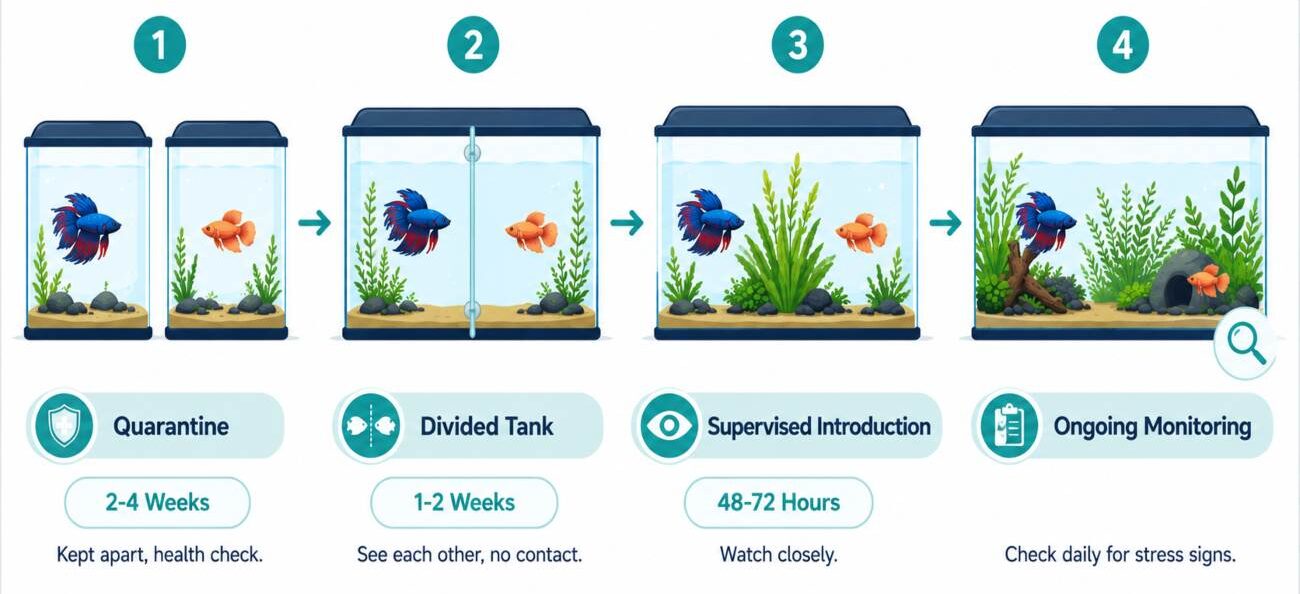 A staged introduction, not a rushed one, is what separates a safe pairing from a dangerous one.
Warning Signs You Need to Separate Them
Some flaring and chasing are normal, but certain behaviors mean it’s time to separate the fish immediately.
Normal, Expected Behavior
- Flaring: Brief fin spreading and gill flaring during the first introduction is normal as the fish assess each other.
- Short Chases: Occasional, brief chasing is part of establishing territory and should stop quickly.
- Minor Posturing: A few days of mild territorial displays can occur before the fish settle into their own spaces.
Separate Them Immediately If You Notice
- Torn Fins: Shredded or damaged fins indicate real fighting, not harmless posturing.
- Constant Hiding: A fish that hides all the time or refuses to eat is under excessive stress.
- Persistent Chasing: Aggression that continues for several days without improving is a warning sign.
- Physical Stress: Clamped fins, scale damage, or lethargy suggest the fish is being harmed.
- Nest Guarding: Remove the female immediately if the male becomes aggressive after spawning or while guarding a bubble nest.
If you notice any of these warning signs, don’t wait. Betta aggression can escalate quickly, and separating the fish immediately is often the safest way to prevent serious injury.
Breeding vs. Cohabitation: Two Different Goals, Two Different Setups
It’s worth being explicit about this because much of the online confusion stems from applying breeding advice to pet-keeping situations, and vice versa.
| Factor | Breeding Setup | Permanent Cohabitation |
| Goal | Successful spawning | Long-term peaceful coexistence |
| Duration together | Hours to days | Months to years |
| Female removed after? | Yes, immediately post-spawn | No, she stays permanently |
| Supervision level | Constant, hands-on | Regular observation, not constant |
| Water temperature | Slightly raised (78–82°F) to encourage spawning | Stable within the normal betta range |
| Tank size | Can be smaller, dedicated breeding tank | Must be large (30+ gallons) |
| Risk to female | Highest right after spawning | Ongoing but lower with a proper setup |
If your goal is breeding rather than long-term cohabitation, the process is very different. It involves conditioning both fish, introducing the female carefully (often using a divider), waiting for spawning, and removing the female immediately afterward because the male typically becomes highly protective of the nest and may attack her. Breeding is a specialized, closely supervised process—not the same as keeping a pair together long term.
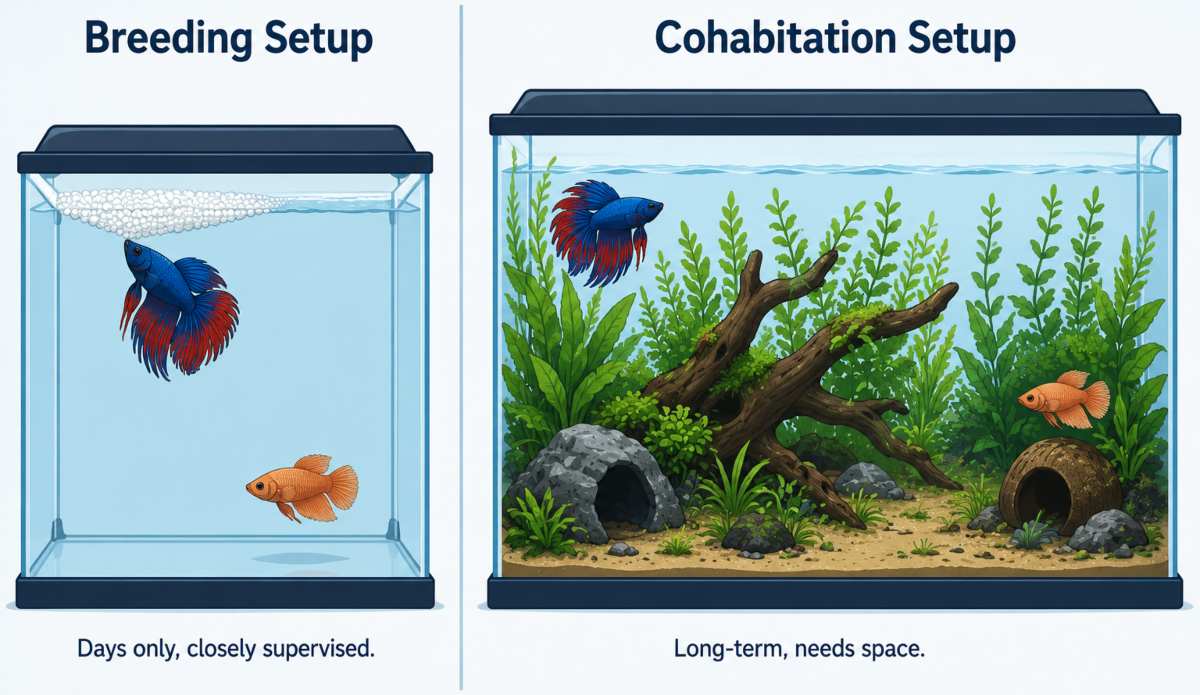 Breeding pairs and permanent pairs need two very different tank setups, not the same one.
Comparison: Your Realistic Betta-Keeping Options
If male-female cohabitation feels riskier than you’d like after reading all this, it’s not your only option for keeping more than one betta.
| Setup | Difficulty | Best For | Key Risk |
| Single betta | Easiest | First-time keepers, small tanks | None specific to cohabitation |
| Female sorority (4–6 females, no male) | Moderate | Keepers wanting a group dynamic | Hierarchy squabbles during the initial weeks |
| One male + female sorority | Moderate to high | Experienced keepers with large tanks | Male aggression concentrating on one female |
| Single male-female pair | High | Very experienced keepers with a dedicated large tank | Escalation risk, especially near breeding condition |
| Two males (same tank) | Not recommended | N/A | Near-certain fatal fighting |
A Quick Pre-Decision Checklist
Before you attempt cohabitation, honestly check whether you can say yes to all of these:
- The tank is 30 gallons or larger
- The tank is densely planted with multiple sightline breaks
- You have more hiding spots than fish
- Both fish have completed a separate quarantine period
- You have a backup tank or divider ready right now, not “eventually”
- You can observe the tank closely for the first several days
- You’re prepared to separate them permanently if aggression doesn’t settle
- This isn’t your first time keeping bettas
If you can’t check every box, especially the backup-tank and first-time-keeper ones, it’s worth waiting until you can, rather than hoping it works out.
Frequently Asked Questions
Will a male betta always attack a female betta?
No. Male aggression toward females is conditional rather than guaranteed. It depends heavily on tank setup, the individual fish’s temperament, and breeding conditions. However, “usually tolerant” isn’t the same as “always safe,” which is why supervision and an exit plan matter regardless of how calm a male seems at first.
How big does the tank need to be for a male and female betta to live together?
Most experienced keepers point to 30 gallons as the practical minimum for permanent cohabitation, with dense planting mattering just as much as raw volume. Smaller tanks dramatically increase the risk of injury because the female has nowhere to retreat.
Can I put a male and female betta together just to breed them, then separate them?
Yes, and this is actually the more common and better-understood use case for pairing the sexes. The female is removed as soon as spawning finishes, since the male’s aggression toward her typically rises once he’s guarding the bubble nest and eggs.
What’s the difference between a betta sorority and a male-female pairing?
A sorority is a group of unrelated female bettas kept together without a male, which tends to be more predictable than mixed-sex pairings because it avoids breeding-related aggression entirely. A male-female pair carries the added variable of mating behavior, which can shift a male’s temperament unpredictably.
Do female bettas fight each other too?
Yes, females establish their own pecking order and can flare and chase during the first days of a sorority setup. However, these conflicts usually resolve into a stable hierarchy rather than escalating to serious injury, which tends to happen more often between two males.
Is it cruel to keep male and female bettas separated permanently?
No. Bettas are naturally more solitary than social by nature, and a well-set-up single-betta tank isn’t a deprived environment. It’s simply matching the fish’s evolved temperament. Separation isn’t a compromise; for many individual bettas, it’s actually the lower-stress option.
The Bottom Line
Male and female bettas can share a tank, but “can” is doing a lot of work in that sentence. Success comes down to space, cover, a staged introduction, and a keeper ready to separate the fish the moment things stop looking like normal hierarchy-building. If you can’t commit to that, keeping them separately or trying a female sorority instead is a perfectly good outcome, not a consolation prize.
Sources: This guide draws on insights from AquariumStoreDepot and FishLab, two well-regarded voices in the betta-keeping community.
A quick note on terms: a male-with-multiple-females setup is often called a “harem,” and an all-female group a “sorority.” These are hobbyist terms, not scientific ones.