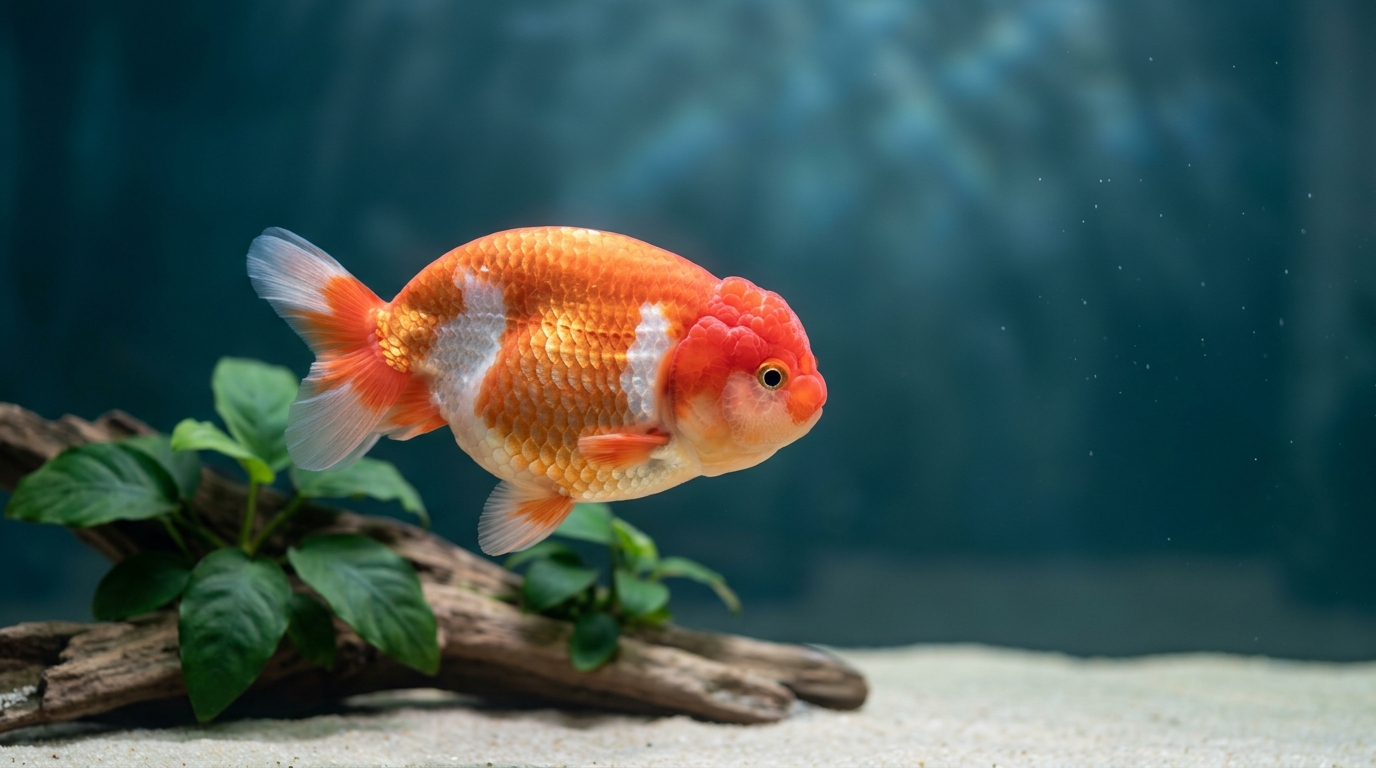
A lionhead goldfish is a slow, peaceful fancy goldfish with no dorsal fin and a rounded cap of soft, fleshy tissue called a wen. It needs at least 20 gallons (75 L) for the first fish and 10 more gallons for each addition, strong but gentle filtration, cool to moderate water, and sinking or pre-soaked food. With good care, it can live 10 to 15 years.
That sounds simple, but lionheads are among the more demanding goldfish. Their compact body, missing dorsal fin, and heavy wen make them poor swimmers, easy to outcompete, and prone to buoyancy trouble. This guide explains what they need and, more importantly, why.
Key Takeaways
- Plan for 20 gallons minimum for one lionhead and 30 gallons for two, then add 10 gallons per extra fish.
- Adults usually reach 5 to 7 inches (13 to 18 cm) and can live 10 to 15 years with excellent water quality.
- Feed small meals of sinking or pre-soaked food to reduce air gulping and swim bladder problems.
- The wen takes about two to three years to develop fully and needs clean water and smooth decor to stay healthy.
- Keep lionheads with other slow, round-bodied fancy goldfish, never with fast swimmers, fin nippers, or tropical fish.
What Is a Lionhead Goldfish and Where Does It Come From?
The lionhead is a fancy goldfish (Carassius auratus), a domesticated descendant of a wild carp relative that Chinese breeders began shaping more than a thousand years ago. The lionhead developed in China, and its name comes from the wen, which resembles a lion’s mane. The exact timeline is debated, so treat any single date you read with caution.
Four traits define the breed:
- An egg-shaped, compact body. It is shorter and deeper than a common goldfish.
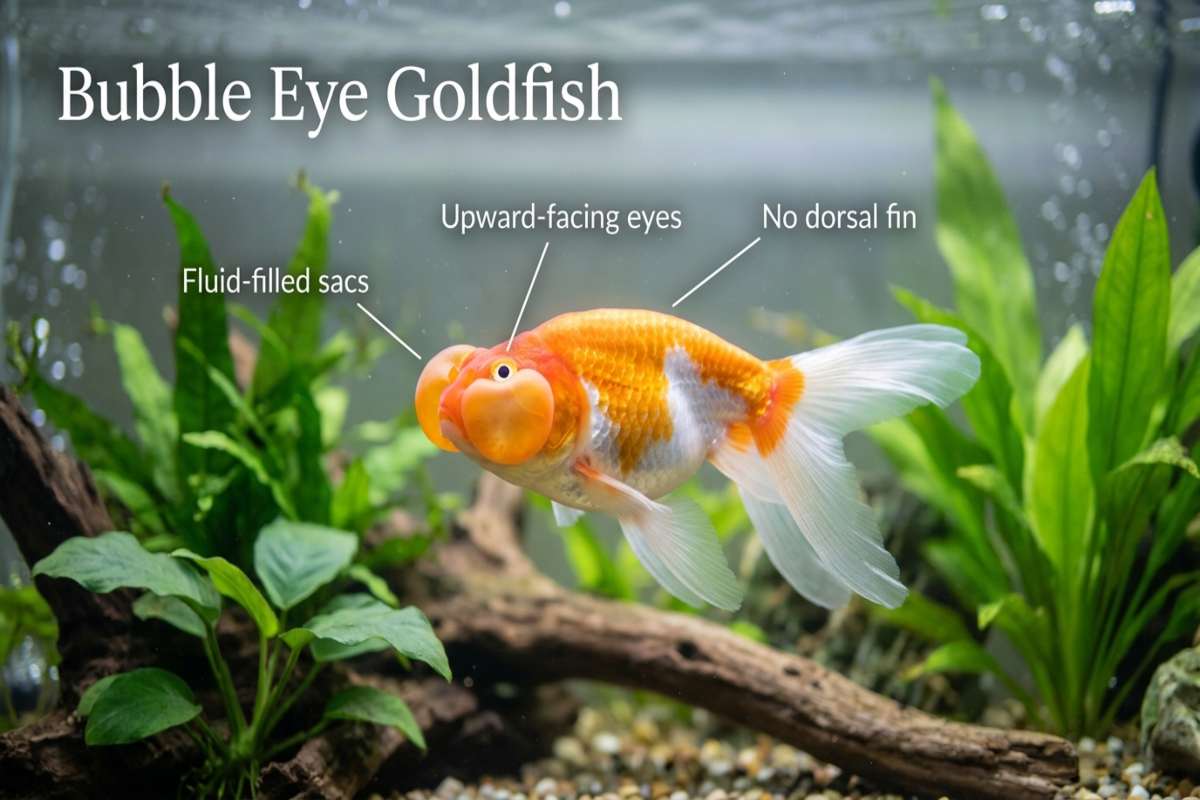
- No dorsal fin. The back is smooth and flat.
- A double caudal fin. The tail is split into twin lobes, usually short.
- A wen. This is a raised growth of soft tissue over the head, cheeks and gill covers.
These traits explain most of the care advice that follows. A dorsal fin helps most fish stay upright, so without one, a lionhead wobbles more and swims slowly. The compressed body leaves less room for the swim bladder and gut, which is why feeding and buoyancy matter so much.
Temperament is a bright spot. Lionheads are peaceful, curious, and often personable. Many learn to associate their keeper with food and will gather at the glass. For a broader look at how a goldfish’s body works, the anatomy page covers it well.
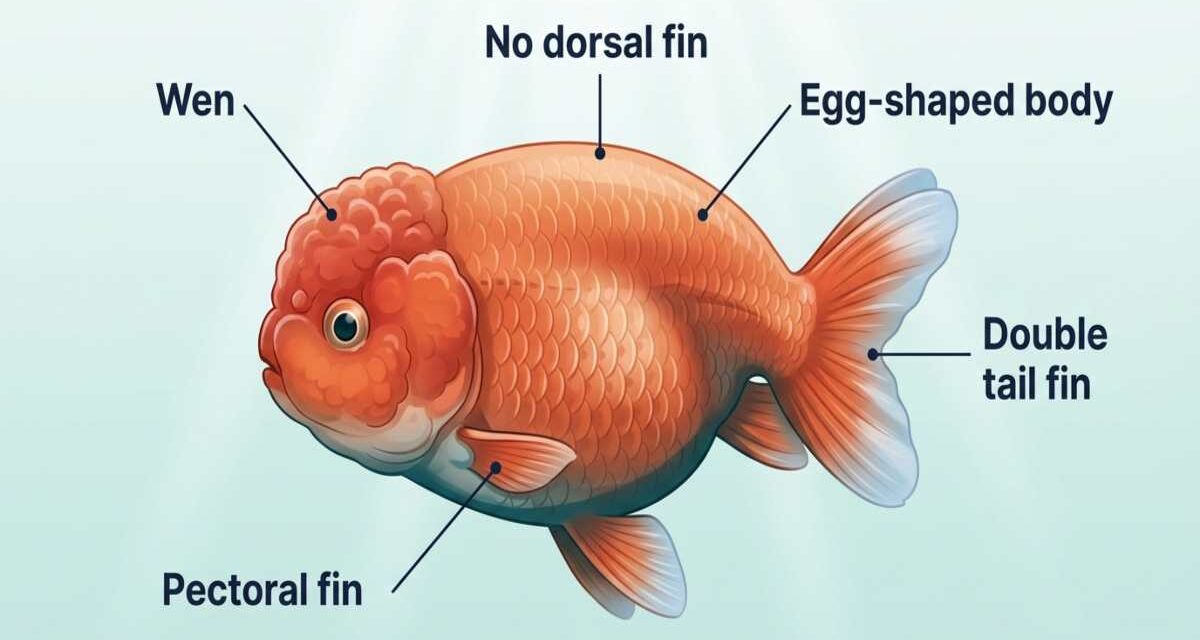 Key anatomy of a healthy lionhead goldfish.
How Is a Lionhead Different From a Ranchu?
People often confuse these two, and many sellers use the names loosely. Both lack a dorsal fin and carry a wen. The difference is mostly in the back line and tail.
| Feature | Lionhead | Ranchu |
|---|---|---|
| Origin | China | Japan, refined from Chinese stock |
| Back line | Fairly straight, gently curved | Strongly arched, hump-backed |
| Body | Slightly longer, less deep | Short, deep, very round |
| Tail | Short to medium, held more horizontally | Short, set low and angled downward |
| Wen | Often heavy on head and cheeks, varies by fish | Hood prized for being even and compact |
Care needs are nearly identical, so everything in this guide applies to both. If you are comparing other varieties, the goldfish varieties category is a good next stop.
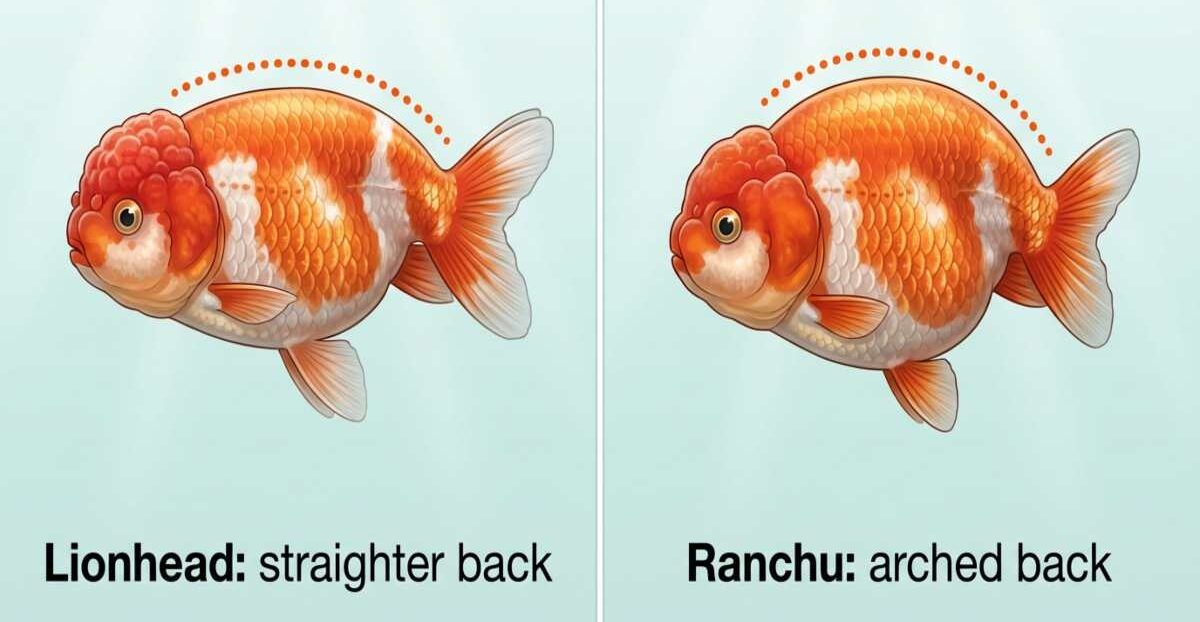 Lionhead and ranchu back lines compared.
How Big Do Lionhead Goldfish Get, and How Fast Do They Grow?
Most adult lionheads reach 5 to 7 inches (13 to 18 cm) in body length, and well-kept fish can approach 8 inches. They are smaller than single-tailed goldfish, but they are not tiny, and they produce plenty of waste for their size.
Growth is steadiest in the first year and then slows. Most fish reach the bulk of their size by two to three years, filling out in the body and wen after that.
One myth deserves a direct answer: a small tank does not keep a goldfish small. It stunts the fish, which can damage the skeleton and organs while the water fills with waste. A lionhead that stays small after a year is a warning sign, not a bonus. For size comparisons across varieties, see the dedicated size guide.
How Long Do Lionhead Goldfish Live?
A realistic lifespan is 10 to 15 years, and some fish live longer. Many die in the first few years, almost always because of avoidable husbandry problems rather than old age.
Four factors shape lifespan most:
- Water quality. Constant exposure to ammonia or nitrite shortens life. Veterinary references such as the Merck Veterinary Manual consistently identify water quality as the foundation of fish health.
- Tank size and stocking. Overcrowding raises waste and stress.
- Diet and feeding habits. Overfeeding and floating dry food can cause buoyancy issues and digestive trouble.
- Genetics. Fish from careless breeding can carry deformities that shorten their lives. Buy from a source that shows you the parents or at least healthy, active stock.
The best way to maximize lifespan is boring: stable water, modest feeding, and early action when something looks off.
What Tank Size Does a Lionhead Goldfish Need?
Plan on 20 gallons (75 L) as the floor for one lionhead, and think of 30 gallons (115 L) as the point where they genuinely thrive. For each additional fancy goldfish, add 10 gallons (about 40 L). Goldfish produce a lot of waste, so more water gives you a bigger buffer if something goes wrong.
| Number of lionheads | Minimum tank | Better choice |
|---|---|---|
| 1 | 20 gal (75 L) | 30 gal (115 L) |
| 2 | 30 gal (115 L) | 40 gal (150 L) |
| 3 | 40 gal (150 L) | 55 gal (210 L) |
| 4 | 50 gal (190 L) | 75 gal (285 L) |
Shape matters too. A long tank, such as a 20-gallon long or a 30- to 40-gallon breeder, beats a tall one. It gives more surface area for oxygen exchange and a more comfortable swimming depth for a poor swimmer.
Bowls and tiny “starter” kits are not suitable. They cannot hold enough water to dilute waste or support a proper filter.
What Does the Ideal Lionhead Tank Setup Look Like?
Which filter works best for a slow swimmer?
You need a filter that handles a heavy bioload without blasting the fish around. Choose one rated for a larger tank than yours, then soften the output with a baffle, a sponge pre-filter, or by pointing it at the glass.
A sponge filter on an air pump, plus a hang-on-back or canister filter, is a great pairing. The sponge provides gentle mechanical and biological filtration, and the second filter adds capacity and redundancy.
Add an air stone or surface agitation for oxygen. Goldfish use plenty of it, especially in warmer water.
Should you use gravel, sand, or a bare-bottom tank?
Each option has trade-offs:
- Bare-bottom: easiest to clean and no choking risk, but it looks stark and can reflect light that stresses fish.
- Sand: safe and natural for foraging, but it needs regular stirring or vacuuming to prevent waste from getting trapped.
- Large smooth gravel: acceptable only if every stone is too big to fit in the fish’s mouth. Small gravel is a choking hazard.
Whichever you choose, vacuum the substrate during weekly water changes to remove the waste that builds up.
What decor and plants are safe for a wen?
The wen is soft and easy to scrape. Choose smooth, rounded decor and test any item by dragging a nylon stocking over it. If the fabric snags, a wen can too.
Hardy aquatic plants for goldfish include anubias, java fern, and java moss, which you can attach to wood or rock instead of planting in the substrate. Goldfish uproot and nibble most delicate plants, so skip fine-leaved species.
Keep lighting moderate. Bright light and long photoperiods encourage green algae, which can grow on the wen.
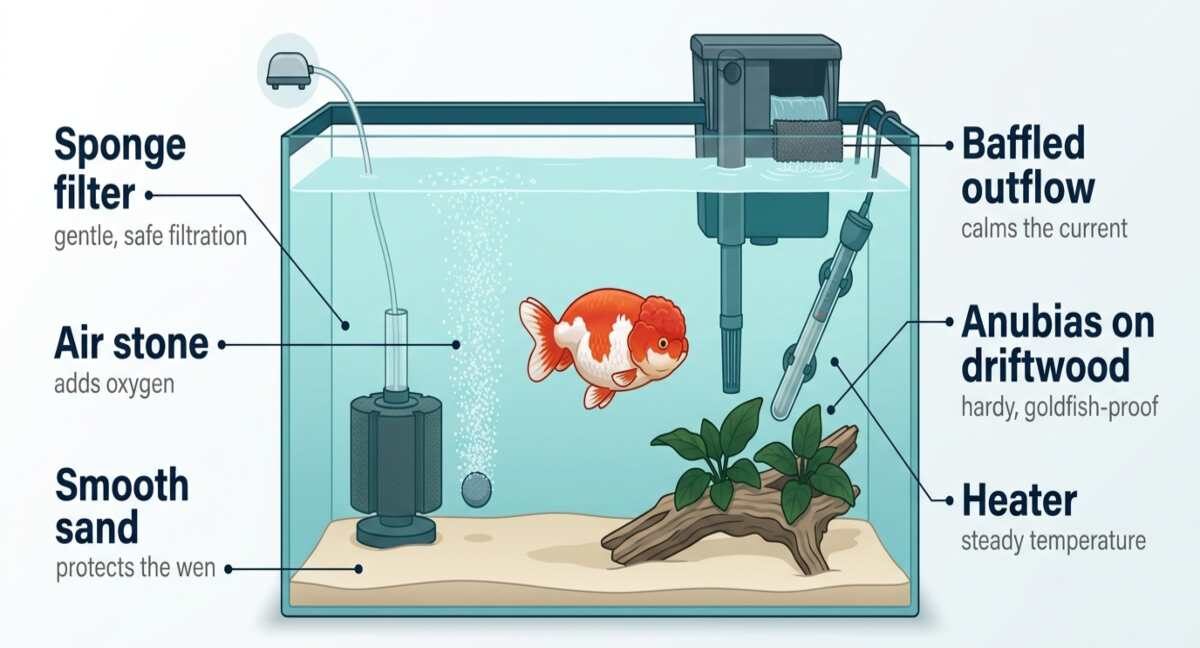 A safe, simple lionhead tank setup.
What Water Parameters and Temperature Do Lionheads Need?
Lionheads like cool to moderate water. Fancy goldfish tolerate less cold than single-tailed types, and temperature swings stress them more than a steady temperature does.
| Parameter | Target |
|---|---|
| Temperature | 65 to 72°F (18 to 22°C), with a brief ceiling around 75°F (24°C) |
| Ammonia | 0 ppm |
| Nitrite | 0 ppm |
| Nitrate | Under 20 ppm ideal, under 40 ppm acceptable |
| pH | 7.0 to 8.0, kept stable |
| Carbonate hardness (KH) | Roughly 4 to 8 dKH to hold pH steady |
In a cool room, a small heater set to around 68°F (20°C) smooths out day-night swings. Aquarium heater stability matters more than hitting a perfect number.
Why does the nitrogen cycle matter so much?
Fish waste produces ammonia, which is toxic. Beneficial bacteria convert it to nitrite, which is also toxic, then to nitrate, which is far less harmful. This is the nitrogen cycle, and a new tank has not built those bacteria yet.
Cycle the tank before adding fish; this usually takes about four to eight weeks. An ammonia spike in a fish-in setup can quickly burn gills and skin. A liquid test kit and a water conditioner that handles chlorine and chloramine are essential.
How often should you change the water?
A weekly 30 to 50 percent change, paired with gravel vacuuming, suits most lionhead tanks. Heavier stocking needs more. Match the new water’s temperature, and rinse filter sponges in removed tank water, never straight from the tap, since chlorine kills the bacteria you need.
What Should You Feed a Lionhead Goldfish?
Feed a high-quality sinking goldfish formula, or soak regular pellets first. Floating dry food encourages gulping air at the surface, which can worsen buoyancy problems in an already compressed body. Pre-soaking for a few minutes is widely used by experienced keepers for this reason.
Goldfish also have no true stomach, so food passes through quickly and waste accumulates fast. That is why small, frequent portions beat large meals. The fish digestive system overview explains the mechanics in more detail.
How often should you feed a lionhead?
Offer one or two small meals a day, only what the fish can finish in about a minute. Juveniles can eat a bit more often. Many keepers skip feeding one day a week to let digestion catch up.
Because the wen can partly block vision, lionheads are slow to find food. Feed with a target feeder or a sinking pellet near them so faster tank mates do not take everything.
Which foods belong in the rotation?
| Food | Role | How to use it |
|---|---|---|
| Sinking goldfish pellets or gel food | Staple | Main diet, soaked if needed |
| Blanched, skinned peas | Fiber treat | Occasionally, widely used though research on benefits is limited |
| Blanched zucchini, spinach, lettuce | Fiber and variety | A few times a week |
| Frozen or soaked freeze-dried bloodworms and brine shrimp | Protein treat | Once or twice a week at most |
Adult protein needs are moderate, while growing juveniles need more. Most commercial goldfish formulas sit around 30 to 40 percent protein. Too much protein-rich live or frozen food can upset digestion, so treat it as a treat.
How Does a Lionhead’s Wen Grow, and How Do You Care for It?
The wen is not a tumor in the usual sense. It is a selectively bred soft-tissue overgrowth that develops gradually. Timing varies between individuals, but this is a typical pattern:
| Age | What to expect |
|---|---|
| 0 to 6 months | Smooth head with little or no visible wen |
| 6 to 12 months | Small bumps appear on the crown and cheeks |
| 1 to 2 years | A clear hood forms |
| 2 to 3 years | Wen approaches full development and may keep changing slowly |
Genetics decides how large the wen gets. Some lionheads develop only a modest wen even with perfect care, while others grow a very heavy one.
How do you keep a wen healthy?
Tissue folds can trap debris, and damaged skin is vulnerable to infection. Good wen care is mostly good tank care:
- Keep ammonia and nitrite at zero.
- Use smooth decor and avoid sharp edges on equipment.
- Look closely once a week for redness, white fuzzy patches, ulcers, or cloudy areas.
- Never scrub or trim the wen yourself. In rare cases, an aquatic veterinarian may recommend removal when growth blocks the eyes or mouth.
Small white dots on a wen are not always disease. Breeding tubercles, tiny white bumps on the gill covers and pectoral fin edges, appear in mature fish during spawning season. Ich, by contrast, looks like scattered salt grains across the whole body and fins.
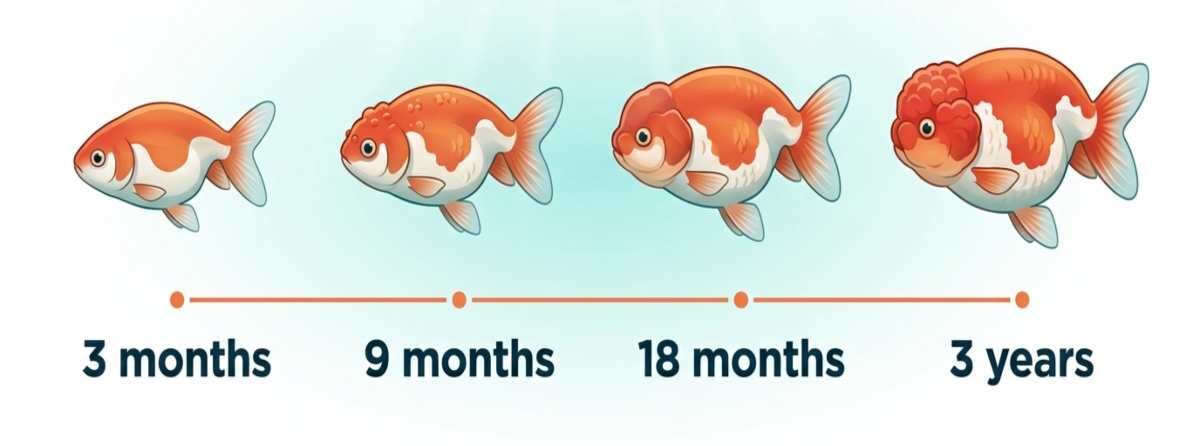
- How a lionhead’s wen develops over three years.
Why Are Lionheads Prone to Swim Bladder Problems?
The swim bladder is a gas-filled organ that helps a fish control its position in the water. In fancy goldfish with compact bodies, it sits in a cramped space, so even minor digestive backups or air gulping can affect buoyancy.
Signs include floating at the surface, sinking, tilting to one side, or swimming upside down. Causes include constipation, overfeeding, gulping air from floating food, cold water, infection, and in some fish, a genetic deformity.
A reasonable first response is to test the water, correct any problems, hold food for a day or two, and then offer a small amount of blanched, skinned pea or soaked food. Slightly raising the temperature within the safe range can help digestion, but avoid rapid changes.
If the fish doesn’t improve, shows swelling, or has trouble eating, see an aquatic veterinarian. Some cases are permanent and need supportive care, such as shallower water and easy access to food.
What Other Health Problems Should You Watch For?
This table is for orientation only and does not replace advice from a veterinarian. For anything serious or that persists, see an aquatic veterinarian.
| Condition | What to look for | First step |
|---|---|---|
| Ich | Salt-like white dots on body and fins, flashing | Confirm and treat promptly |
| Ammonia or nitrite burns | Red streaks, black patches, gasping | Test water, change water, add oxygen |
| Dropsy | Swollen body, raised “pinecone” scales | Serious, seek veterinary help |
| Wen infection | Redness, ulcers, fuzzy patches | Improve water, consult a vet |
| External parasites | Flashing, clamped fins, visible parasites | Inspect closely, treat for the identified parasite |
Quarantine every new fish for at least four weeks before adding it to your main tank. It is the cheapest disease prevention available, and The Fish Care’s health guides on dropsy, parasites, and ich explain what to do if something slips through.
Can Lionhead Goldfish Live With Other Fish?
Yes, but only with the right companions. Lionheads are slow and poor at competing for food, so tank mates should match their pace and temperature needs.
| Good companions | Poor companions |
|---|---|
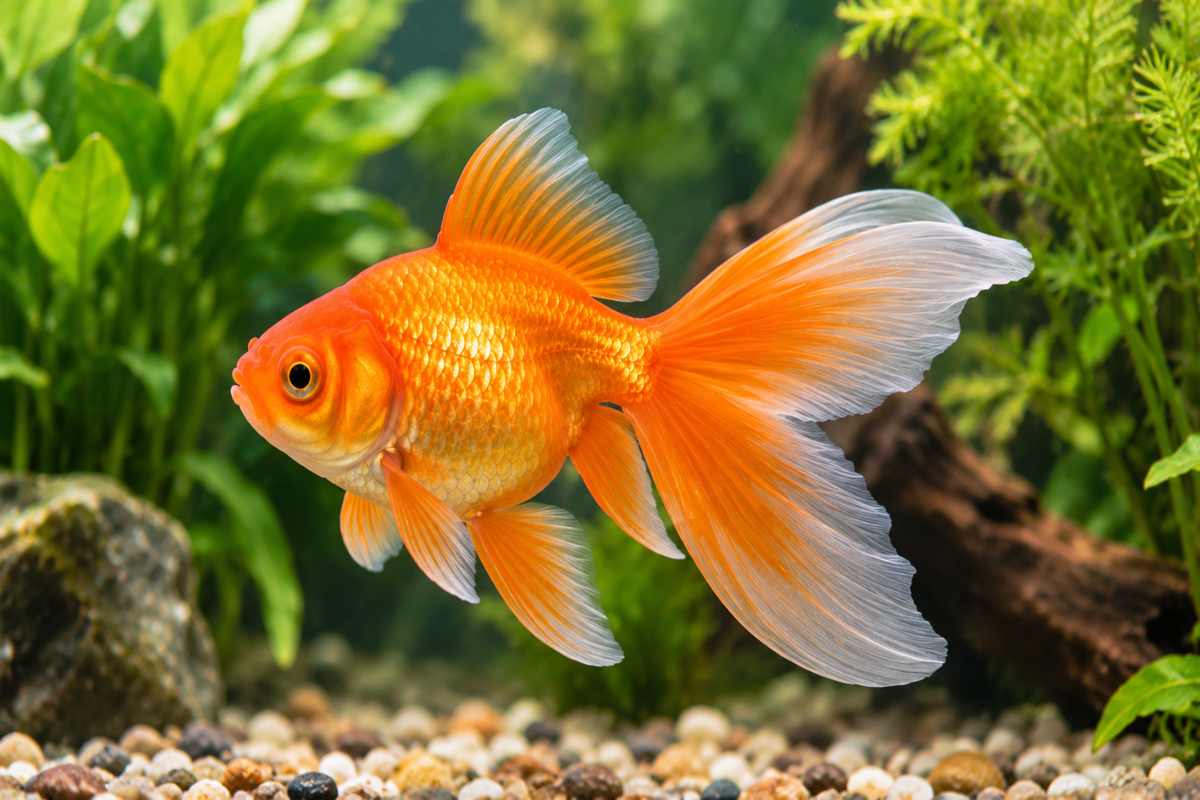
| Other lionheads and Ranchu-type fancies | Common goldfish, comets and shubunkins, which are fast and outcompete for food |
| Black Moors and Orandas | Fin nippers such as many barbs and tetras |
| Fantails and similar slow, round-bodied fancy goldfish | Tropical fish, which need warmer water than goldfish enjoy |
| Pearlscales | Small fish that a goldfish may eat |
Can lionheads live with tropical fish? In general, no. Tropical species prefer warmer water than is ideal for goldfish, and goldfish’s extra waste makes the tank harder for sensitive species.
What Colors Do Lionhead Goldfish Come In, and Can You Breed Them?
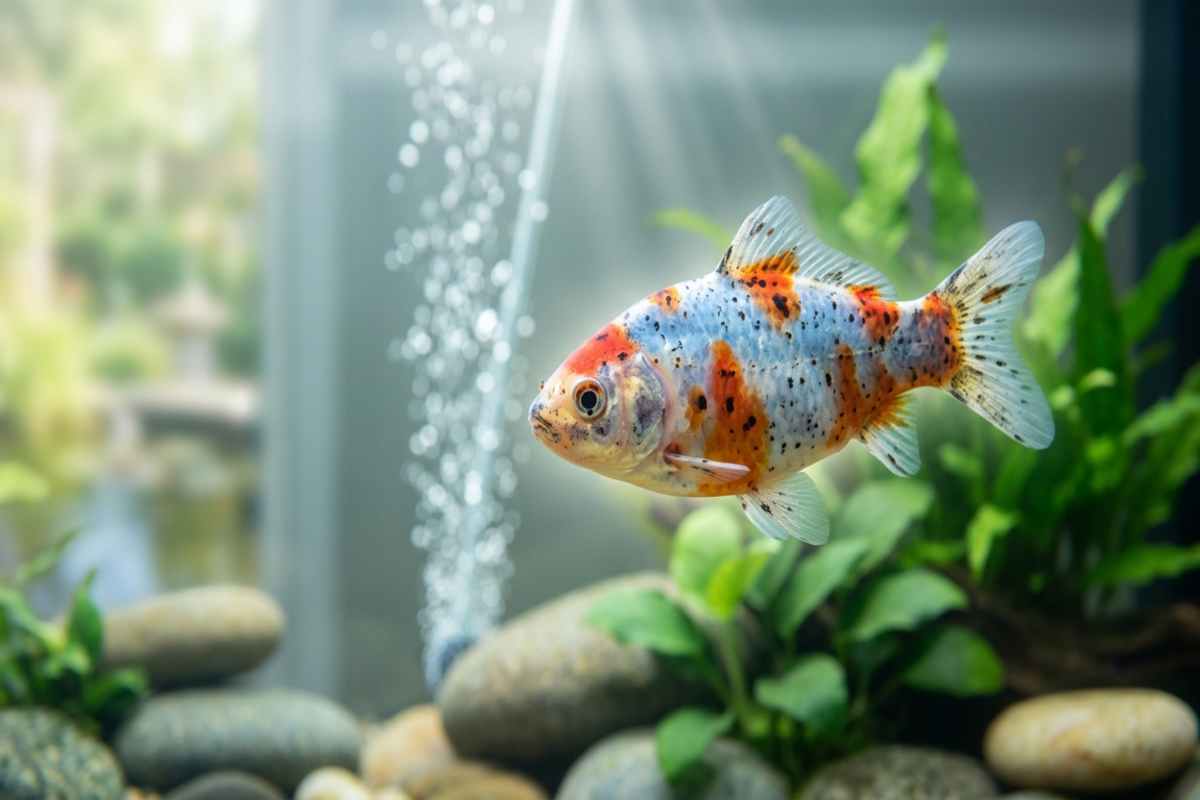
Common lionhead colors include red, orange, white, red and white, and calico. Juveniles are often bronze or brown and can change color as they mature. Black patches can appear temporarily as healing after ammonia burns, so a sudden color change deserves a water test.
Breeding fancy goldfish is possible but rarely predictable. When quality and body shape vary even between siblings, serious breeders cull heavily. Few hobbyists have the space, and it is best attempted once you are comfortable with the basics.
Is a Lionhead Goldfish Good for Beginners?
It can be, with caveats. Lionheads are hardy when water quality is right, but they are less forgiving than single-tailed goldfish, and their body shape magnifies feeding and buoyancy mistakes. A beginner who commits to cycling the tank, testing water, and feeding carefully will do well. Someone expecting a low-maintenance bowl pet will not.
What does a weekly lionhead care routine look like?
- Test ammonia, nitrite, nitrate, and pH.
- Change 30 to 50 percent of the water and vacuum the substrate.
- Rinse filter sponges in old tank water.
- Check the heater and temperature.
- Inspect the wen and body for redness, spots, or swelling.
- Watch feeding and swimming for any change.
Is a Lionhead Goldfish Worth the Extra Care?
For many keepers, yes. Lionheads are gentle, expressive fish with a hard-to-match character, and their quirks are manageable once you understand why they happen. Nearly every problem traces back to water quality, tank size, or feeding.
If you want to keep learning, The Fish Care’s goldfish guides cover varieties, setup, disease, and nutrition in more depth. Start with the basics, give your lionhead room, and it will reward you for years.
Frequently Asked Questions (FAQs)
What is the minimum tank size for two lionheads?
30 gallons (115 L) is the minimum for two, and 40 gallons is a better choice. Use the 20 gallons plus 10 per extra fish rule as a baseline.
How long does a lionhead’s wen take to grow?
Usually two to three years for full development, with noticeable growth between six months and two years. Genetics cause wide variation.
Can lionheads live with tropical fish or other fancy goldfish?
Other slow fancy goldfish are good companions. Tropical fish are generally a poor match because of differences in temperature and waste.
How often should I feed my lionhead to prevent swim bladder issues?
One or two small meals a day of sinking or pre-soaked food, with an occasional fasting day.
How can I maximize my lionhead’s lifespan?
Keep ammonia and nitrite at zero, give it a large enough tank, feed carefully, and quarantine new fish. A healthy lionhead can reach 10 to 15 years.