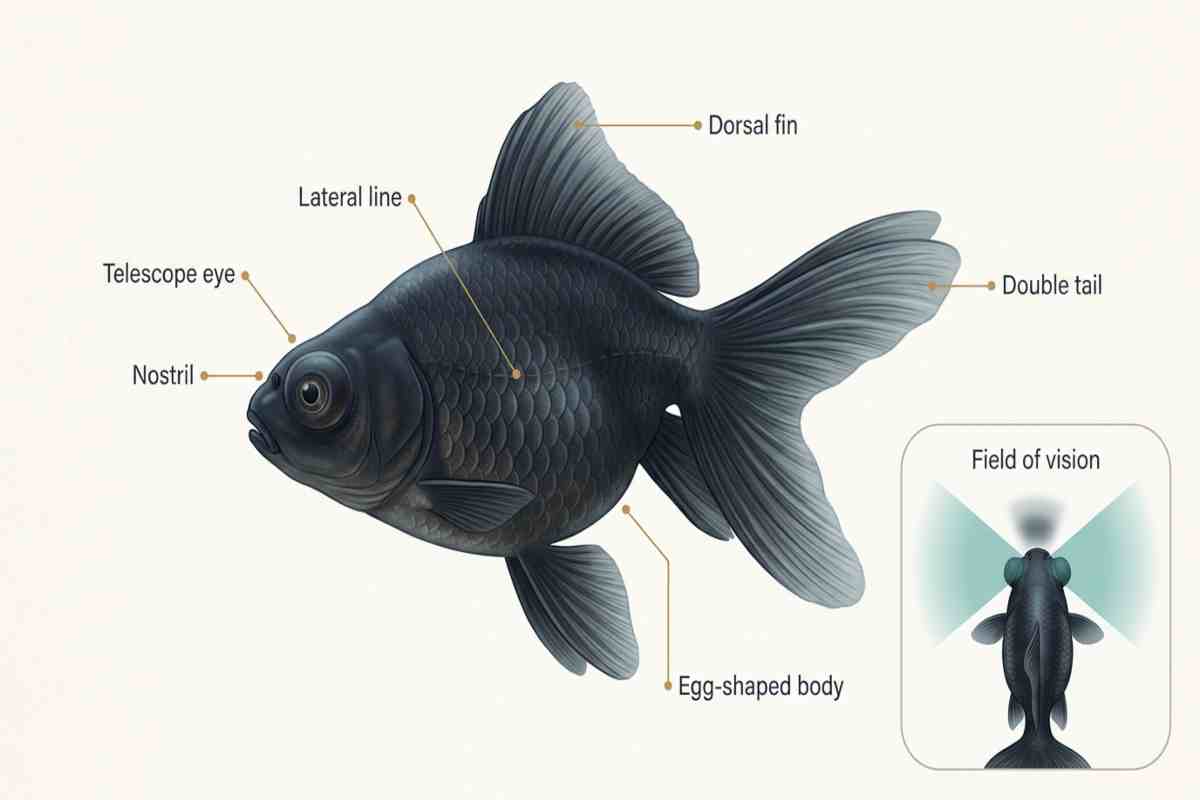
A Black Moor is a velvet-black fancy goldfish with telescope eyes and a double tail. It needs at least 20 gallons (75 L) for one fish, plus about 10 gallons for each additional fish. With good care, it lives 10 to 15 years, grows to roughly 6 to 8 inches, and does best with strong filtration, gentle water flow, smooth decor, sinking food, and slow-moving tank mates. Its eyesight is poor, and its eyes are easy to injure, so Black Moors are rewarding but not truly “easy” goldfish.
| Quick Facts | Black Moor Goldfish |
|---|---|
| Scientific name | Carassius auratus (selectively bred fancy variety) |
| Adult size | About 6–8 in (15–20 cm); some grow larger |
| Lifespan | Commonly 10–15 years; 20 is possible with excellent care |
| Minimum tank | 20 gal (75 L) for one; add 10 gal (38 L) per extra fish |
| Temperature | 65–75°F (18–24°C), kept stable |
| pH | 7.0–8.0, stable |
| Diet | Omnivore: sinking pellets, gel food, blanched vegetables, occasional frozen foods |
| Temperament | Peaceful, slow, easily outcompeted |
| Care level | Moderate |
What Is a Black Moor Goldfish?
A Black Moor, also called a Black Telescope, is a fancy goldfish developed through centuries of selective breeding in China. Biologically, it is still the common goldfish, Carassius auratus, which FishBase lists as a freshwater species native to East Asia. There is no wild Black Moor. Every one in the hobby is a bred variant.
Three traits define it:
- Telescope eyes: large eyes that protrude from the sides of the head.
- Double tail: a split caudal fin, like a fantail’s.
- Velvety black color: a matte, deep black body, often with a slightly brownish tint at the fin edges.
Baby Black Moors do not look like adults. Fry hatch with normal eyes and a dull olive-bronze color. The eyes begin to protrude, and the black pigment deepens over the first months, so a juvenile at the store may not look like a “Black Moor” yet.
Why Black Moors Can’t See Well
The bulging eyes sit on short stalks and point sideways, which limits forward and upward vision. A Black Moor finds food mostly by smell and its lateral line, a row of pressure-sensing pores along its body. That is why it is slow to find floating food, bumps into objects, and gets crowded out by faster fish.
The same anatomy makes the eyes vulnerable. A scrape on a sharp rock, a plastic plant edge, or a filter intake can start an infection. Good Black Moor care largely depends on protecting those eyes.
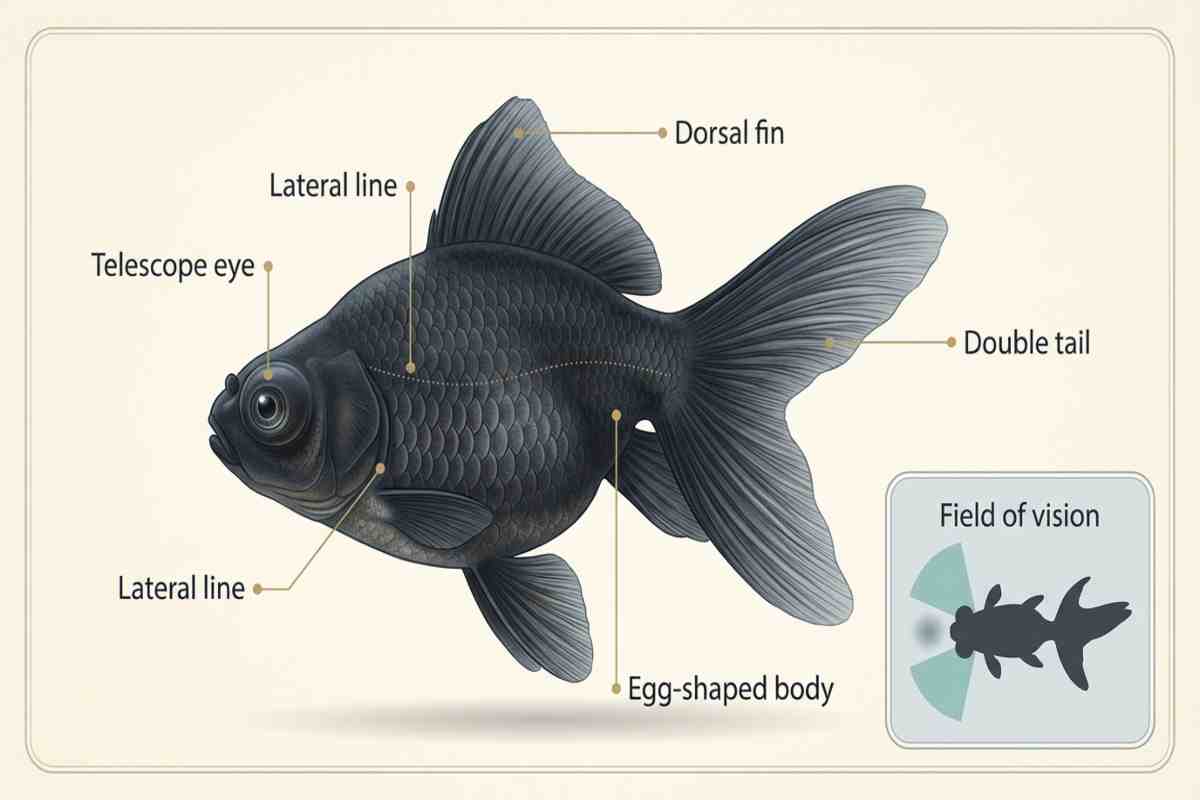 How a Black Moor’s telescope eyes limit its vision.
Black Moor vs. Other Fancy Goldfish
| Variety | Eyes | Body and Tail | How It Differs |
|---|---|---|---|
| Black Moor | Telescope | Egg-shaped, double tail | Always black (though color can change) |
| Panda Moor | Telescope | Same body | Black and white patches |
| Telescope (other colors) | Telescope | Same body | Orange, calico, or red-and-white versions |
| Celestial Eye | Eyes point upward | No dorsal fin | Even poorer vision; more delicate |
| Bubble Eye | Large fluid sacs below the eyes | No dorsal fin | Extremely fragile; not a first fancy |
| Fantail | Normal | Egg-shaped, double tail | Hardier; a good companion |
Are Black Moors Good for Beginners?
They can be, with a caveat. Black Moors tolerate cool room temperatures and aren’t picky eaters, which makes them forgiving in some ways. But they are messy; they need a bigger tank than most newcomers expect, and their fragile eyes and poor vision make mistakes costly.
A new keeper who cycles the tank first, tests water, and avoids sharp decor will do fine. Beginners often go wrong with a bowl, a tiny tank, or a mix of fast and slow goldfish. As we stress across The Fish Care’s goldfish guides, the fish is rarely the problem; the setup usually is.
Black Moor Size and Growth Rate
Most adult Black Moors reach about 6 to 8 inches (15–20 cm) in body length, and well-kept fish can occasionally get larger. Growth is fastest in the first two to three years, then slows. Exact rates vary with genetics, food quality, and water quality.
A common myth says goldfish “grow to the size of their tank.” They do not. A fish in a too-small tank can be stunted by ammonia and nitrate buildup and stress, which can shorten its life and cause deformities, while its internal organs keep developing. If a Black Moor is small, that is more often a warning sign than a sign of a well-matched tank.
How Long Do Black Moor Goldfish Live?
With good care, 10 to 15 years is realistic, and some reach 20. Fish kept in bowls or poorly filtered tanks often die within a few years.
What shortens a Black Moor’s life the most:
- Chronic ammonia, nitrite, or high nitrate
- Overfeeding and constipation
- Eye injuries that become infected
- Aggressive or fast tank mates
- Sudden temperature swings
Black Moor Tank Setup
Tank Size
The usual rule is 20 gallons for the first fish and about 10 more for each additional one. Treat that as the minimum. Goldfish produce a lot of waste, so a larger tank dilutes it, buffers mistakes, and gives slow swimmers room. Two Black Moors do better in 30 gallons than in 20, and a 40-gallon tank is a comfortable home for a pair.
Filtration and Water Flow
Black Moors need two things that seem to conflict: heavy biological filtration and gentle current.
- Choose a filter rated for a tank larger than yours. Sponge filters and large canister filters both work well.
- Baffle or redirect the outflow. A strong jet exhausts a slow, egg-shaped swimmer.
- Cover or guard intake slots so an eye or fin cannot be pulled in.
- Keep the surface moving for oxygen. Cool water holds more oxygen than warm, but goldfish still use plenty.
Substrate, Decor, and Plants
Keep everything in the tank smooth.
- Substrate: fine smooth sand or bare bottom. If using gravel, choose pieces larger than the fish’s head, because goldfish sift the substrate and can choke or become impacted on small stones.
- Decor: run a hand or pantyhose over each piece. If it snags, it can scratch an eye.
- Plants: silk plants, or hardy live plants like anubias and java fern, which goldfish tend to leave alone. Soft stem plants are often eaten.
- Layout: keep it stable. Fish that navigate mostly by memory and the lateral line get stressed when you rearrange.
Water Parameters
| Parameter | Target |
|---|---|
| Ammonia | 0 ppm |
| Nitrite | 0 ppm |
| Nitrate | Under 40 ppm; under 20 is better |
| pH | 7.0–8.0, stable |
| Temperature | 65–75°F (18–24°C) |
| Hardness | Moderate; avoid very soft, acidic water that lets pH crash |
Cycle the tank before adding fish so beneficial bacteria can convert ammonia to nitrite, then to nitrate. Then change roughly 25–50% of the water weekly, adjusted by your nitrate test, and always add dechlorinator. Most homes don’t need a heater, but fancy goldfish tolerate cold less well than single-tail types, so avoid long stretches below about 60°F (15°C).
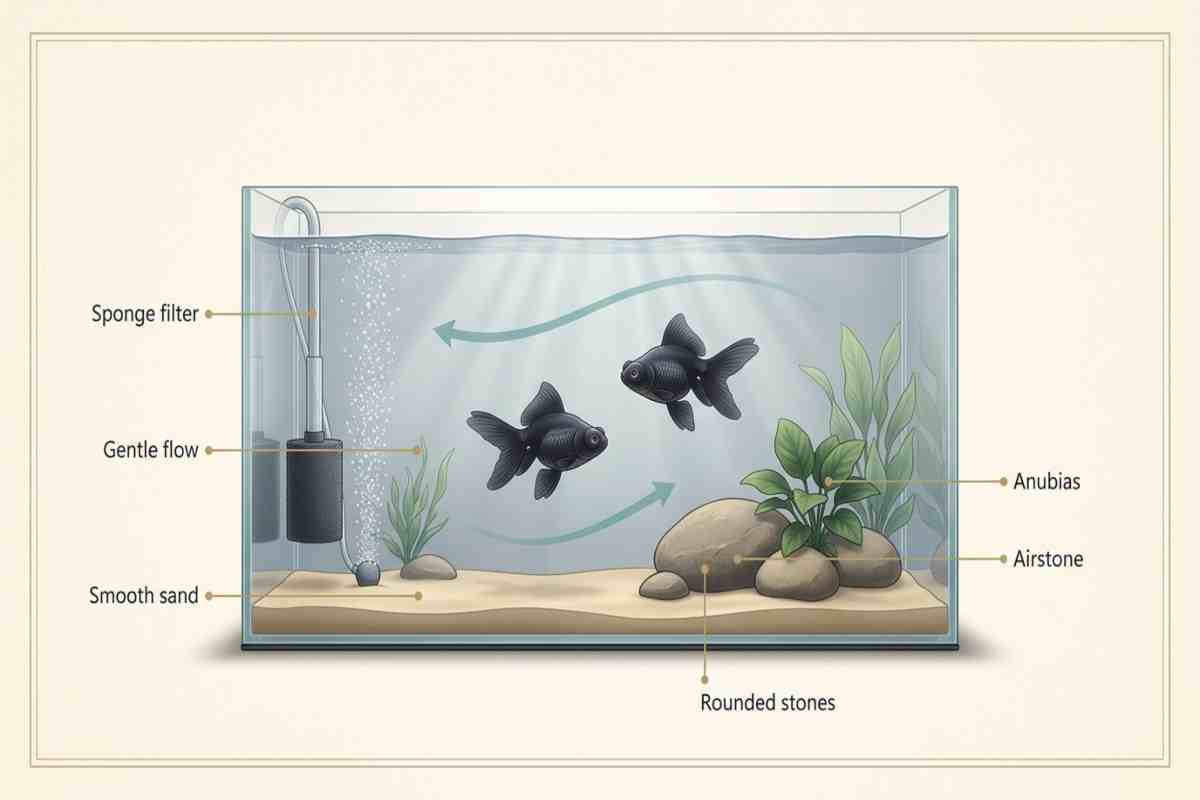 An ideal Black Moor tank: gentle flow, smooth sand, safe decor.
What Do Black Moor Goldfish Eat?
Black Moors are omnivores that eat almost anything, which is exactly why they are easy to overfeed.
- Staple: a quality sinking goldfish pellet or gel food, which suits a bottom-oriented, slow feeder.
- Vegetables: blanched, shelled peas, zucchini, spinach, or lettuce a few times a week for fiber.
- Treats: frozen or live bloodworms and brine shrimp once or twice a week, not daily.
- Amount: only what the fish finishes in about one to two minutes, once or twice a day.
Two habits help a fish with poor eyesight. First, feed at the same spot each time so it learns where food lands. Second, pre-soak dry pellets or flakes for a minute so they sink and swell before the fish eats them.
Floating Flakes and Swim Bladder Problems
A frequent claim is that floating food makes goldfish gulp air and develop swim bladder disease. The evidence for that is mostly anecdotal. Stronger risk factors include the Black Moor’s short, compressed body, overfeeding, constipation, and poor water quality. Sinking or pre-soaked food and regular vegetables reduce the risk without relying on the air-gulping theory. Some keepers also fast their fish for a day when they look bloated.
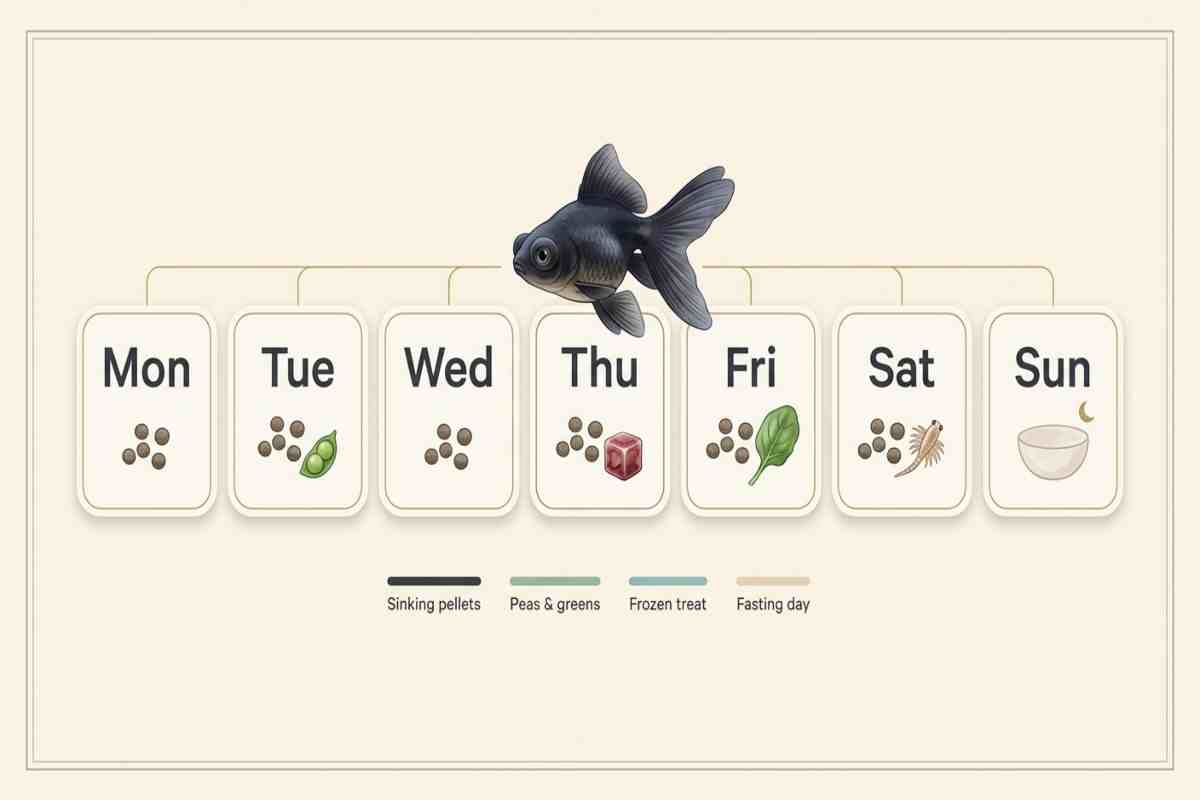 A simple weekly feeding routine for a Black Moor goldfish.
Black Moor Goldfish Tank Mates
The rule is simple: pair slow with slow.
| Compatibility | Fish | Why |
|---|---|---|
| Good | Other slow fancy goldfish: Fantails, Ryukins, Orandas, other Black Moors | Similar speed, temperature, and diet |
| Use caution | Celestial Eyes, Bubble Eyes | Very fragile; they may be bullied or injured |
| Avoid | Comets, Commons, Shubunkins | Fast, large, and quick to steal food; they also outgrow most home tanks |
| Avoid | Tropical fish | Different temperatures; fin-nippers such as many barbs make it worse |
| Avoid | Plecos and similar algae-eaters | Some will rasp at a goldfish’s slime coat |
Can Black Moors live with single-tail goldfish? In a tank, it is not a good idea. Single-tails are faster and grow much larger, and the Black Moor loses the food race. They belong in a pond, or at least in a much larger system.
Why Is My Black Moor Turning Gold, Bronze, or White?
Turning Gold or Bronze Is Often Normal
Black Moors can slowly fade to bronze, orange, or gold, sometimes in patches. This is common and usually not a sign of illness. Genetics play the biggest role. Black pigment cells (melanophores) can decline with age, letting underlying orange pigment show through. Bright light, sunlight, and temperature changes may also contribute.
The fish is fine if it eats, swims normally, and has clear eyes, intact skin, and fins—even if its color changes.
Turning White: Look Closer
“White” can mean very different things. Check what you actually see.
| What You See | Likely Cause | What to Do |
|---|---|---|
| Tiny white dots like salt grains on the body and fins | Ich (white spot disease) | Treat promptly; see how to treat ich in goldfish |
| White or gray cottony fuzz | Fungal infection, often secondary to injury | Fix water quality, isolate, treat as advised |
| Flat gray or white patches, often with frayed fins or a pale band behind the head | Possible columnaris | Act fast; this bacterial infection can progress quickly |
| Slow, even fading to silver or white over months, fish otherwise healthy | Pigment loss or genetics | Monitor; no treatment needed |
| Black patches appearing after poor water, then fading | Healing ammonia burns | Check ammonia and nitrite immediately |
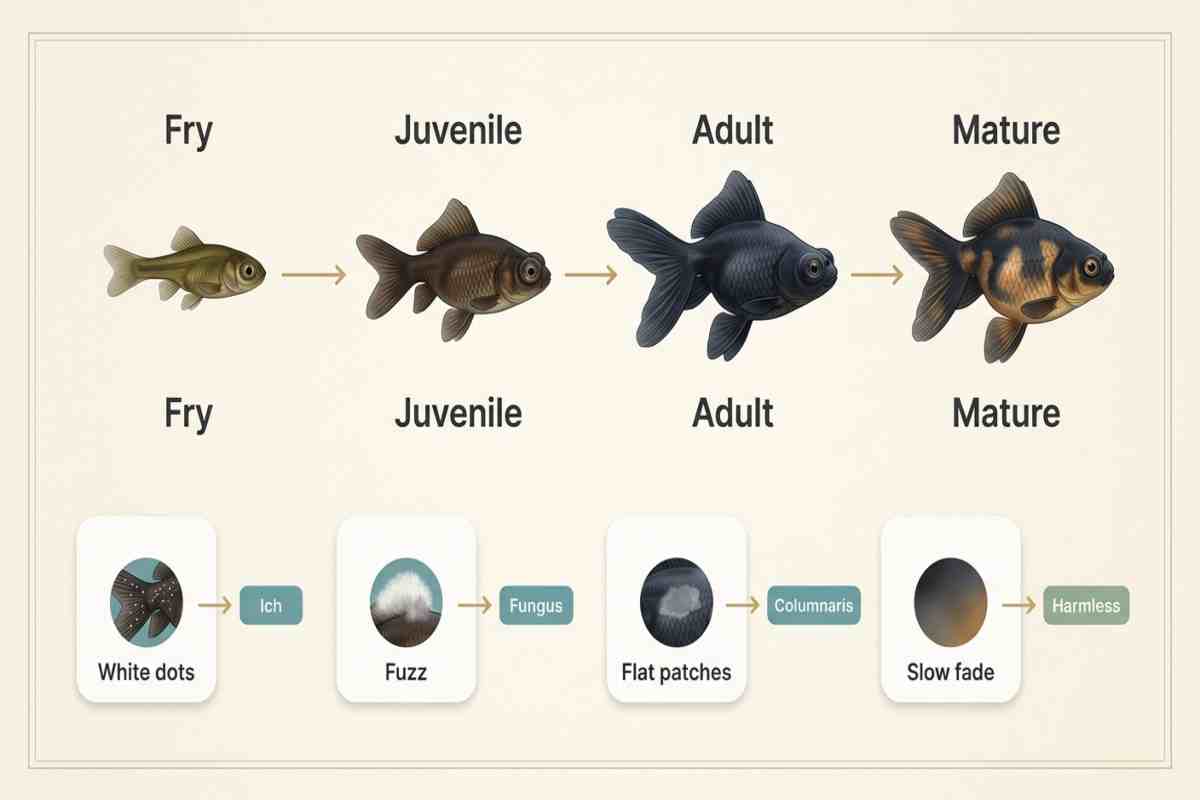 Normal color change in a Black Moor versus signs of disease.
Cloudy Eyes, Pop-Eye, and Other Health Problems
Cloudy Eyes
Cloudiness on the surface of the eye usually points to poor water quality, an injury, or a bacterial infection. Test for ammonia and nitrite first and do a water change. Then check the tank for anything that could scratch an eye. Mild cases often improve once you fix the water. If the cloudiness persists, spreads, or comes with bleeding, an aquatic veterinarian can prescribe the right antibacterial rather than you guessing.
Pop-Eye (Exophthalmia)
Black Moors always have prominent eyes, so “pop-eye” means swelling beyond their normal. A good habit is to take a clear side-view photo of a healthy fish as a baseline. Compare it to that photo if an eye looks larger, redder, or cloudy. One swollen eye often points to injury or local infection. Both eyes swelling, especially with a bloated body, suggests a water-quality or systemic problem. For more on causes and treatment, see this guide to fish pop-eye.
Other Problems to Know
- Ich: white dots, flashing against objects.
- Fin rot: frayed, receding fins, usually after poor water.
- Dropsy: swollen body and raised scales; often serious.
- Swim bladder trouble: floating, sinking, or tilting.
- Fungus: cottony growths on wounds.
For reliable veterinary background on fish diseases, the Merck Veterinary Manual is a trusted reference. Quarantine new fish for at least four weeks in a separate tank before adding them to your main aquarium, as this is the best way to prevent disease from entering.
Common Black Moor Mistakes
- Keeping one in a bowl or a tank under 20 gallons
- Adding a filter with a strong, unbaffled flow
- Using sharp rocks, resin decor, or rough plastic plants
- Mixing with Comets, Commons, or tropical fish
- Overfeeding, then wondering why the water turns cloudy
- Skipping a test kit and guessing
- Panic-medicating a normal color change
Weekly Care Checklist
- Test ammonia, nitrite, and nitrate
- Change 25–50% of the water, with dechlorinator
- Rinse filter media in old tank water, never under the tap
- Check eyes, fins, and body for changes
- Feed small amounts at the same spot; include vegetables
- Make sure no decor has broken or developed sharp edges
A Black Moor is a gentle, charming goldfish that rewards a thoughtful setup: a roomy tank, strong filtration with soft flow, smooth surroundings, sinking food, and calm tank mates. Protect its eyes, test the water, and don’t worry if the black slowly turns bronze. Do that, and a Black Moor can stay with you for well over a decade. If you want to keep learning, The Fish Care’s goldfish guides are a good next step.
Frequently Asked Questions
How long do Black Moor goldfish live?
Usually 10 to 15 years, and sometimes up to 20 with excellent water quality, good food, and safe tank mates.
What do Black Moor goldfish eat?
Use sinking pellets or gel food as a staple, add shelled peas and greens for fiber, and offer occasional frozen bloodworms or brine shrimp. Feed small portions once or twice daily.
Why is my Black Moor goldfish turning white?
It can be harmless pigment loss, but white dots suggest ich, cottony fuzz suggests fungus, and flat patches may indicate columnaris. Check water parameters first, then match the pattern to the table above.
Are Black Moor goldfish good for beginners?
They are manageable for beginners who start with a properly cycled, large-enough tank and smooth decor. They are not ideal for anyone who wants a small, low-maintenance setup.
Can Black Moor goldfish live with single-tail goldfish?
Not in a typical aquarium. Single-tails are faster and larger, so Black Moors lose out on food and can get hurt. Keep them with other slow fancy goldfish.
How big do Black Moor goldfish get in a tank?
Usually 6 to 8 inches. A small tank won’t keep them safe; it can harm their health.
Why are my Black Moor goldfish’s eyes cloudy?
Most often poor water quality, an injury, or a bacterial infection. Test the water, remove hazards, and see an aquatic vet if it doesn’t clear.
Do Black Moors turn gold permanently?
Usually yes. Once the black fades, it rarely returns, though the fish itself stays healthy.